Digital Ataraxia, or Managing VUCA
[Reading time: 5.5 mins. source read-o-meter]
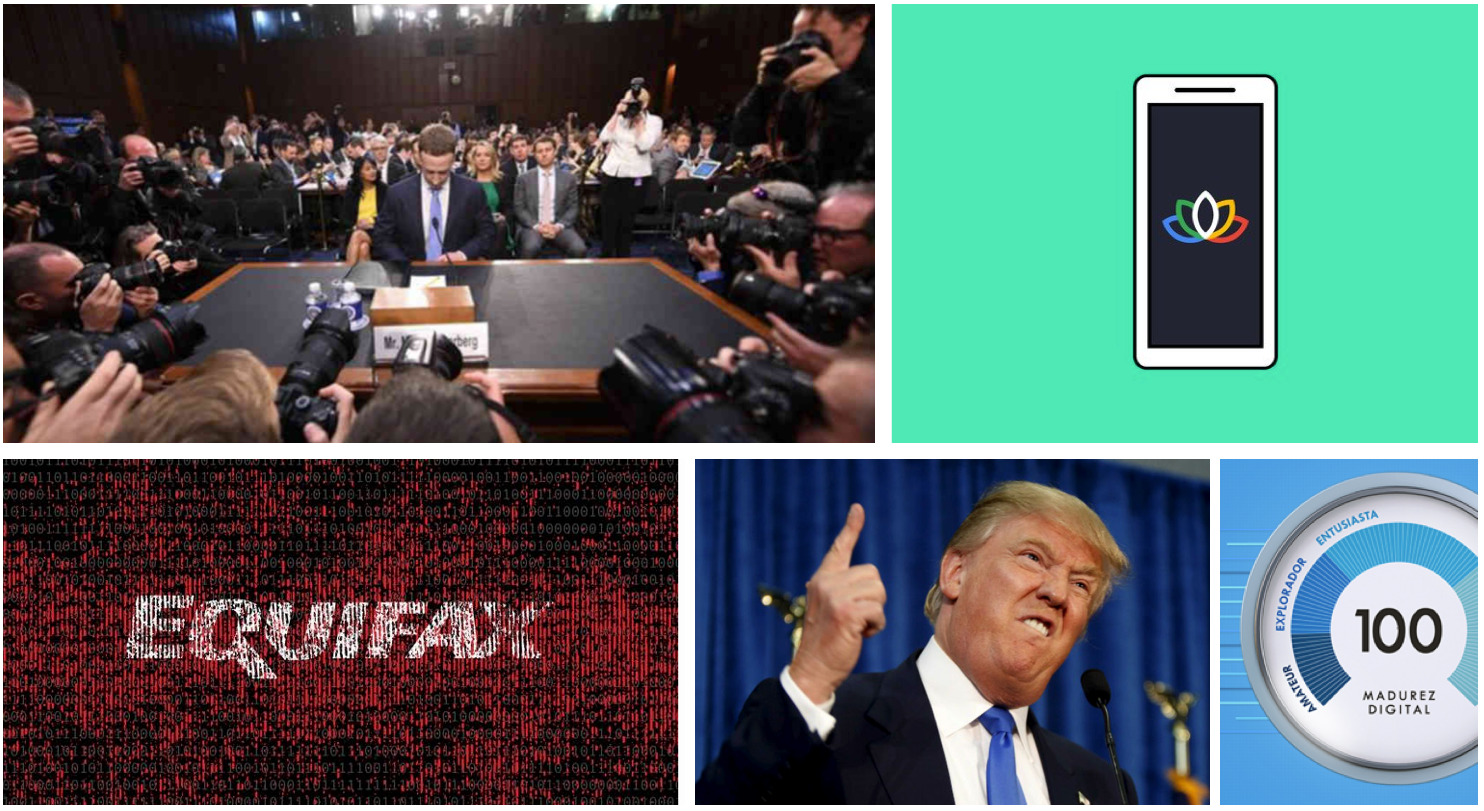
Cambridge Analytica, the second raid on EQUIFAX's records in 2 years, the proliferation of reports denouncing the impact on the job market of the arrival of artificial intelligence, robotics and machine learning, entire industries changing the rules of the game in less than five years, elections altered by the influence of fake news, is it possible that anxiety is starting to be a business? Or are we the victims of the media's reaction to an already very diminished attention?
[Reading time: 5.5 mins. source read-o-meter]
[See POST "Digital Ataraxia" on blog @b_crespo QUANTUM MARKETHINK]
If any of us had been asked five years ago whether we would have been able to anticipate the results of BREXIT, the election of Donald Trump as President of the United States, to guess that Mark Zuckerberg would have apologized before the Congress of the United States of America, that 50% of the jobs we know today would be at risk from the arrival of technology, or that Google would present an application to soothe the anxiety generated by the use of digital devices; we would simply say we are talking about a different course for humanity. And here we already are. Telling the story in a way that surprises is a complex task. Personally, I never stop being surprised.
The concept of ataraxia comes from the Greek ἀταραξία ataraxía [1] and refers to the state of mind proposed by the Epicureans, Stoics and Skeptics, thanks to which a person develops the ability to live in a state of calm and imperturbability. In other words, ataraxia is the practice of tranquility and serenity. Is it really possible to live in a state of calm in which the whole makeshift structure of a reality we were never raised to live in collapses?
Enough! There is no sense at all in resorting to the speed of change to convey an emotion as aggressive as fear. It is nothing new that digital disconnection workshops and sessions have proliferated in recent years. The continuous exposure to news through messaging systems and social networks is taking us to a state of continuous anxiety that considerably affects our mood. The word VUCA is seeping out of every pore of our skin and it is time we got a handle on this anxiety. In fact, the 2018 Edelman barometer points directly at the media as the vertical with the lowest trust index (even below financial services). And surprisingly this same study shows that technology companies enjoy robust health when it comes to trust. Won't they have to give back part of that value in the form of time or health?
If we had to turn to a traditional concept such as corporate social responsibility at the present moment, we would have to reflect on conveying calm to a user and to audiences on the verge of a nervous breakdown. It is no coincidence that at its three-day annual gathering Google I/O announced — through one of its product managers, Tristan Harris [2] — the creation of an application, wellbeing.google, to recommend how to handle the distractions caused by the obsession and the captive attention of the universe of impacts and notifications we receive from always carrying a mobile device. From focusing on the important topics, to reducing notifications or making new recurring tasks easier (smart filters for images), making our lives easier seems to be the new approach to social responsibility in a digitalization environment. A digitalization shoehorned into 5 inches (or more) and located in our pocket has translated our freedom into a compulsive act of continuous checking.
"Making our lives easier seems to be the new approach to social responsibility in a digitalization environment".
Nicholas Carr already reflected exactly a decade ago on the concept of "diminished attention" in his article in The Atlantic Is Google making us stupid?. Years later he published a book called The Shallows [3] and there he set out his view of how we have become beings of diminished attention making decisions in a context where stimuli keep growing and information is overwhelming. With the launch of wellbeing.google it seems that the Alphabet empire has answered Carr's provocative question a decade later. Perhaps it was time to get a handle on so much stimulus, so much email, so many push notifications, so much "social noise"?
I am sorry to say that it is still easy to accumulate anxiety if you know how to play with the right stimuli. As proof, I share some reflections grounded in studies:
- Today half of human beings' paid activities (work) could be replaced by technology that is already available (2017, HBR - McKinsey)
- More than half of the activity on the Internet is non-human activity (2017, KPBC)
- The total global cost of data "hacking" (data breaches) will reach 2.1 trillion dollars in 2019, a growth of 400% compared with 2015 (2017 Juniper Research)
- The average time to detect a data security breach in the Americas is 99 days and it has an average cost of 4 million dollars (2017, Gartner)
And the saddest part is that playing with this information will always bring a media outlet more audience than any good news. That is how we are. And I refuse to work on the concept of guilt. We have guilt to spare in latitudes like mine. The media play with our diminished attention in an environment overloaded with stimuli and where the greatest of fears is the fear of not knowing what is going to happen next. There is already a lot written about the doctrine of fear [4] and I don't want to dwell on it any further. I think we still have a lot to learn about our capacity to take responsibility for steering our observer towards an environment of calm and quiet.
"...there will always be more technology and a smarter and growing use of the possibilities of data in a universe of interactions that is ever more traceable."
We already have AI (artificial intelligence), ML (Machine Learning), NLP (Natural Language Processing), Blockchain, etc. within reach. And what will happen when we start to calculate the risks of deploying deep learning, capsule networks, quantum computing or the omnipresence and omni-traceability of smart dust? I don't want to trivialize this and there will always be more technology and a smarter and growing use of the possibilities of data in a universe of interactions that is ever more traceable. And just as Gartner recognized for this year CARTA (Continuous Adaptative Risk and Trust) as the only mindset and way of planning risk management in a space that is less proprietary and more hybrid in the development of systems, perhaps that message has to be brought down to a place that is less technical and richer in emotion. It falls to us to own our fears in an environment where volatility, uncertainty, complexity and ambiguity have settled into our lives. And the key to doing this will never lie in technology or in data, it will always lie in people.
We have "consumed" so many possibilities around data and technology that we are at a point close to delirium ("Digital Ayahuasca"). And there are still those to come. That is the only certainty I have.
I think it falls to us to regain our calm and perhaps, after so many synapses activating fear, we have to go through some sweats and shivers. And afterwards, enjoy the capacity for surprise. There, and in our curiosity, lie most of the opportunities we have not yet seen.
"Seeking certainty about what is to come means forfeiting all surprise. The fear of uncertainty blocks opportunities." @b_crespo
Dedicated with great affection to the professionals of the 4th edition of the Digital Transformation Management Program at IE Business School:
Juan José Alarcón, Sara Andrade, Alberto Arias, Nacho Arribas, Lourdes Brito, Reyes Calderón, Carlos Cardoso, Gustavo Corral, Beatriz Escriña, Inés Fernández, Adolfo Fernández, Manuel González, Vicente Granizo, Jorge Lastra, Juan Carlos Lorenzo, Belén Moscoso, Pedro Pérez, Ignacio Romera, Esther Sánchez, Nina Sánchez, Araceli Vila and Juan Manuel Zafra.
Sources:
- Wikipedia. https://es.wikipedia.org/wiki/Ataraxia . Last accessed May 11, 2018
- The Verge. https://www.theverge.com/2018/5/10/17333574/google-android-p-update-tristan-harris-design-ethics . Last accessed May 11, 2018
- Carr, Nicholas (2011) The Shallows: What the Internet is doing to our brains. W. W. Norton & Company. USA.
- Klein, Naomi (2007) The Shock Doctrine. Knopf. Canada.
The author
Bernardo Crespo
C-suite advisor in AI, data and strategy. CEO of Quantum Markethink and Academic Director at IE. He helps leadership teams make sound decisions in the age of AI.
LinkedIn