Escaping the Productivity Trap: Inclusive Institutions in the Agentic AI Era
Across the globe, two very different economic models — one market-driven, the other state-directed — have converged on a strikingly similar outcome. Despit…
When Productivity Breeds Feudalism
Across the globe, two very different economic models — one market-driven, the other state-directed — have converged on a strikingly similar outcome. Despite unprecedented growth, technological innovation, and productivity gains, prosperity has become increasingly concentrated in the hands of a narrow elite.
Workers today produce more output than at any other moment in history, yet their share of the rewards continues to shrink. Data from the Economic Policy Institute’s Productivity–Pay Tracker (EPI) shows the scale of this divergence: since 1979, productivity in the U.S. has risen by 86%, while typical hourly pay has increased only 32%. In other words, productivity has grown 2.7 times faster than wages — a gap that captures how the benefits of efficiency have been systematically decoupled from worker compensation.
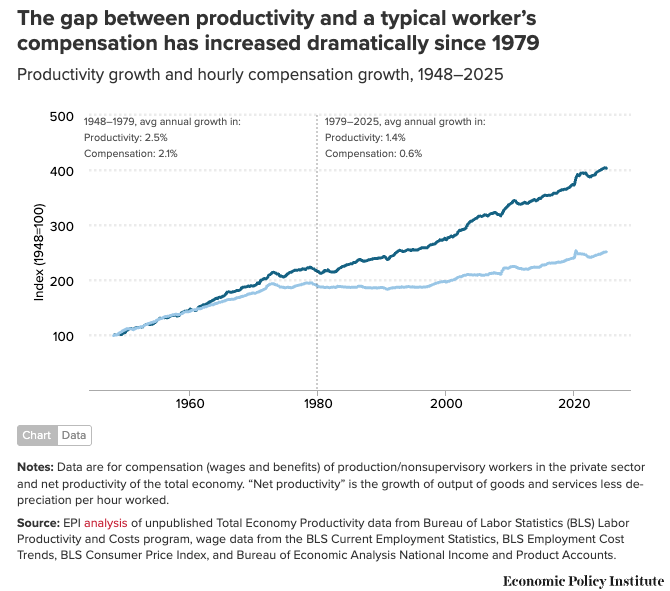
This is not an isolated statistical quirk but a structural pattern. Essential infrastructures of the modern economy — platforms, data networks, logistics systems, and digital marketplaces — are controlled by a handful of dominant players. These actors sit at the chokepoints of value creation, extracting disproportionate rents while shifting risks onto those who perform the actual labor.
The paradox is stark: the more efficient the system becomes, the less secure and equitable it feels for the majority. Productivity, once imagined as a rising tide lifting all boats, has instead become the foundation of a new kind of feudal hierarchy. This new wave is reinforcing the same few boats again. Some authors have coined a new best-selling concept, such as technofeudalism. But let's focus on the future effects, not the past ones.
The AI Aristocracy and the Risk of Permanent Hierarchies
If today’s reality already carries a feudal logic, the rise of artificial intelligence threatens to cement it into permanence. AI is not just a tool; it is becoming the foundation of future economies. Whoever controls the data, the models, and the compute resources will hold disproportionate power over industries, governments, and societies.
The danger is that this concentration of technological capability will accelerate the very trends already in motion. Advanced systems require massive capital, specialized talent, and access to data on a scale only a few can command. This creates natural monopolies where gains accumulate exponentially at the top, while displacement and precarity cascade downward.
The results are already visible. The number of billionaires worldwide has exploded, with fortunes increasingly tied to technology and platform control (Forbes Billionaires List - compare 2005 with 2025). In China, a similar dynamic can be observed, where networks of established business leaders and technology founders dominate rankings of personal wealth. (List of Chinese by net worth). Far from democratizing prosperity, both systems — one through market concentration, the other through state-linked coordination — reveal how productivity gains can concentrate in ever smaller circles of privilege, reinforcing economic stratification across continents.
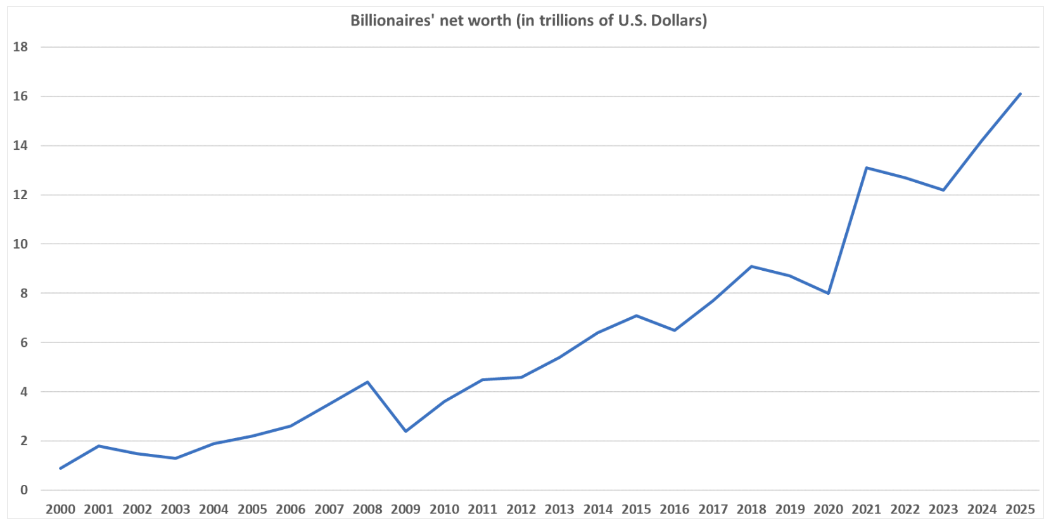
The result could be a new aristocracy of code — a small cadre of actors reaping extraordinary rents while the majority are reduced to dependent roles, struggling to maintain relevance in a system designed to minimize their bargaining power. This new AI wave upends the labor productivity equation. Traditional employment structures erode, risks are shifted onto individuals, and the capacity for collective negotiation weakens further.
In parallel, political systems everywhere face the challenge of ensuring that concentrated wealth does not distort public priorities. When influence accumulates at the top, the balance between collective well-being and elite interests can become strained. Mechanisms of accountability risk being weakened, while surveillance and algorithmic governance increasingly shape the way societies are organized.
The agitation here is not abstract. Once such hierarchies consolidate around AI, they may prove nearly impossible to dislodge. Unlike the lords of old, who ruled over fields and castles, this new class could rule over the very infrastructure of thought, work, and interaction. AI is trickling into our lives with the same unhurried pace as beach sand slipping through our fingers. In a few short years, we will not be able to recall how we existed without it. By then, AI will have already eroded the foundations of an entire system.
The danger is not simply inequality, but the entrenchment of a social order where servitude is rebranded as participation and where exit is structurally impossible. Quoting Hemant Taneja, CEO and managing director of Applied AI and tech intensive venture capital firm General Catalyst: “Capitalism is a privilege: it has to work for society or we won’t be allowed to practice it. Being careful about the role of applied AI in society is really important.”
"Capitalism is a privilege: it has to work for society or we won’t be allowed to practice it. Being careful about the role of applied AI in society is really important." –Hemant Taneja
What about Inclusive Institutions by Design
The way out of this trap is not to reject productivity or halt technological advance, but to change the institutional arrangements through which their gains are distributed. History shows that prosperity flourishes where institutions are inclusive — where economic and political systems limit the extraction of elites, broaden participation, and ensure that innovation translates into widely shared progress. This concept of inclusive institutions is not new; it was recognized with the Nobel Prize in Economic Sciences last year. (See the work of Daron Acemoglu, Simon Johnson, and James Robinson on the importance of inclusive institutions for a nation's prosperity.)
In the era of agentic AI, inclusivity cannot be an afterthought; it must be embedded into the design of institutions from the start. That requires a bold reimagining of political ideas for a technological age. Central to this shift is questioning the very metrics we use to evaluate success. As argued in GDP in the AI Economy: Why We Need to Rethink How We Measure Value, an overreliance on GDP masks the true distribution of gains and blinds policymakers to inequalities hidden behind aggregate growth figures. GDP may rise even as wages stagnate, precarity spreads, or democratic influence erodes.
Escaping the productivity trap requires replacing narrow GDP-driven measures with multidimensional frameworks that capture median income growth, time affluence, ecological sustainability, and the inclusivity of opportunity. By redesigning our scorecards, we force institutions to prioritize outcomes that serve human flourishing rather than abstract economic aggregates. Concretely, this means:
Democratizing Digital Infrastructure Access to the foundational resources of the digital economy — data, platforms, and compute — must not remain monopolized. Public data trusts, cooperative ownership models, open-weight models and shared digital utilities can ensure broad participation in the creation and use of AI.
Redefining Economic Success If output is measured only in GDP or market valuations, institutions will serve those metrics at the expense of human well-being. Success should instead be tracked through inclusive measures: access to knowledge and decent standards of living, median income growth, working-hour reduction, health outcomes, and ecological sustainability.
Capturing and Redistributing Digital Rents Wealth generated by essential digital infrastructures should not accumulate solely at the top. Taxing monopoly profits, platform fees, and AI rents can fund universal healthcare, education, climate adaptation, and other public goods — ensuring that productivity gains circulate across society.
Reinforcing Political Inclusion To prevent capture by new elites, political institutions must strengthen mechanisms of accountability. That means robust protections for worker voice, limits on concentrated lobbying power, transparency in governance, and civic organizations capable of shaping technological trajectories.
Inclusive-by-Design AI Governance AI itself must be governed with inclusivity at its core: participatory oversight bodies, algorithmic audits, and transparent reporting structures to ensure these systems enhance rather than erode democratic capacities.
Toward a New Political Imagination
Escaping the productivity trap requires a shift in imagination as much as in policy, and I am afraid we need ruling and governance. Productivity should no longer be seen as an end in itself, but as a means to human flourishing. Technology should not be harnessed for domination, but for liberation from unnecessary toil, for strengthening communities, and for broadening opportunities. We all have in mind what happened during the last digital wave with social media. If we do not deploy it responsibly, the outcome could be undesirable.
To get there, societies must abandon the excessive concentration on GDP-related metrics that reduce human progress to output curves. In the AI era, where machines increasingly generate value independent of human labor, clinging to GDP and productivity metrics is both misleading and dangerous. We need inclusive institutions aligned with new measures of prosperity, institutions that can capture the true wealth of societies: time, dignity, resilience, long and healthy lives, access to knowledge (or the use of knowledge), and a decent standard of living as part of an ecological balance.
This is more than a technical adjustment; it is an ideological, spiritual and political transformation. It implies a new social contract where AI and productivity gains are directed toward reducing inequality, strengthening democratic voice, and expanding shared capabilities. Instead of productivity serving elites, productivity must serve the many. Instead of AI consolidating hierarchies, AI must become an enabler of inclusive citizenship. Fortunately, there is still time.
The alternative is clear: if inclusive institutions are not built, AI will harden the emerging feudal order into a technological aristocracy. But if societies choose to embed inclusivity into the very architecture of the digital economy — rethinking both institutions and the metrics that guide them — productivity gains can support a renaissance marked not by hierarchy and precarity, but by dignity, freedom, and shared prosperity.
The crossroads is already here. The choice is whether to treat productivity as a trap that feeds elites, or as a resource channeled through inclusive institutions to uplift everyone. In the agentic AI era, the answer will define the shape of the decade to come.
Note: This article was produced with the assistance of an AI writing tool, powered by OpenAI technology. The article's concept, narrative direction, and visual elements were entirely developed by Bernardo Crespo. The AI functioned as a writing aid, with all creative and strategic decisions made by the author. [This article labels as Machine led. Humans conduct checks, highlight and correct errors, enhance output. Based on Dubai Future Foundation. "Human-Machine Collaboration (HMC) Icons." Dubai Future Foundation, dubaifuture.ae/hmc ]
BIBLIOGRAPHY
Sources used and mentioned in this article:
"Intuition Machine." "The Productivity Trap: How America and China Are Building Neo-Feudal Societies." Medium, 26 June 2023. Intuition Machine, medium.com/intuitionmachine/the-productivity-trap-how-america-and-china-are-building-neo-feudal-societies-59a335528929. Accessed 26 August 2025.
Economic Policy Institute. "The Productivity–Pay Gap." Economic Policy Institute, https://www.epi.org/productivity-pay-gap/. Accessed 26 August 2025.
"The World's Billionaires." Wikipedia, Wikimedia Foundation, 20 July 2025. https://en.wikipedia.org/wiki/The_World%27s_Billionaires . Accessed 26 August 2025.
Velasco, Crespo. "GDP in the AI Economy: Why We Need to Rethink How We Measure Value." LinkedIn, 23 May 2023. LinkedIn Pulse, linkedin.com/pulse/gdp-ai-economy-why-we-need-rethink-how-measure-value-crespo-velasco-yrpwf/. Accessed 26 August 2025.
Acemoglu, Daron, and James A. Robinson. Why Nations Fail: The Origins of Power, Prosperity, and Poverty. Crown Business, 2012.
Financial Times. "General Catalyst's Hemant Taneja: Al investors are navigating 'peak ambiguity'." Financial Times, 27 de agosto de 2025, ft.com/content/2757870b-dbbf-4603-9fc3-7ccd03ffc8da. Accessed 27 August 2025.

Bernardo Crespo is a seasoned digital transformation and data strategy leader with over 25 years of experience. He has held leadership positions in Fortune 500 companies and digital consultancies, and has founded and advised numerous startups and venture builders. Currently, as CEO of his own firm, Quantum Markethink, he provides strategic guidance to C-suite executives, helping them navigate the complexities of digital transformation.
Furthermore, he serves as an Academic Director at IE Executive Education, where he brings his expertise in emerging technologies, digital strategy, data strategy, and artificial intelligence to the classroom. Prior to these roles, he spearheaded digital transformation initiatives at Merkle Spain and led digital marketing at BBVA, where he notably pioneered the application of gamification in banking.
Bernardo is also the co-author, with Gam Dias, of "The Data Mindset Playbook: A Book about Data for People Who Don't Feel Like Reading about Data" (KDP, March 2023).
Articles augmented by AI: Newsletter "My AI-ter Digial Ego"
Articles 100% crafted by a human: Newsletter "Digital Sustainability"
The author
Bernardo Crespo
C-suite advisor in AI, data and strategy. CEO of Quantum Markethink and Academic Director at IE. He helps leadership teams make sound decisions in the age of AI.
LinkedIn