GDP in the AI Economy: Why We Need to Rethink How We Measure Value
The system we use to measure growth and value generation in our economies has long shown its cracks. Measuring the economy through the quantitative aggrega…
THE ORIGIN OF GDP AND ITS VALIDITY IN THE DIGITAL AGE
The system we use to measure growth and value generation in our economies has long shown its cracks. Measuring the economy through the quantitative aggregation of transactions was once a brilliant idea, but can we truly capture the value generated in an economy solely through economic transactions? Does GDP represent the full scope of value creation by all agents within an economy?
The modern concept of GDP (Gross Domestic Product) was developed by the American economist Simon Kuznets in 1934 and was adopted as the primary measure of a country’s economy at the Bretton Woods conference in 1944. It was a post-war system designed to measure an economy in reconstruction.
Informal economies (barter systems, community-based mutual aid systems, such as tribes or informal cooperatives), which are characteristic of developing economies, were never included in Kuznets' system that focused on investment and consumption.
With the advent of the digital economy and the rise of smartphones, subscription models have become the new norm. This shift has brought even greater challenges to measuring economies based on transactions. The pandemic only deepened this gap.
While GDP primarily focuses on measuring the production and consumption of tangible goods and traditional services, the subscription economy is driven by recurring revenues generated from digital services and intangible products, such as software, entertainment, and digital media. This creates a discrepancy, as many of these transactions and values are not fully reflected in traditional economic statistics.
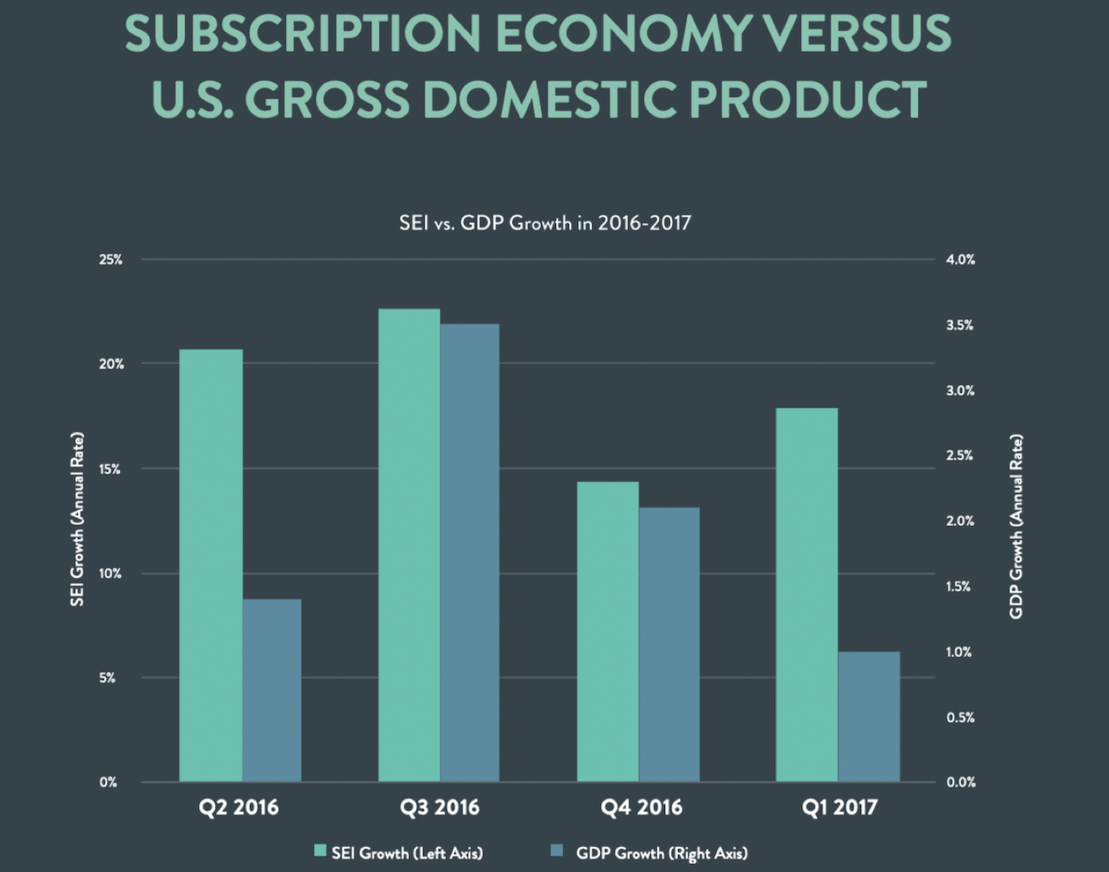
Sectors like entertainment (Netflix, Spotify) and technology (Apple, Google, Adobe) have been revolutionized, and it’s expected that this trend will continue as more companies adopt these models. Even banking, with the rise of platforms like Neobanks, is transforming the relationship between banks and customers into a flat-fee service model, more akin to subscriptions than transaction-based payments. Subscription costs have become one of the most prominent chapters in the monthly management of household expenses in any family economy.
How do we assign the value of a subscription paid by a resident of Spain to a service offered by an American company, which first based its European subsidiary in Ireland, and then moved it to the Netherlands upon subscription renewal? In many sectors, we rely on manual adjustments to national accounts, often based on discretionary criteria from local economists working with outdated national accounting systems. Can we truly trust GDP to measure economic growth? Should we assume that errors in accounting impact all major economic powers (G7, G20, etc.) equally?
THE FAILURES IN VALUE MEASUREMENT
The digital economy and the subscription model economy is not the only reason we have realized GDP’s shortcomings. We have known for a long time that without a monetary exchange, value creation slips beneath the radar of GDP. New Zealand economist Marilyn Waring argues that the most significant unmeasured sector in OECD economies is parental care for children, a task that ranks first in value creation in countries like Australia and New Zealand.
The problem is that no transaction is involved when a parent takes their children to school each morning, stays home with them after school, or cares for their elderly family members on weekends.
The solution cannot simply be to improve GDP measurement. As Waring pointed out in her study on the biases in the UN's System of National Accounts—a system that assigns more value to transactions generated after a war than to the value of caring for Mother Nature or loved ones—it's not a good system. And this doesn’t even account for the economic transactions that go unnoticed by traditional economic systems (collaborative projects, volunteer work, time-banking platforms, and cryptocurrency transactions, among others).
Our method of measuring GDP has always been flawed, penalizing any value creation that isn’t measured by a monetary exchange. Furthermore, acts of kindness, generosity, and any non-monetized effort that ensures our social cohesion are neither included in GDP nor ever were.
Perhaps, after the digital era (with subscription models, code-based economies, the rise of collaborative platforms, and the Netflix, Uber, and Airbnb economies), and now in the AI era—perhaps even the generative AI era (agent-based economy)—these imperfections are setting the stage for a period of absolute revision.
acts of kindness, generosity, and any non-monetized effort that ensures our social cohesion are neither included in GDP nor ever were.
MEASURING ECONOMY VALUE IN THE AGE OF AI
This month, OpenAI closed another funding round, raising $6.6 billion with a post-money valuation of $157 billion, making it the largest round in history. To put it simply, OpenAI holds the same value as companies like Goldman Sachs, Unilever, Siemens, or Pfizer, but does so with less than $4 billion in revenue and fewer than 5,000 employees. However, its valuation is twice the market cap of companies like Dell, Ferrari, Thomson Reuters, or Mercedes-Benz, and five times that of companies like Danone, eBay, Delta Airlines, or Bayer.
Why is there so much value creation in a company focused on generative AI? And coming back to our original point: Is AI improving the problem of GDP measurement or merely exacerbating it?
Here are some illustrations on the impact of the AI economy:
How do I measure the value generated by code written elsewhere in the world and freely downloaded by me from GitHub to save time in automating my tasks?
How do we quantify the time saved by using generative AI to automate repetitive tasks and reuse that time for personal well-being or caregiving, especially when these activities don’t have a direct economic impact and don’t show up in GDP measurements?
How do we value the impact on the economy of an agent created by me with generative AI from Spain using my ChatGPT subscription paid to OpenAI's Irish subsidiary and leveraged by a professional in Japan, Australia or Colombia, how do we account for the productivity savings generated when the agent is free? There is certainly value generated and there is no transaction to back it up.
We cannot trust a declarative system for value measurement. Instead, we must promote a new method of measuring value in economies based on mutual benefit, combined with aggregated transactions deflated by the destruction of common value.
We cannot assume that harming the environment and natural resources results in positive GDP growth. We cannot assume that waging war automatically leads to value creation and GDP growth afterward.
We cannot allow attracting foreign investment to lead to increased prices for essential and vital goods, such as housing. We cannot allow a mother caring for her children at birth to receive no recognition in GDP or, worse, to have a negative impact.
We cannot allow an increase in subscription-based consumption to dilute its impact on the economy. We cannot permit that the productivity gains from individuals and companies using AI do not fully show up in GDP beyond a local, unharmonized accounting adjustment.
I am tired of left and right politics and, above all, tired of accounting stupidity (both in national accounting and in startups, but that’s another conversation). Our value measurement system has served us so far, but it needs to be sent to the infirmary for review. Everything is born, everything dies, and nothing remains. How are we going to distribute value fairly in an economy that looks nothing like the one left after World War II?
Our value measurement system has served us so far, but it needs to be sent to the infirmary
Some of the following inequities have been unresolved for years, and we have failed to respond:
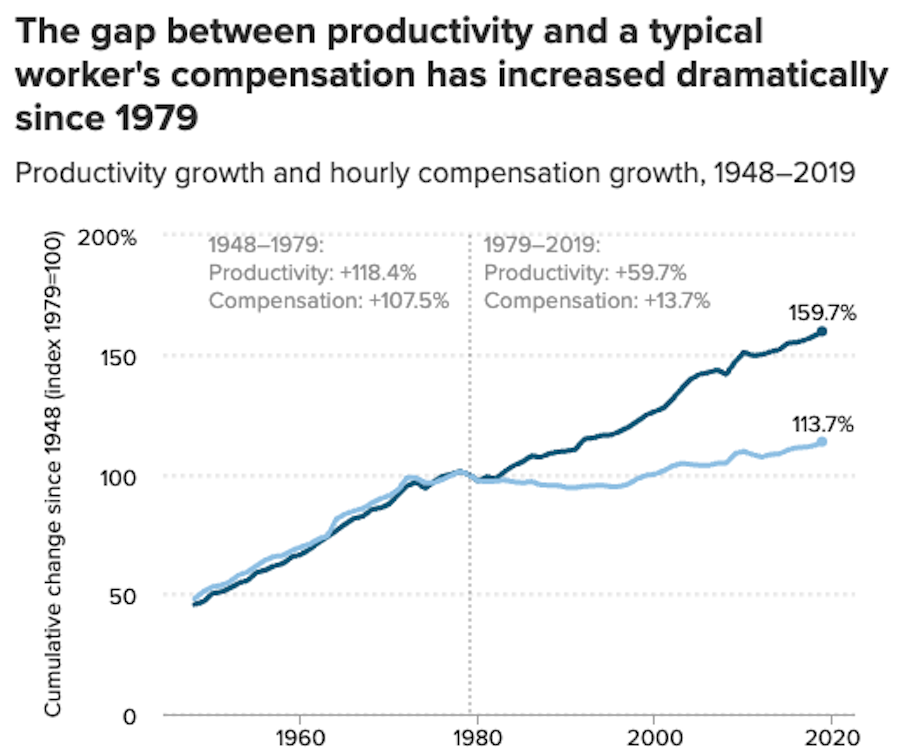
- Unequal distribution of productivity gains and wage evolution Lawrence Mishel’s research shows that increasing inequalities, driven by growing employer power, have generated a productivity-pay gap since 1979. Productivity has grown 3.5 times more than wages for the average worker. [Lawrence Mishel: “Growing inequalities, reflecting growing employer power, have generated a productivity–pay gap since 1979” Sept, 2021 am https://www.epi.org/blog/growing-inequalities-reflecting-growing-employer-power-have-generated-a-productivity-pay-gap-since-1979-productivity-has-grown-3-5-times-as-much-as-pay-for-the-typical-worker/ ]
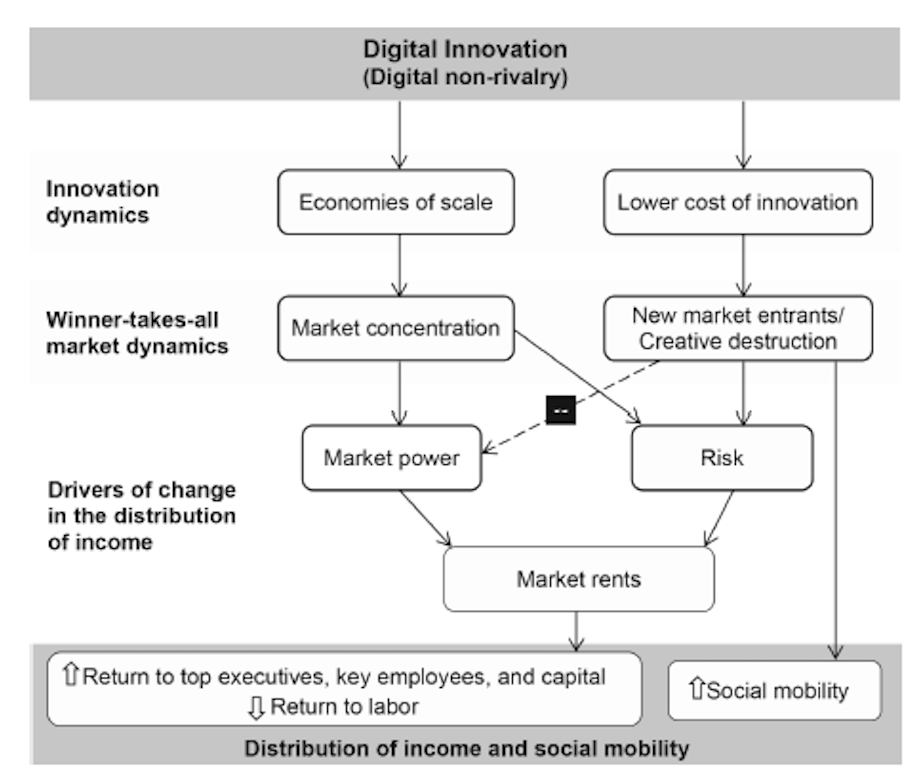
Most of the benefits of digital innovation do not reach average workers These benefits are concentrated among executives, key employees, and shareholders of the most successful companies, while average workers have not seen corresponding increases in their incomes. [Guellec, D. (2021). Digital innovation and the distribution of income. University of Chicago Press. ISBN 978-0-226-72817-9.]
The digital economy is widening the wage gap Highly skilled workers adapt better, while less skilled workers face a higher risk of unemployment. [Yang, G., Yao, S., & Dong, X. (2023). Economía digital y brecha salarial entre trabajadores altamente y poco cualificados. Economía digital y desarrollo sostenible, 1(1). https://doi.org/10.1007/s44265-023-00009-y ]
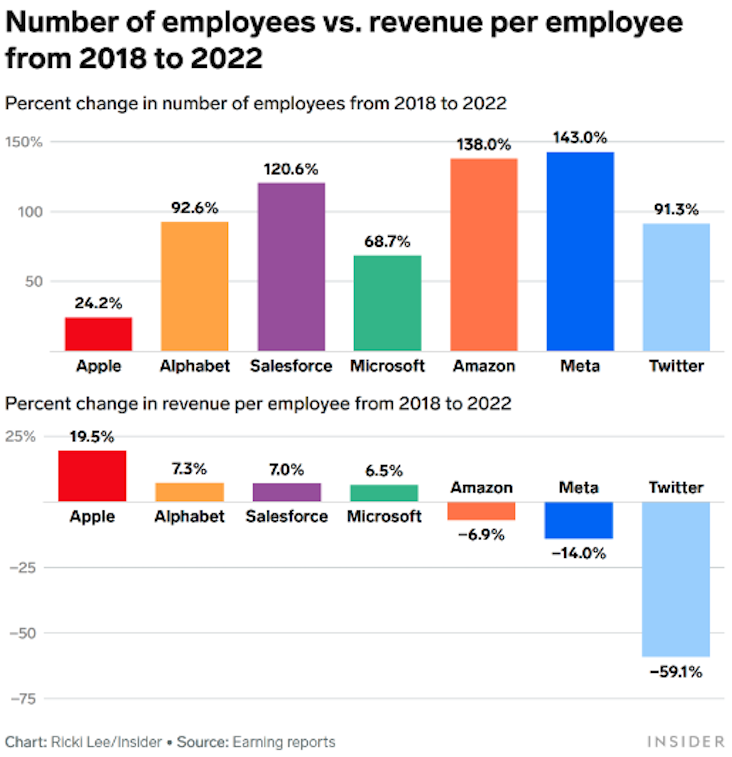
- Excessive focus on revenue per employee as a strategic indicator in digital giants versus traditional companies Digital giants often prioritize revenue per employee, making it a key metric, whereas traditional companies measure success differently. [https://www.businessinsider.com/4-charts-show-falling-revenue-per-employee-at-tech-firms-2023-3 ]
SEEKING A SOLUTION COMMENSURATE WITH THE CHALLENGE
This is not a matter of power distribution (at least, not in this conversation). What we are dealing with is a challenge of value distribution and measurement in a new economy. For the last eighty years, our North Star has been generating transactions and distributing added value or wealth, measured as economic aggregate. Both the way we generate value and the way we distribute it have changed, and there are early symptoms of a sick society—one that chooses the wrong leaders and doesn’t know how to prosper or design standards of prosperity by the same standards of the past. We have too many loud voices and too few intellectuals.
Perhaps the problem isn’t about old ideologies but about shared values and the necessary emergence of a wave of critical thinking to redesign the new economy. The problem is that the first to reinvent themselves should be the media, to construct narratives that align civil society ideologically, but their excessive proximity to old centers of political power and their high dependency on value measured in terms of advertising revenue or media consumption has left them more vulnerable than ever.
Perhaps the problem isn’t about old ideologies but about shared values and the necessary emergence of a wave of critical thinking to redesign the new economy.
Defining the value of an economy beyond quantifiable transactions in legal tender should be the new wave of critical thought required to redesign what prosperity means in the AI era. Perhaps we need to design a system of double accounting during the transition (GDP + new taxonomies of value), rather than trying to replace GDP with a completely valid new model. Though such models exist, and they come in many flavors: Gross National Happiness (GNH), Human Development Index (HDI), Genuine Progress Indicator (GPI), and Better Life Index (BLI).
This potential solution of double accounting should focus on developing a more inclusive and dynamic measurement system. Instead of relying solely on GDP, we could implement a new methodology based on three pillars:
Measuring value that escapes transactions Time is one of the most valuable resources, especially the time of those who devote their lives to caring for loved ones in unprotected spaces, ensuring the social cohesion that other economic activities fail to accurately measure.
Measuring new value created in the digital and AI eras We should include metrics that quantify the value of time saved through AI. Metrics that aggregate the value of shared knowledge: open-source code, collaborative platforms, free generative AI agents and voluntary projects represent enormous amounts of economic value that are currently not measured. A new indicator could quantify the value of non-monetary contributions that drive global innovation and efficiency.
Focusing on sustainability and well-being metrics It is crucial to integrate metrics that account for environmental impact and social cohesion. Adopting a system that measures not only economic growth but also human well-being and environmental sustainability could offer a more complete and fair picture of progress. Initiatives like the Genuine Progress Indicator (GPI) or the Gross National Happiness (GNH) index could be excellent starting points. And it’s time to create a historical record and elevate it to the same level of recognition as GDP.
Those same neoclassical economists who admit the imperfections of GDP but still cling to it will not live to see the disasters caused by a generation that loses trust in the system because someone left them behind. I refuse to create a world worse than the one I inherited. And sadly, we are heading that way, not just regarding environmental care.
CAN WE REINVENT GDP?
Or is it enough to simply cover what hasn’t been measured until now? Should we abandon GDP entirely for having rewarded wars and the destruction of the planet under the guise of prosperity and growth? Can we redefine our economies as aggregates of value rather than aggregates of transactions? If questions define value in the era of generative AI, why don’t we continue asking the questions that will redesign our desired future and let AI do the heavy lifting?
I dream of a world where growth is measured by value creation and social cohesion. However, for the time being, we must accept that GDP remains the prevailing metric. How can we bridge the gap between this dream and our current reality?
Between living and dreaming, there is a third thing. Guess it. –Antonio Machado
“Entre el vivir y el soñar hay una tercera cosa. Adivínala.” — (Atribuida a) Antonio Machado.
If we are unable to reach consensus on a new metric for global growth and output, we may have to start using <>, even if its value is not counted in current GDP. At least we will keep generating value (no counted by GDP) to our beloved and our economies.
It is not a perfect solution and the drift is at least sustainable.
Sources:
Wikipedia contributors. (n.d.). Gross domestic product. In Wikipedia, The Free Encyclopedia. Retrieved October 20, 2024, https://en.m.wikipedia.org/wiki/Gross_domestic_product
Sultana, F., Freed, L., Bishop, L., Shteynberg, E., Manavadiya, M., Kolachina, V., Bhalala, D., & Zhang, D. (2022). Implications of the subscription economy. ResearchGate. https://www.researchgate.net/profile/Faiza-Sultana-4/publication/357904318_Implications_of_the_Subscription_Economy/links/66dc6c5ab1606e24c2124e60/Implications-of-the-Subscription-Economy.pdf
TEDxChristchurch 2019: The unpaid work that GDP ignores by Marilyn Waring Marilyn Waring: The unpaid work that GDP ignores -- and why it really counts | https://www.ted.com/talks/marilyn_waring_the_unpaid_work_that_gdp_ignores_and_why_it_really_counts
REPORT on GDP and beyond – Measuring progress in a changing world 20.4.2011 - (2010/2088(INI)) https://www.europarl.europa.eu/doceo/document/A-7-2011-0175_EN.html

Bernardo Crespo is an investor, entrepreneur, and startup advisor, Bernardo empowers diverse startups and venture builders. Spanning disciplines from digital marketing to data modeling, Bernardo has guided hundreds of C-suite executives in crafting and executing impactful digital transformation roadmaps for their companies.
As Academic Director of Digital Transformation, and also AI and Data Literacy at IE Executive Education, Bernardo brings his expertise to academia. He previously served as Digital Transformation Leader at Divisadero, a Merkle company, collaborating with Fortune 500s alongside Adobe, Google, and Salesforce. Earlier in his career, he led digital marketing at BBVA, playing a key role in their digital transformation journey. His pioneering work on gamification at BBVA became a recognized case study by Gartner and Forrester.
Together with Gam Dias, Bernardo is coauthor of the book "The Data Mindset Playbook: A book about data for people who don't want to read about data '' KDP. Oct. 2022.
Subscribe to my newsletters on LinkedIn!
Manually Crafted Expertise: Newsletter "Digital Sustainability"
AI-Powered Insights: Newsletter "My AI-ter Digial Ego"
The author
Bernardo Crespo
C-suite advisor in AI, data and strategy. CEO of Quantum Markethink and Academic Director at IE. He helps leadership teams make sound decisions in the age of AI.
LinkedIn