How to Measure the Success of your Digital Strategy
Success and failure are 2 sides of the same coin. Winston Churchill used to say that success is not final and that failure is not a fatal mistake, and that the courage to continue is the only thing that counts. And courage needs measurement as its enabler in digital.
_“Success is not final, failure is not fatal: it is the courage to continue that counts.” -_Winston Churchill.
Every time I face translating digital strategy into indicators, I find myself doubting how to adapt a basic block of metrics that lets us see success or the areas for improvement in a simple way, on a dashboard that is easy to read and intuitive. And always regardless of the vertical or the industry.
If we put all the ingredients of digital strategy into the same container, only a summary view of certain alerts allows us to make use of measurement to keep moving forward. Indicators as a catalyst for courage. In the lines that follow I am going to set myself the exercise of reflecting on how the digital strategy of many companies hides an important paradox. I have always believed there is a lot of work to do in digital before paying to convert.
Regardless of whether we use a more generic view of our activity (upper funnel) or a more specific one (lower funnel), there is always a set of digital assets or territories to take into account in order to assess our digital strategy. The following image shows, at a glance, all the ingredients to bear in mind:
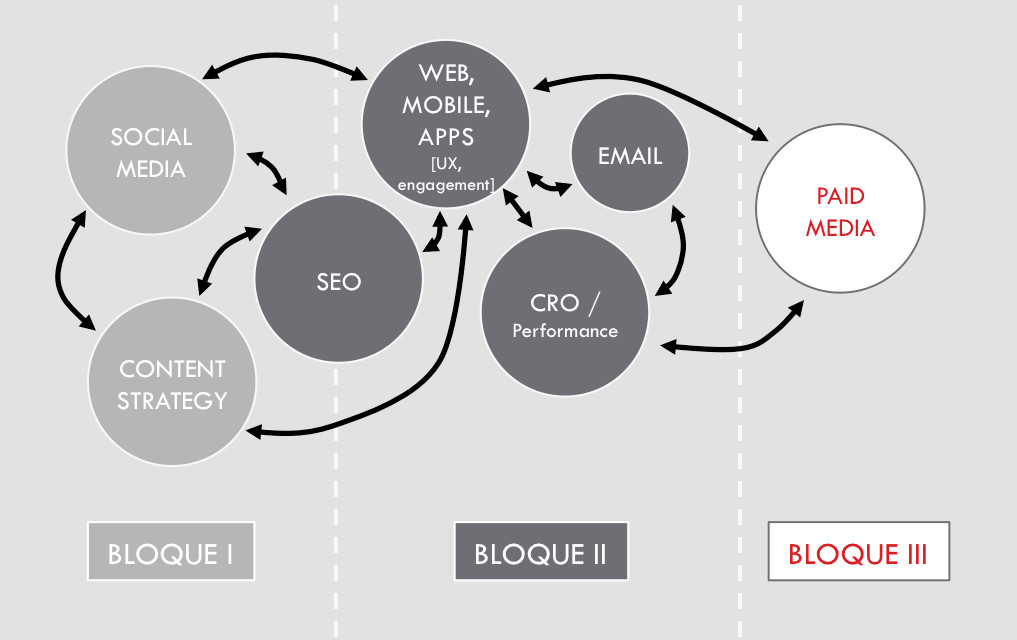
BLOCK I: Both the content strategy and the content on social media allow us to create the first surface of contact with potential users of our offering or service. Google Now took the decisive step roughly a year ago with the creation of “Ok Google”. Basically it was putting two observed trends into context: the growing use of natural-language-based search -conversational search- and the pervasiveness of mobile devices.
To translate it into strategy and then into indicators: can I build my content strategy on the most natural form of search, so as to connect social media, content strategy, SEO and my digital assets? That is the decisive step.
Google Adwords has taught us to build generic search strategies -non-branded search- and brand search strategies -branded search- and isn't it possible to connect what a user is thinking during a purchase process in order to guess future buying behaviours? Is it possible to build a content strategy for the edges of the earlier search process? Instead of thinking about “New Mazda CX-5” or “Madrid-Turin flights”, we would be thinking about “What is the most expensive car breakdown?” or “Mole Antonelliana opening hours”. I am using my imagination here, there is no science in these exercises.
This line of thinking generates both niches for organic search rankings and some room for efficiency in SEM. And it certainly creates a strategic opportunity to connect my digital assets, the social media strategy and the content strategy. And the link between them is organic search rankings.
BLOCK II: You have already got the first visit. Your users have touched some of the content on your main digital assets (blog, website, app, etc.). Does it make sense for these users to land on the same landing page as those who come in from your Home? Wouldn't it be worth creating a different space that connects conversation -conversational search- with your content?
After all, that user hasn't given you permission for anything yet, you ran into them in the street and you have invited them to your party. The seduction process continues. Confronting the user with a direct “call to action” doesn't seem like the right move. Doing this exercise probably requires longer conversion processes and it's still almost hand-crafted work. And you can always apply technology to this process. You may have to create personalised newsletters for different types of users depending on how close to or far from the moment of purchase they are. “10 places to eat near the Piazza del Castello” or “Average Lifespan of an Urban SUV”.
What should we measure to assess the success of this approach?
BLOCK III: Now you have a qualified audience, and you also have the first conversions, which let you implement improvements on your original landing page. You have qualified audiences that have converted and qualified audiences that have not. If they come back to your Home, do both audiences still see the same thing? By keeping the same content definition in the most visited spaces of our digital assets, we are stealing cross-selling space. And it is even more wasteful, if that is possible, to pay for impressions of that offer when we know for certain that they have already bought. Does it make sense for us to pay for these users on display or on SEM?
At this stage there is a double job: a) “Burning” these audiences in our paid media strategy and looking for similar audiences; b) Learning from the purchase experience both in qualitative terms and in terms of prospecting. And thinking about the next purchase by those users.
Having been able to generate learnings about the type of user who buys, having the traceability of who consumes content prior to a purchase and having built a learning curve on conversion, this is the moment when it is worth looking outside. I already know who converts, how and how much. Now is the time to spend my euros bringing in exactly lookalike audiences. Doing it earlier would have meant learning in an inefficient way.
**And now, after reading the three blocks, swap the labels BLOCK I, II and III for Earned, Own and Paid Media. Does it add up?**Had you thought about digital strategy in these terms? Thanks in advance for the feedback.
The next question is quite simple. Now take your digital budget, or your digital marketing budget, or your marketing budget. Break the budget down into the 3 blocks:
Does this split make sense?
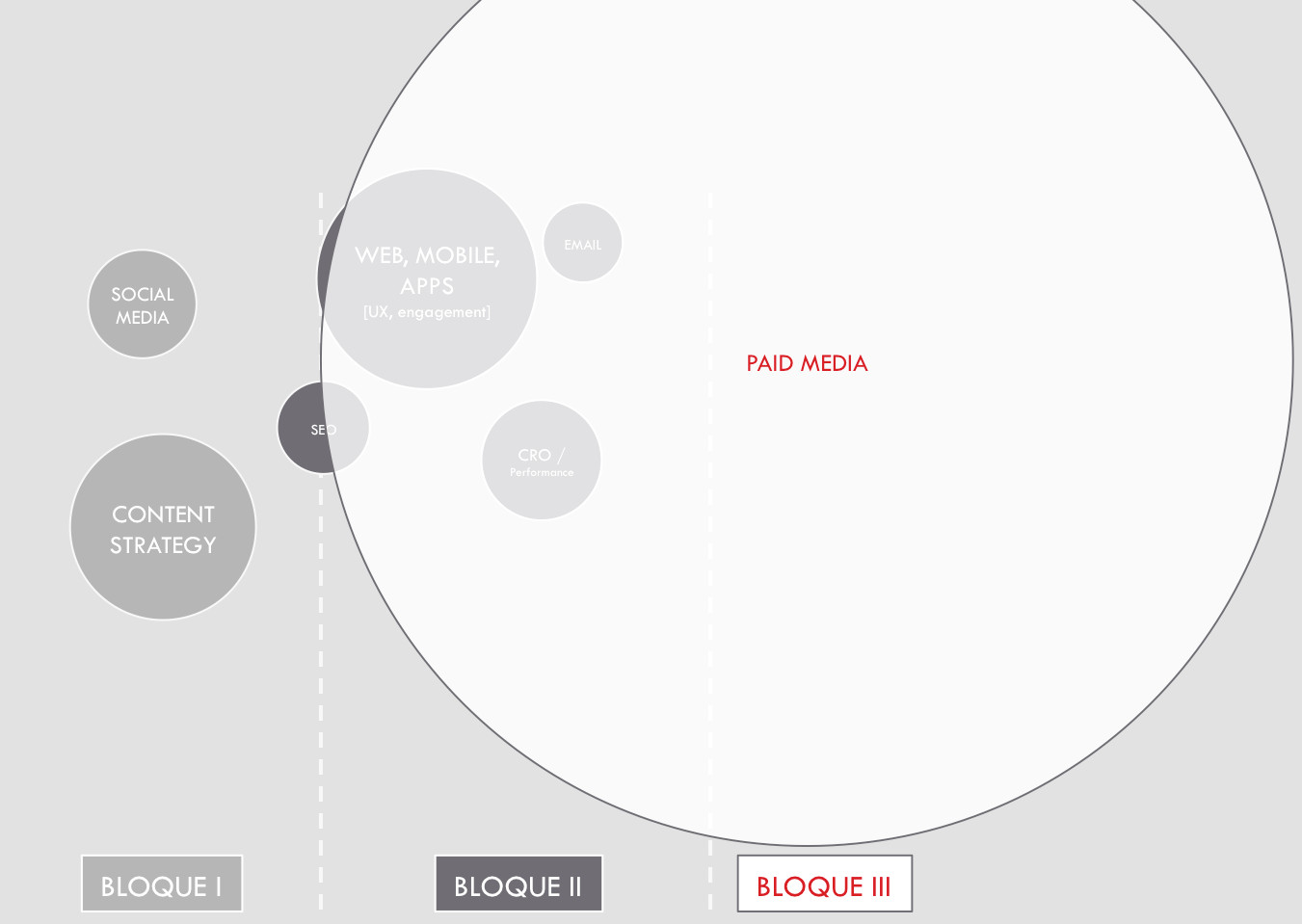
Some of the following questions bring out a DIGITAL PARADOX, an important one in my view:
- Haven't we got the order of the factors wrong? Why do we invest in bringing in traffic without having learned who is who on my digital assets?
- How many of the conversions I have had in the last year belong to users who were already users the previous year? And to users who have not been impacted (paid media)?
- Am I still sending my users to the same HOME or to a similar landing page regardless of where they come from or of their previous interactions?
- Had I ever thought about the contribution of Social Media or the Content Strategy to my organic search rankings?
- Am I able to break down the contribution of BLOCKS I, II and III (earned, own and paid) to my final conversion?
- Am I still assigning the success of the paid media contribution on the basis of impressions? How many of those impressions are generated by bots (Ad Fraud)?
- Is the impressions figure given to me by whoever buys the media for me, or do I get it directly myself?
- Do I measure the contribution of all the interactions before the purchase, or is the measurement done for me by someone independent?
- Why do we start paying for traffic without measuring everything above?
- Do I have the right travelling companion to optimise my results? And my investment?
I hope this post clears up a few ideas. I mean that from the heart.
About me:
Bernardo Crespo is Digital Transformation Leader at Divisadero.
Director of the Executive Programme in Digital Transformation at IE Business School and an Ontological Coach certified by Newfield Network in Bogotá (Colombia).
Degree in Business Studies from UCLM and final year of a BA Honours in Management and Economics, University of St Andrews. Executive Master in Relationship Marketing, CRM and E-commerce from ICEMD and a lecturer at various business schools in Spain. He worked as digital marketing director at BBVA España.
I currently devote myself to helping companies walk the path of Digital Transformation at DIVISADERO.
The author
Bernardo Crespo
C-suite advisor in AI, data and strategy. CEO of Quantum Markethink and Academic Director at IE. He helps leadership teams make sound decisions in the age of AI.
LinkedIn