Multidisciplinary Learning: Chemistry and Emotionality in Companies
The 2025 Nobel Prize in Chemistry was awarded to the discoverers and developers of MOFs (Metal-Organic Frameworks)…
The 2025 Nobel Prize in Chemistry was awarded to the discoverers and developers of MOFs (Metal-Organic Frameworks). The laureates were Susumu Kitagawa, Richard Robson and Omar Yaghi, “for the development of MOFs”. Richard Robson was one of the pioneers: he explored the idea of building coordinated networks with metal and organic molecules, connecting them as “struts and nodes”. Susumu Kitagawa developed improvements so these structures would be more stable, adaptable and functional for practical applications (for example, being able to open and close, respond to stimuli, absorb gases). Omar Yaghi helped formalize the concept of a “metal-organic framework”, improved the methods for building them predictably and optimized their porosity.
THE SEARCH
I couldn't get my head around this concept in simple terms until I used the “Study Mode” feature in ChatGPT, released this past July 29 (https://openai.com/index/chatgpt-study-mode/ ). Here is the result for learning what MOFs are:
[NETWORK] Imagine a structure made of metallic pieces (metal atoms) connected by organic “rods” (carbon molecules).
[POROSITY] That structure forms a “grid” with many gaps or pores inside — like a molecular sponge
[TRANSFORMATION RITUAL] These gaps allow it to store, filter or trap molecules (gases, water vapor, pollutants, etc.) within its network.
Thanks to their design, MOFs can have enormous internal surfaces even though their exterior volume is small.
Some examples of these MOFs applied to different fields (the icons preceding each example give away the author of this part of the content):
🧱 1. MOFs as CO₂ capture materials in buildings | Example: ZIF-8 and MOF-74 (Mg-MOF-74) | The wall doesn't just protect, it purifies the air.
These MOFs have been integrated into facade coatings or “breathing” paints that trap carbon dioxide from urban air.
The goal is to turn building surfaces into “passive carbon sinks”.
Experimental architects in London and Berlin (such as those at EcoLogicStudio) have collaborated with chemists to prototype panels that use MOFs together with algae or biocements.
🌡️ 2. MOFs to regulate indoor temperature and humidity | Example: MOF-801 and MOF-303 (based on zirconium and aluminum) | Walls stop being passive; they store energy and materials.
These MOFs can absorb moisture from nighttime air and release it during the day.
In 2023, a team from MIT and the University of California, Berkeley tested atmospheric water harvesting systems with MOFs in desert climates (inspiration for passive architecture in arid zones).
In architecture, this opens the door to self-regulating humidity walls or roofs that condense drinking water.
☀️ 3. MOFs as part of integrated energy systems | Example: HKUST-1 (with copper) and MIL-101(Cr) | Walls stop being passive; they store energy and materials.
They can store hydrogen or methane very densely, ideal for distributed renewable energy systems.
In European research projects (such as MOF4Air or HyStorIES), they are being explored for facade panels capable of capturing CO₂ and reusing it to produce synthetic fuels on site.
Architects call this closed-loop architecture.
🏙️ 4. Active urban surfaces inspired by MOFs | Conceptual example: “Breathing Skins” prototype (TU Munich). Bioreactive, adaptable and living architecture.
This experimental project combines membranes with MOFs that change shape and permeability depending on the environment.
They behave like a “smart skin” that regulates ventilation and filtration without electrical consumption.
🧩 5. Photocatalytic paints and coatings with MOFs | Example: Ti-MOF derivatives (titanium)
They absorb sunlight and break down atmospheric pollutants (NOx, VOCs).
There are already experimental coatings that clean the air in heavily polluted urban areas (inspired by the Palazzo Italia building at Expo Milano, although traditional photocatalysts were used there).
MOFs offer greater efficiency and durability.
THE CONNECTION WITH OTHER DISCIPLINES
The miracle (in case by now you have already lost 100% of your capacity for surprise where AI is concerned) comes next. And that's when we humans step in.
You must have heard ad nauseam about the value of multidisciplinary learning in the age of AI as a new emerging skill, but how do you apply it? I hope the following exercise is useful, if only as an illustration:
Once we understand the concept of MOFs as molecular frameworks that let us capture, store and trap molecules, and that can be applied in construction for condensing water in semi-desert areas or capturing CO2 in urban areas or even storing hydrogen and methane very densely for distributed renewable energy systems, wouldn't it be ideal if a building were able to attract, condense and transform the emotionality of its employees to improve the workplace climate?
Of course, it isn't possible (for now). Since emotions aren't physical molecules, they aren't material compounds, even though they can be processed by neurotransmitters, which are indeed matter — chemical substances responsible for transmitting information from one neuron to another. Still, my reflection is a different one, and this is where multidisciplinary learning really opens up. What if it were possible in a not-too-distant future? Could we take away learnings that would let us alter toxic moods in business organizations? And what if we scale up the vision and scope of application?
MULTIDISCIPLINARY THINKING: Chemistry and Emotionality in Companies
The following reflections are the result of an exercise built under human supervision and developed 100% by a machine across several iterations, until we landed on a result worth sharing with other humans: Can't we humans trigger the process of reflection collaboratively between a human and a machine to connect learnings across seemingly disconnected territories?
If we think of it metaphorically, a company could have its own “emotional MOFs”. In other words, although a company cannot retain something as complex and non-material as human emotion, which is a combination of electrical, hormonal and social activity, we can indeed make use of the analogy to connect the concept learned from MOFs with the power of organizational cultures.
We would be creating the concept of cultural MOFs, or human constructs that can have the power to emulate traditional MOFs. MOFs “purify” the air molecularly; healthy organizational cultures “purify” the emotional air.
Trust networks that trap fear or distrust and transform it into learning.
Porous leadership that lets emotions circulate instead of building up as pressure.
Rituals and caring conversations, which function as catalysts: they convert frustration into constructive energy.
We could then say that the “cultural MOF” is a system of relationships structured enough (like the metallic part) and human enough (like the organic part) to absorb and transform negative emotions in a collective sense. And couldn't we connect the concept of business organizations, or even societies or countries, to this beautiful metaphor?
I'm convinced that in less than a decade we will be able to apply this technique to construction to develop emotionally non-toxic physical spaces — can you imagine expanding the concept of sustainability by applying this learning to a workspace? To an office building?... To the White House?
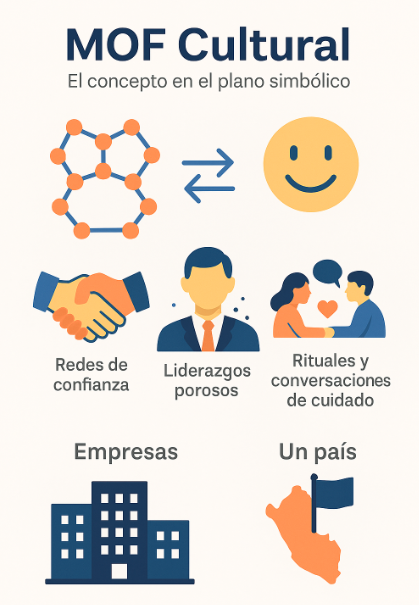
Cultural MOF
A Cultural MOF is a network of human relationships structured like an intelligent material, whose purpose is to absorb tensions and transform them into constructive collective energy:
[NETWORK] The metallic part represents the stable structure — the norms, values and collective agreements.
[POROSITY] The pores are the symbolic spaces where dialogue, emotion and cultural renewal circulate.
[RITUALS] The organic part represents the emotional and social life — the people, the empathy and the creativity.
The following infographic presents this analogy developed with illustrative examples to understand and develop the concept of cultural MOFs [Cultural MOFs Infographic ].
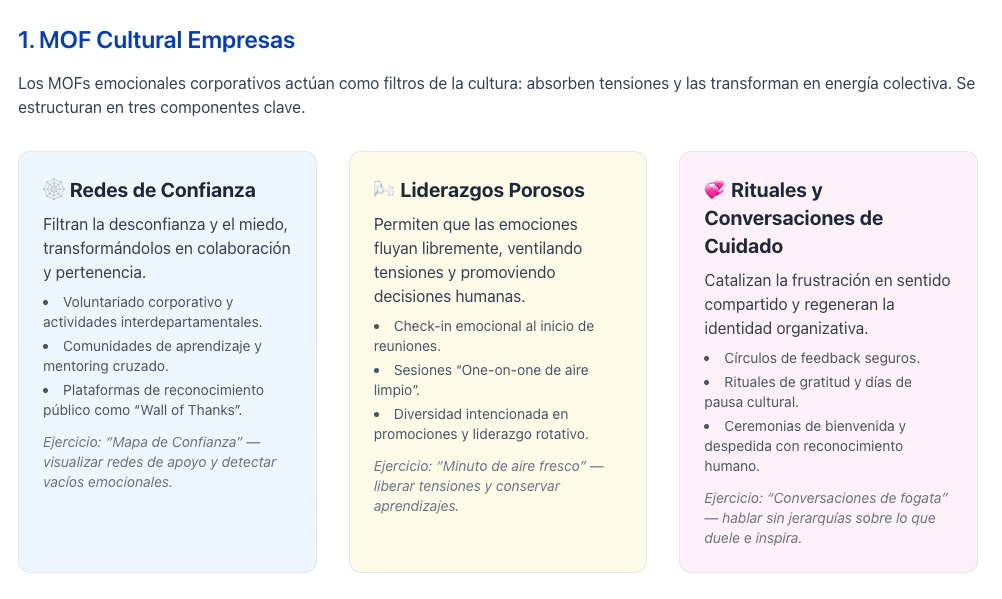
Cultural MOF Company
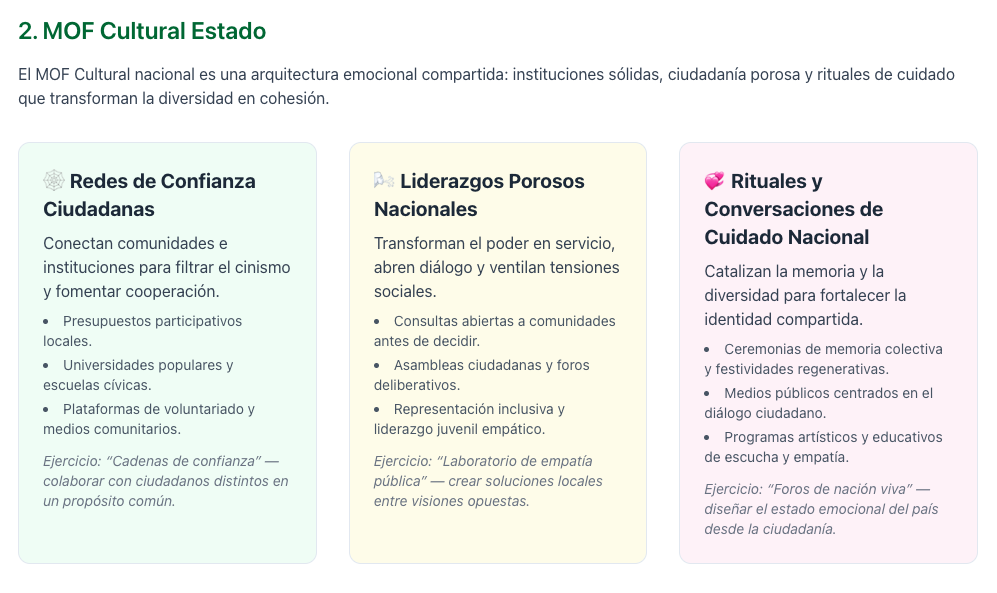
Cultural MOF State
Any one of us has, for the first time, the chance to connect organic and inorganic chemistry with business psychology and change management. Doesn't that seem like magic? It does to me, and that's why I've spent my time sharing it. I believe this kind of exercise creates value and at the same time considerably reduces the risk of cognitive offloading.
Personally, I believe the learning lies not so much in the discovery itself, as in the exercise of connecting seemingly disconnected disciplines to create spaces for reflection and lateral thinking that, with the help of AI, allow the development of new creative horizons for domains and territories not connected until now. And this is only the beginning.
“The world rewards specialization. But specialization comes at cost. You learn more and more about less and less, until you know everything about nothing." — Nathan Myhrvold.
Note: [This article is tagged as "Machine assisted". Machines and humans work together. Diagram based on the Dubai Future Foundation. "Human-Machine Collaboration (HMC) Icons." Dubai Future Foundation, dubaifuture.ae/hmc]
Bernardo Crespo | @b_crespo
Bernardo Crespo is a seasoned digital transformation and data strategy leader with over 25 years of experience. He has held leadership positions in Fortune 500 companies and digital consultancies, and has founded and advised numerous startups and venture builders. Currently, as CEO of his own firm, Quantum Markethink, he provides strategic guidance to C-suite executives, helping them navigate the complexities of digital transformation.
Furthermore, he serves as an Academic Director at IE Executive Education, where he brings his expertise in emerging technologies, digital strategy, data strategy, and artificial intelligence to the classroom. Prior to these roles, he spearheaded digital transformation initiatives at Merkle Spain and led digital marketing at BBVA, where he notably pioneered the application of gamification in banking.
Bernardo is also the co-author, with Gam Dias, of "The Data Mindset Playbook: A Book about Data for People Who Don't Feel Like Reading about Data" (KDP, March 2023).
Articles augmented by AI: Newsletter "My AI-ter Digial Ego"
Articles 100% crafted by a human: Newsletter "Digital Sustainability"
The author
Bernardo Crespo
C-suite advisor in AI, data and strategy. CEO of Quantum Markethink and Academic Director at IE. He helps leadership teams make sound decisions in the age of AI.
LinkedIn