A non-Digital POST about TRUST
What if we woke up and email didn't work?, what if none of the phone numbers on our mobile devices could no longer…
What if we woke up and email didn't work?, what if none of the phone numbers on our mobile devices could receive calls anymore?, what if some marvelous intelligent algorithm managed to replicate and forge an entire chain of blocks?
Everything works and everything flows…
… until trust brings the system down. Throughout the history of humanity, only trust in not being invaded, trust in health and in the custodians of health -call them doctors, healers or shamans-, or trust in finding daily sustenance to continue our existence, has been the guarantor of the sustainability of any system. The mere threat of losing one's life was reason enough to react in advance.
The mere intuition or glimpse of the loss of our possessions or our safety would put all of a system's trust at risk. And, sadly, trust feeds on the recurrence of a chain of favorable or satisfactory events. When one of those events fails in isolation, the perception of stability breaks and trust cracks. Confusion, suspicion, distrust and, in some cases, even resentment appear. Something similar happens in relationships between human beings. If I discover you've lied to me, I'll hardly be able to trust your word again. If, on top of that, your lie hurt me, I might look for some occasion to settle — and be just about it — accounts with you.
What happens if we lose trust in the system?, what would happen if tomorrow we pay with our card and it doesn't work or is declined?, what happens if the emergency phone number on the back of the card doesn't answer?, and what would happen, to complicate things further, if the ATM didn't recognize our card?, what would happen if there were no bank branch to handle our complaint?
Everything works, until trust gives way to panic.
A Chilean master in the art of linguistically reconstructing emotions and moods, Julio Olalla, explained the following in a “paper” from more than fifteen years ago_1_:
Panic
I affirm that X is happening or has happened.
I judge that I'm about to lose everything.
I judge myself absolutely incapable of facing X.
I declare that I'm paralyzed (or running without direction)
What if panic gave way to a mood opposite to trust? Distrust is a mood, a recurring predisposition to negative judgment about a specific action. In this case, about the functioning of a system (payments, telecommunications, etc.) In other words:
“I declare that system X has stopped working correctly.
I judge, from my experience, that the functioning of system X is unstable.
I declare that I'm going to take anticipated corrective measures when using system X.”
What if system X stopped working one day?, is it possible not to take anticipated corrective measures having lived through the experience of not being able to pay?, where would I deposit my money?, would I really allow my emoluments to land in a checking account whose withdrawal system (card or ATM) had previously failed?, would I trust a telecommunications company, if none of my devices could receive calls one morning?, would I allow direct debits to be charged to my checking account, if the system had failed?
Would it make sense to trust a system that didn't have a physical customer service model on hand?, how could we mitigate the risk of distrust if physical user service centers disappeared? This isn't about talking of steps back in time, it's about restoring trust. Perhaps the simplest path is to find what unites suppliers and buyers in any market.
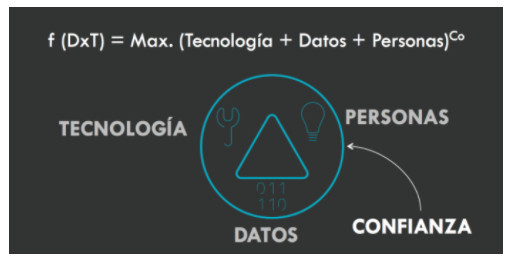
Are we perhaps recovering the foundations of the definition of any system?, isn't customer experience perhaps a synonym for trust?, isn't trust perhaps a catalyst for the combination of technology, data and people (see the digital transformation formula, 3, page 18)?
The automation of trust
We're getting closer and closer to a system in which people hand over their will and their value judgments to predefined, automated criteria. With the capacity to learn based on iterations. It isn't far-fetched to think that an application could automatically manage the switching of all my direct debits when event Y and event Z occur concurrently in time. For example, if I receive two overdraft charges or credit card maintenance fees for an amount higher than X, proceed to switch all my direct debits and all my income to another checking account at another institution.
Choosing a telecommunications company, an insurance company or a banking institution stirs about as much excitement in most mortals as looking for a plumber when a pipe has burst at home. It simply has to be done, and the sooner the better. It's a bitter pill. There's no sentimental relationship to hold on to, it's a purely transactional act. Much as it may pain the service providers just listed, there's no prior relationship of trust to hold on to. Quite the opposite. Most banking, insurance or telecommunications users have at some point experienced an insurance claim left unattended, an unwanted fee being charged, or a phone bill bigger than expected. And what's the reason we don't switch service providers? Forgetfulness, laziness, fear. And utilities — electricity and gas — are fast joining that list of service providers that don't generate a relationship of trust.
How many of the people who have gone through a similar situation wouldn't trust an algorithm to switch service providers when any of the above situations occur again? [rhetorical question].
If companies like IFTTT, Zapier or Workato are capable of automating simple tasks through integrations or APIs, for example, if I write a tweet that contains this keyword, send an email to a mailing list, or, if I leave work, turn on the heating at home, or, if it detects certain movement in my account… how far can we configure the automation of our trust?
If we're capable of getting hooked, as human beings, on the activity of a social network and, at the same time, we're aware that the activity of that social network is starting to be run by bots -up to 15% according to a study_4_, from March 2017- how far are we capable of interacting naturally if there's only an algorithm on the other side, non-human activity run by predefined rules?
In a study carried out by the McKinsey Global Institute, whose results are shared in Harvard Business Review, it reviews the countries whose jobs are most likely to be hit by automation, given the technology currently available. The study yields one deceptively simple figure: half of jobs could be automated with the technology currently available.
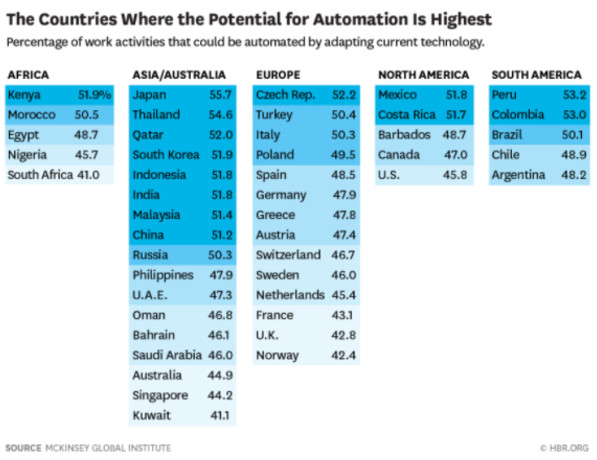
Could the authors of this study find, in the relationships between suppliers and buyers of products or services degraded by a lack of trust, an accelerator of automation? (another rhetorical question)
Trust is the foundation of relationships, and relationships have to be cared for to guarantee their continuity. When one of the events on which the judgment of stability rests fails, trust cracks. Confusion, suspicion, distrust and, in some cases, even resentment appear. Something similar happens in relationships between human beings.
Access the original POST on the DIVISADERO blog
The author
Bernardo Crespo
C-suite advisor in AI, data and strategy. CEO of Quantum Markethink and Academic Director at IE. He helps leadership teams make sound decisions in the age of AI.
LinkedIn