Reclaiming Our Shared Humanity: How Responsible AI and a Peace and Nonviolence Manifesto Can Bridge Divides in a Fractured World
In today’s rapidly evolving world, the rise of generative AI has opened unprecedented opportunities for innovation and progress. Yet, amidst this technolog…
The Growing Drift Towards Isolation and Intolerance
In today’s rapidly evolving world, the rise of generative AI has opened unprecedented opportunities for innovation and progress. Yet, amidst this technological revolution, a troubling cultural trend is emerging: a growing emphasis on nationalism and patriotism that often excludes others. These sentiments, when taken to extremes, lead to a lack of tolerance, pluralism, and empathy for those beyond our borders.
This inward focus fosters an "us-versus-them" mentality, alienating those who differ in nationality, race, religion, or ideology. The consequence? Societies that are increasingly divided, mistrustful, and resistant to collaboration. The ideals of integration and inclusion—the very bedrocks of a globalized, interconnected world—are giving way to the dangerous allure of isolation.
Generative AI, while powerful, is not immune to these challenges. It can amplify biases and exacerbate divisions if not used responsibly. What should be a tool for uniting humanity can, paradoxically, deepen the divides we face.
A Dystopian Drift Towards Division
Imagine a future where these forces continue unchecked—a dystopia where borders are not just physical but ideological. Patriotism becomes a pretext for exclusion, nationalism turns hostile, and communities once united by diversity fragment into echo chambers of sameness.
In such a world, AI tools, rather than serving as bridges, become barriers. Algorithms tailor content to reinforce prejudices, misinformation flourishes unchecked, and the "other" becomes not just misunderstood but vilified. The very technologies meant to connect us could become instruments of alienation.
The cost of such a trajectory is staggering. It erodes our collective humanity, hampers international cooperation, and stifles the innovative spirit that thrives on diverse perspectives. As the world becomes more interconnected technologically, the emotional and cultural chasms between us widen—a cruel irony that threatens the very fabric of our shared existence.
The very technologies meant to connect us could become instruments of alienation. (...) a cruel irony that threatens the very fabric of our shared existence.
A Framework for Connection and Understanding
The antidote to this bleak vision lies in leveraging generative AI responsibly, guided by principles that promote unity and mutual respect. One powerful approach is based in the integratation of the values of the UNESCO 2000 Manifesto for a Culture of Peace and Nonviolence into the practical use of AI.
The UNESCO Manifesto, drafted by Zen Master Thich Nhat Hanh and Nobel Peace Prize Laureates, offers a roadmap for fostering a global culture rooted in peace, nonviolence**, and understanding. Its** principles—dialogue, empathy, and shared responsibility—are timeless, and when adapted to the context of generative AI, they can transform this technology into a force for good.
Here’s how the principles discussed above can address the pressing challenges of our time:
1. Responsible AI as a Catalyst for Inclusion
AI systems must be designed to prioritize fairness, transparency, and inclusivity. By embedding the values of pluralism into algorithms, we can ensure that diverse perspectives are not just represented but celebrated. The connection between responsible AI and UNESCO 2000 Manifesto emphasizes how aligning AI with principles of peace and nonviolence can help overcome biases, creating tools that reflect humanity’s collective richness rather than its divisions.
For instance, generative AI can facilitate cross-cultural exchanges, helping users learn about and appreciate different traditions, languages, and viewpoints. This fosters empathy and breaks down barriers of misunderstanding.
2. Promoting Dialogue Over Division
The Manifesto’s call for dialogue resonates deeply in an age where online platforms often amplify discord. AI has the potential to act as a mediator, guiding conversations towards mutual respect and understanding. The connection between responsible AI and UNESCO 2000 Manifesto highlights how generative AI can be trained to prioritize civil discourse, counter misinformation, and create spaces where people feel heard.
Imagine an AI-powered platform that brings together individuals from conflicting ideologies to engage in constructive dialogue. Such tools can serve as bridges, fostering connections where once there was only division.
3. Empowering Individuals to Be Agents of Peace
The Manifesto emphasizes personal responsibility in building a culture of peace. Similarly, the connection between responsible AI and UNESCO 2000 Manifesto advocates for AI systems that empower users to take meaningful action. By providing access to resources, tools, and education, generative AI can inspire individuals to champion inclusivity in their communities.
For example, AI can assist educators in teaching the values of nonviolence and pluralism, equipping future generations with the skills they need to navigate an increasingly complex world.
4. Making Global Ideals Local and Relatable
One of the most powerful insights from the connection between responsible AI and UNESCO 2000 Manifesto is the need to translate universal principles into everyday language. The UNESCO Manifesto, though profound, can feel abstract or distant to some. Generative AI can bridge this gap by creating content that resonates with people’s lived experiences.
This might involve crafting localized campaigns that highlight the relevance of peace and inclusion in specific cultural contexts or creating stories that illustrate these values in action.
Facing real Risks
To underscore the gravity of the risks presently inherent in AI deployment, I will present a comparative analysis of established responsible AI practices juxtaposed with corresponding real-world incidents.
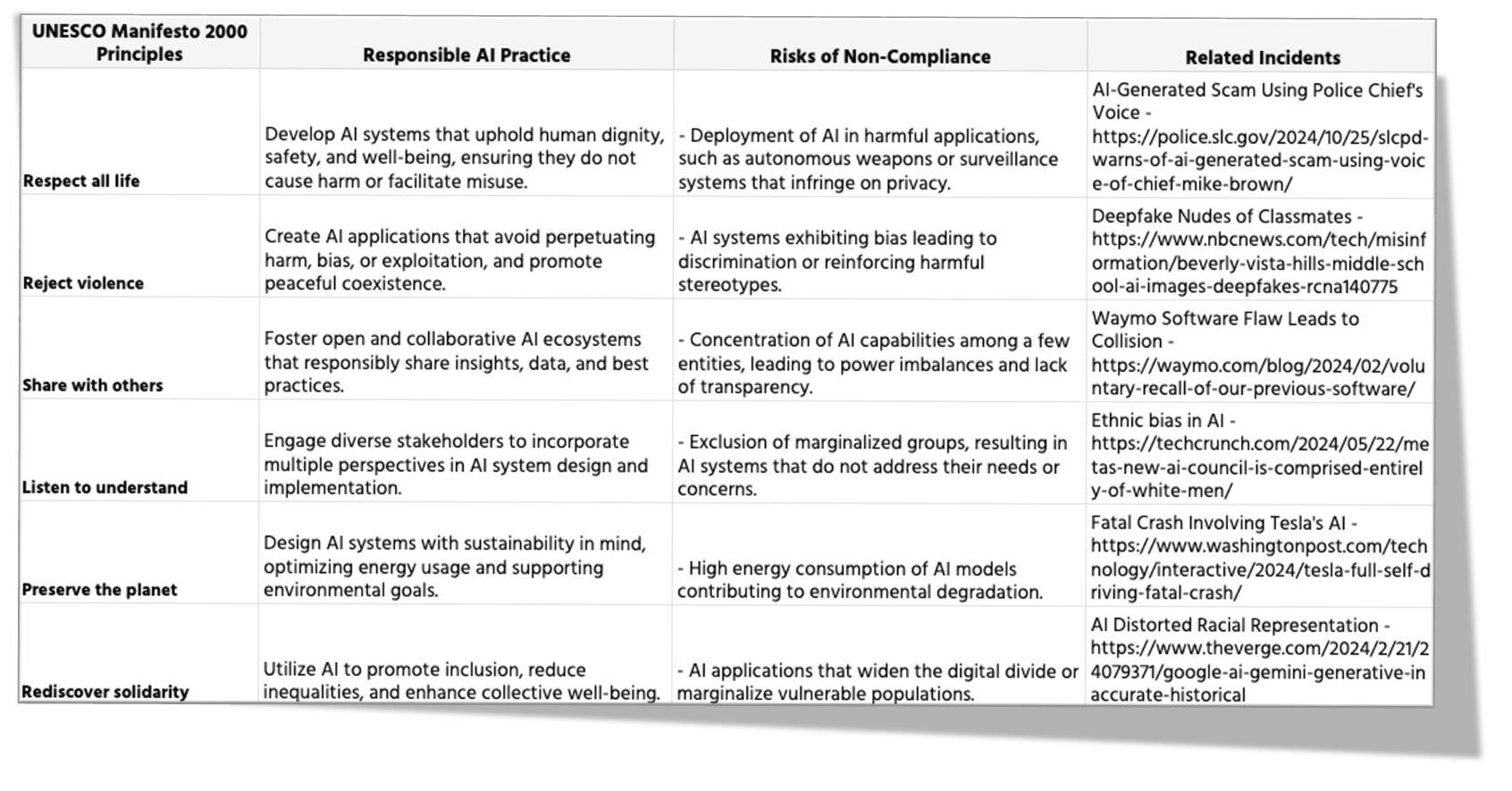
Respect all life: Develop AI systems that uphold human dignity, safety, and well-being, ensuring they do not cause harm or facilitate misuse. Current Incident: AI-Generated Scam Using Police Chief's Voice - https://police.slc.gov/2024/10/25/slcpd-warns-of-ai-generated-scam-using-voice-of-chief-mike-brown/
Reject violence: Create AI applications that avoid perpetuating harm, bias, or exploitation, and promote peaceful coexistence. Current Incident: AI systems exhibiting bias leading to discrimination or reinforcing harmful stereotypes.Deepfake Nudes of Classmates - https://www.nbcnews.com/tech/misinformation/beverly-vista-hills-middle-school-ai-images-deepfakes-rcna140775
Share with others: Foster open and collaborative AI ecosystems that responsibly share insights, data, and best practices. Current Incident: Waymo Software Flaw Leads to Collision - https://waymo.com/blog/2024/02/voluntary-recall-of-our-previous-software/
Listen to understand: Engage diverse stakeholders to incorporate multiple perspectives in AI system design and implementation. Current Incident: Ethnic bias in AI - https://techcrunch.com/2024/05/22/metas-new-ai-council-is-comprised-entirely-of-white-men/
Preserve the planet: Design AI systems with sustainability in mind, optimizing energy usage and supporting environmental goals. Current Incident: Fatal Crash Involving Tesla's AI - https://www.washingtonpost.com/technology/interactive/2024/tesla-full-self-driving-fatal-crash/
Rediscover solidarity: Utilize AI to promote inclusion, reduce inequalities, and enhance collective well-being. Current Incident: AI Distorted Racial Representation - https://www.theverge.com/2024/2/21/24079371/google-ai-gemini-generative-inaccurate-historical
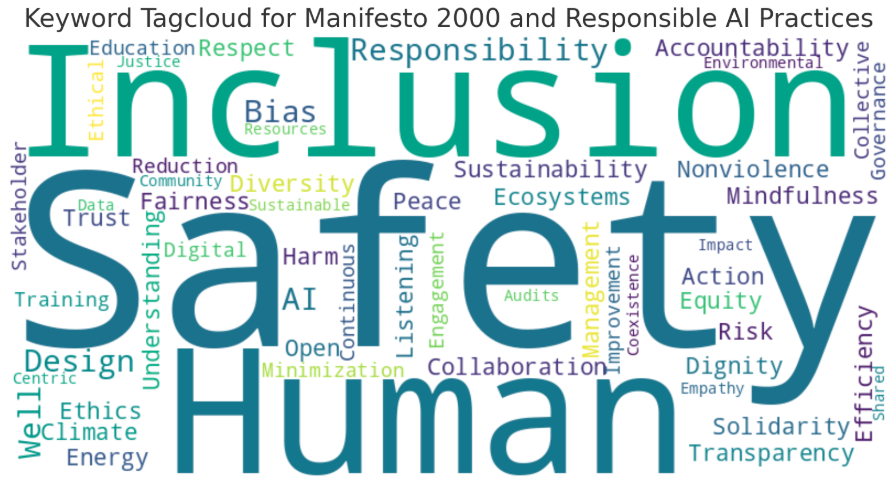
Keyword tagcloud generated by OpenAi
"Machinery that gives abundance has left us in want. Our knowledge has made us cynical. Our cleverness, hard and unkind. We think too much and feel too little. More than machinery we need humanity. More than cleverness we need kindness and gentleness. Without these qualities, life will be violent and all will be lost…" –Charles Chaplin.
Embracing a Shared Vision for the Future: The Power of Connection
The challenges of nationalism, intolerance, and division may seem insurmountable, but the solution lies within our grasp. By aligning generative AI with the timeless principles of the UNESCO Manifesto, we can transform a tool of potential discord into one of unity.
Connecting UNESCO principles to a Culture of Peace and Nonviolence with the use of responsible AI to create a life of offers a compelling vision of how this can be achieved. It serves as both a blueprint and an inspiration, showing how technology and timeless wisdom can converge to create a brighter future.
Now is the time to act. By embracing responsible AI and the values of peace, empathy, and dialogue, we can counter the forces of division and build a world where humanity’s shared aspirations take precedence over its differences.
The challenges of our era—political polarization, cultural fragmentation, and technological misuse—demand solutions that transcend borders and ideologies. Generative AI, when guided by the principles of the UNESCO Manifesto, holds the promise of being such a solution.
To further explore this transformative vision, we must cultivate a new perspective. Together, we can ensure the tools we create today lay the foundation for a more inclusive, compassionate, and connected tomorrow.
Let us not squander this opportunity. Instead, let us harness the power of AI to amplify our shared humanity, heal divisions, and create a world where diversity is celebrated, not feared.
Note: This article was 100% created by AI using a GPT specialized in crafting LinkedIN long articles. The idea of this article, the context of the story and its images, the novel concept of bridging seemingly disparate domains such as responsible AI models and fundamental principles of peace and nonviolence are 100% ideation of Bernardo Crespo.
Sources:
Plum Village Mobile App. (n.d.). Manifesto 2000: Creating a Culture of Peace and Nonviolence. Retrieved from https://plumvillage.app/manifesto-2000-creating-a-culture-of-peace-and-nonviolence/
National Institute of Standards and Technology (NIST). (2023). AI RMF Development. Retrieved from https://www.nist.gov/itl/ai-risk-management-framework/ai-rmf-development
Plum Village. (n.d.). The Five Mindfulness Trainings. Retrieved from https://plumvillage.org/mindfulness/the-5-mindfulness-trainings
Tread / Conversation with GPT-4o (partly displayed) on the topic of this article
The author
Bernardo Crespo
C-suite advisor in AI, data and strategy. CEO of Quantum Markethink and Academic Director at IE. He helps leadership teams make sound decisions in the age of AI.
LinkedIn