Turning Survival into Growth
Maybe none of us believes that the conversation right now is about looking for transformation models: You've lost your mind! How can you think…
Maybe none of us believes that the conversation right now is about looking for transformation models: You've lost your mind! How can you think about transformation in this context?
And in truth we are all longing to solve this impossible equation for growth. Turning survival into growth. Sooner or later it is time to grow again. And attitude is what makes the difference.
[This POST was previously published on Bernardo Crespo's blog under the title "Solving the Equation for Growth" ]
To put it simply, this context of total uncertainty brings us 3 different types of company (attitudes):
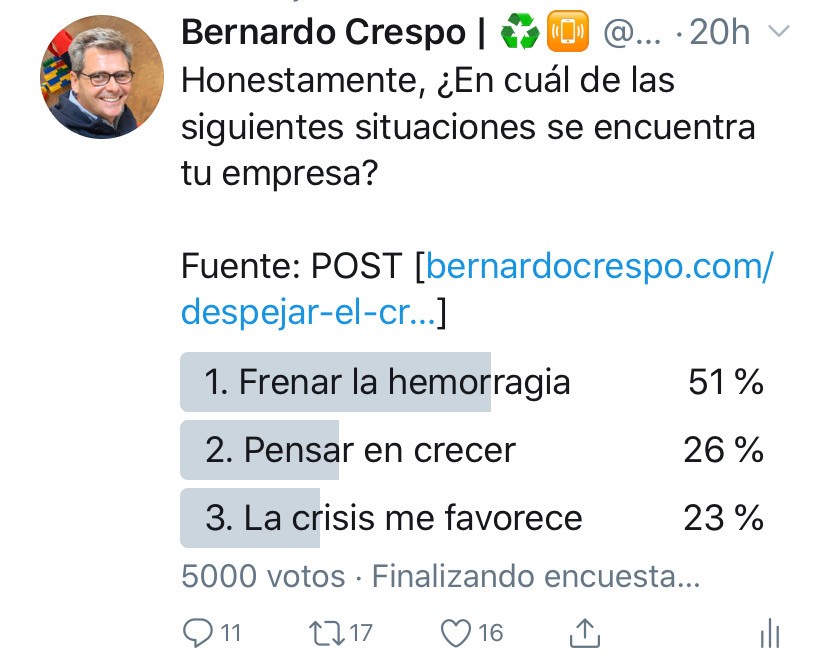
- Companies focused on stopping the bleeding caused by COVID-19. [≅ 51%*] For these companies the only possible model for managing growth is efficiency. These companies will only focus on stopping the bleeding in 2020, on thinking about how to reach past growth rates over the course of 2021. And perhaps at some point in 2022 they will think again about evolving the business model to explore new paths for growth.
- Companies whose focus is on mitigating the risks of the current situation. [≅ 26%*] These companies have accepted that it is time to use this moment of stagnation so that, without feeling obliged to grow in 2020, they can think about evolving their business model and mitigating the risk of possible COVID-19 flare-ups, diversifying their revenue streams in order to deal with future situations like the current one.
- Companies that are focused on making the most of the tailwind currently blowing. [≅ 23%*] Think of companies like ZOOM or Amazon that had never lived through a context as favourable as the current one for generating growth.
In this post I want to put the **focus on the first two companies. [**Approximately 77% according to the view -attitude, emotionality- of a sample of 5,000 random responses from users with an account in Spain on Twitter on May 28, 2020 - Link]
ELEMENTS FOR GROWING AGAIN
If before the current context there were two possible models for managing change and business transformation (see the post The Noise of Digital Transformation), a focus on digitalising to achieve efficiency (B2B or industry 4.0 model) and a focus on digitalising the distribution model (retail model), this context brings some different keys and I think it is time to explain it with the support of images to keep it simple.
To bring some order to the strategic approaches to growth, let me set out a few preliminary concepts:
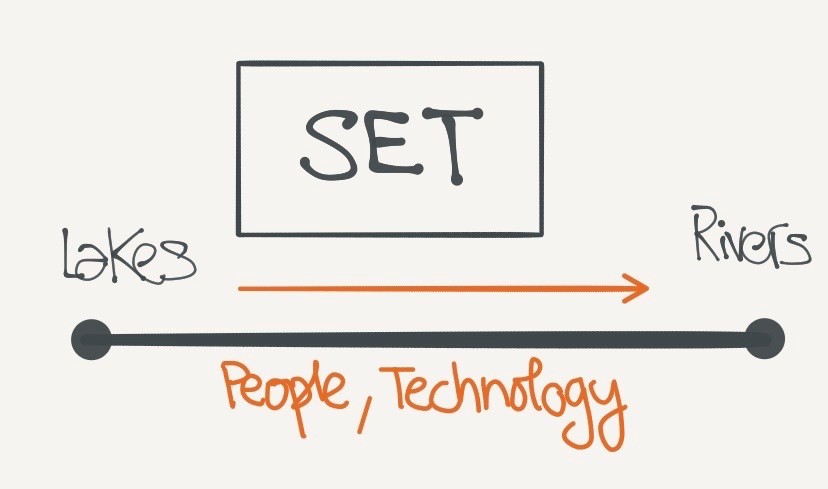
- SET: Your attitude, the mindset of the team that governs your business transformation. The leadership skills that describe your company and the legacy technology your operations rest on.
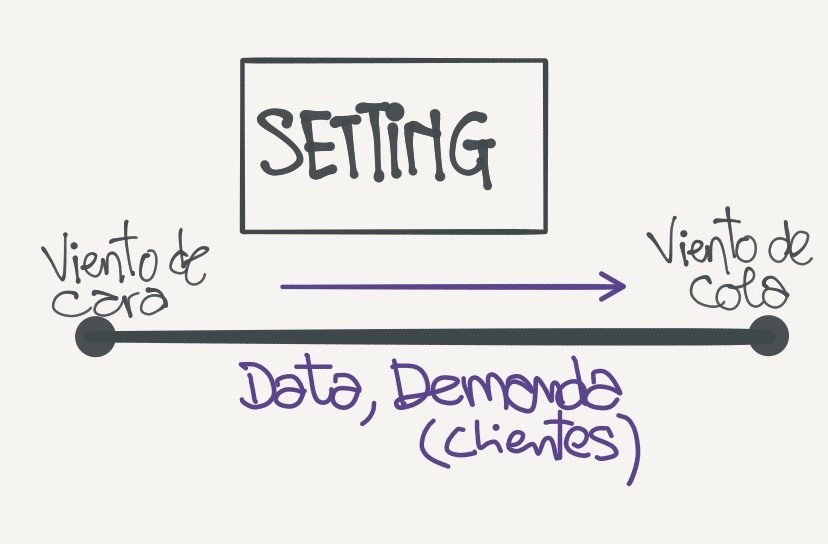
- SETTING: The context, the average growth rates of your sector or market, your access to information (data) and your adaptability to changes in demand for your product (customers).
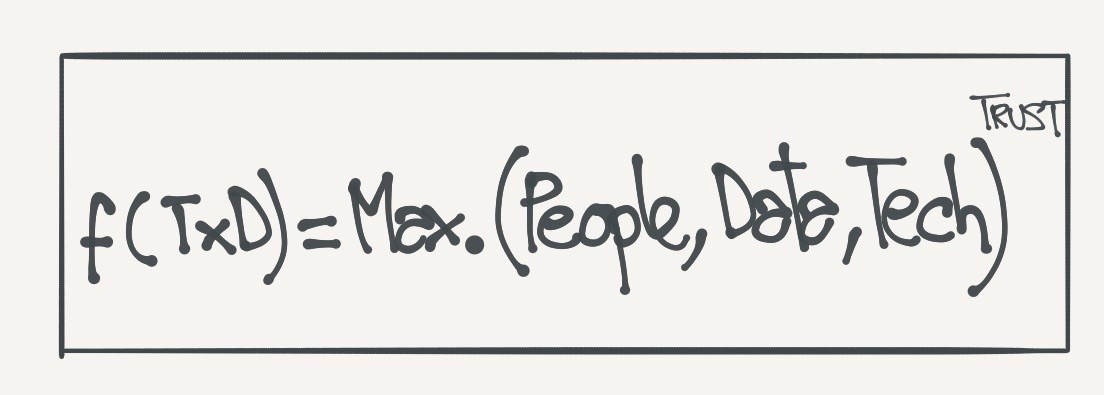
Ultimately, “set” and “setting” depend to a large extent on the variables of the digital transformation equation: People, Data & Technology. While SET is largely determined by "people" (employees) + "technology", SETTING is clearly shaped by "data" + "people" (customer). To put it visually:
Since new images or metaphors have appeared in each of these concepts, I explain them simply below:
- LAKES (or still water): A strange feeling that my company is sitting in a backwater where there is no room left for growth and the only challenge for growing is to take share from other competitors. Whether because of my legacy technology or the mindset of the governing team, growing is only possible by managing costs (focus on efficiency) or through risky exercises in inorganic growth. This still-water metaphor contrasts with the next one (rivers). In this situation the conversation is led by the CFO and by the M&A team.
- RIVERS (or flowing water): My company only has to worry about optimising growth rates. There is a clear fit between my value proposition and demand in the market (product-market fit) and the only challenge is knowing how to use the current to get further. The current does the pushing, and the challenge is using the right skills (people) to lead change and applying technology exponentially to grow faster than my competitors. This metaphor stands for the longed-for desire to flow. In this situation the conversation inside the company is dominated by agile methodologies, digital product management and growth leads (Head of Growth).
- HEADWIND (wind straight in your face): In this context, growth is tied to effort. Whether because of the regulatory environment or the macroeconomic one, the difficulty of growing is undeniable. Any attempt to grow means a lot of effort and is not immune to failure. Any change in the competitive context or shift in the competition (disruption) turns growth forecasts into a perfect storm. These contexts are dominated by old-guard CFOs or "cost controllers".
- TAILWIND (the wind at your back): A context in which, whatever you do, you will keep growing and your challenge will always be to grow faster than your competitors. When you have a tailwind, your challenge is to ramp up A/B experiments and hack the growth model so that your rate looks more like X2, X5, X10. Your focus is on translating marketing and business development into exponential growth rates. Holding back spending and investment is the enemy. In this context the conversation is dominated by CDOs or by Strategy Directors.
With all the elements and metaphors on the table, let me share a summary image:
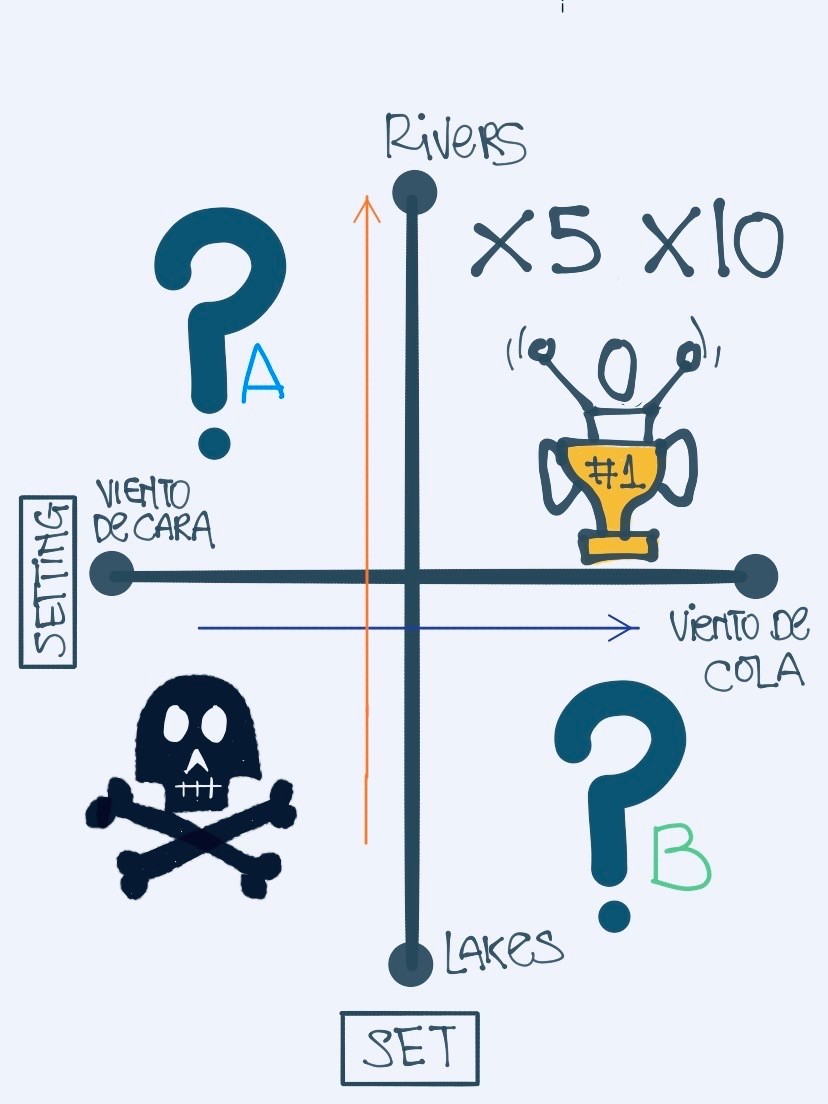
Which of the strategic unknowns would you like to be in? Do you think you are in A or in B? I explain it in detail further on.
SOLVING FOR GROWTH
The big challenge in solving the equation for growth in an environment like the current one (COVID-19) still lies in the same ingredients as before: "People, Data & Technology". Only that now every move is enormously marked by the absence of trust ("TRUST"). And this variable of the equation always played in the exponential league.
Perhaps guessing consumer behaviour is complex in any context and now, it is simply unpredictable. Will my customer buy a car before the summer? Will they think about moving house if they might lose their job? Will they decide to buy a plane trip if travel between countries is restricted? Will that company carry on buying my consulting services if all it wants now is to contain OPEX?
As for the strategic unknowns, let me solve them below as a supporting narrative for each company's self-diagnosis:
SITUATION A
This first strategic unknown is reserved for those companies that had already transformed the mindset of the leadership team and had, or were on their way to acquiring, the right technology. Here the challenge is to draw on the creativity of the new team and think about new business models, reshape the front end to generate new forms of growth and use data to know how to translate it into new ways of doing business or new growth levers (Data as a product). Planning scenarios in "situation A" depends on an honest assessment of the state of my information gathering (Data collection), of my ability to turn data into new products and new projects (Data Analytics & Data Modelling), as well as on the courage to start new value propositions that bring out spaces of demand not explored before.
How do you estimate growth in "situation A"? It depends to a large extent on my ability to uncover unexplored behaviours in demand or on access to previously unseen sources of information (new algorithmic exercises or new strategic data agreements). Optimism or conservatism in my growth forecasts is determined by how well I master the use of data and by my ability to create new business models.
SITUATION B
In this situation, you were already a star pupil when it came to using data and you knew how to build a model that adapted to the demands of an already digitalised customer. In other words, you had already embarked on digitalising your company. The problem is that your company finds itself in a regulatory context or an economic crisis context. Your supply markets have closed, isolation regulations make access to your offer difficult or simply the isolation and distancing measures have abruptly halted the way you carry on your business (distribution model). Planning scenarios in "situation B" depends to a large extent on the versatility of your organisational model, on your agility in project management, as well as on bringing technology into these new projects / products.
How do you estimate growth in "situation B"? It depends to a large extent on my ability to adapt to change. The strength of my traditional innovation department and the historical success rate of past new product launches will largely determine whether these growth estimates are reached. Optimism or conservatism in the growth forecast is determined by past experience of pivoting successfully.
I am sure that the reader is at this point imagining more scenarios or situations, and none of them is worth going over because they belong to the bottom-left quadrant (💀) or to the top-right quadrant, or, the perfect scenario of exponential growth (🏆).
On the other hand, if you have never thought about reviewing the skills of your leadership team or your leadership model, if your technology was dominated by legacy you cannot get past, if access to data was never a priority in your company, and, if you did not digitalise your distribution model, there is nothing more to say.
The challenge, in situation A as much as in situation B, is centred on the demand side. It is time to EXPLORE new possibilities at the same time as we EXPLOIT the current P&L. It is time to keep your clothes dry (exploit) and to swim at the same time (explore). And swimming depends on our ability to read changes in demand.
HOW TO READ CHANGES IN DEMAND
Going back to the thinking in The Noise of Digital Transformation, there were not only 2 models for managing change or business transformation. There was always a third model for managing transformation and it was putting the focus on demand:
“The real challenge for companies lies in interpreting the challenge of transformation as a sound and not as noise. And that means seeing the possibilities of making the value chain more efficient; thinking about a new distribution model where users have already decided how to interact with digital assets; And at the same time, starting to sketch the next business model that will change the rules of the game in your vertical.”
The challenge, before and now, still lies in rethinking the business model from the demand side.
The author
Bernardo Crespo
C-suite advisor in AI, data and strategy. CEO of Quantum Markethink and Academic Director at IE. He helps leadership teams make sound decisions in the age of AI.
LinkedIn