3D Strategy: How to Connect Digital, Design & Data
I've spent the last 20 years jumping from process definition and internal consulting to the most traditional marketing and from there to loyalty, from customer loyalty…
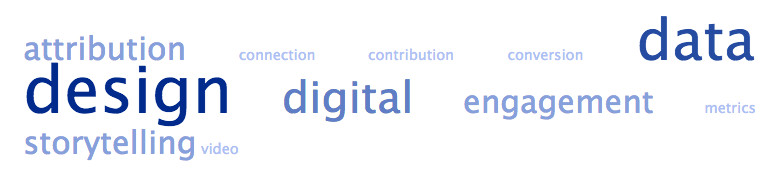
I've spent the last 20 years jumping from process definition and internal consulting to the most traditional marketing and from there to loyalty, from customer loyalty to technology and from digital to being a “data believer”. Now I've wanted to go back to teaching with a challenge that excites me and that thrills me. That's the moment when you feel -as an academic imperative of sorts- that it's time to sum up in one line the reasons that make a digital strategy successful. Although taking on the challenge would be pretentious, it might be easier -and certainly cooler- to sum it up in a tag cloud. And let the reader make their own connections.
[This post was originally published on the DIVISADERO blog.]
Of course, in that "Tag Cloud" concepts such as engagement, connection, conversion, metrics, storytelling, contribution, attribution, video, digital, data, etc. show up. In the end, the challenge of summing it all up in a “tagline” would always remain. A “statement” that is self-contained and reaches the heart, and then connects with the brain. I'll leave that for the end. That said, I believe that if data is the universal glue that connects everything in the digital era, there is one additional ingredient that turns the complex into the simple: Design.
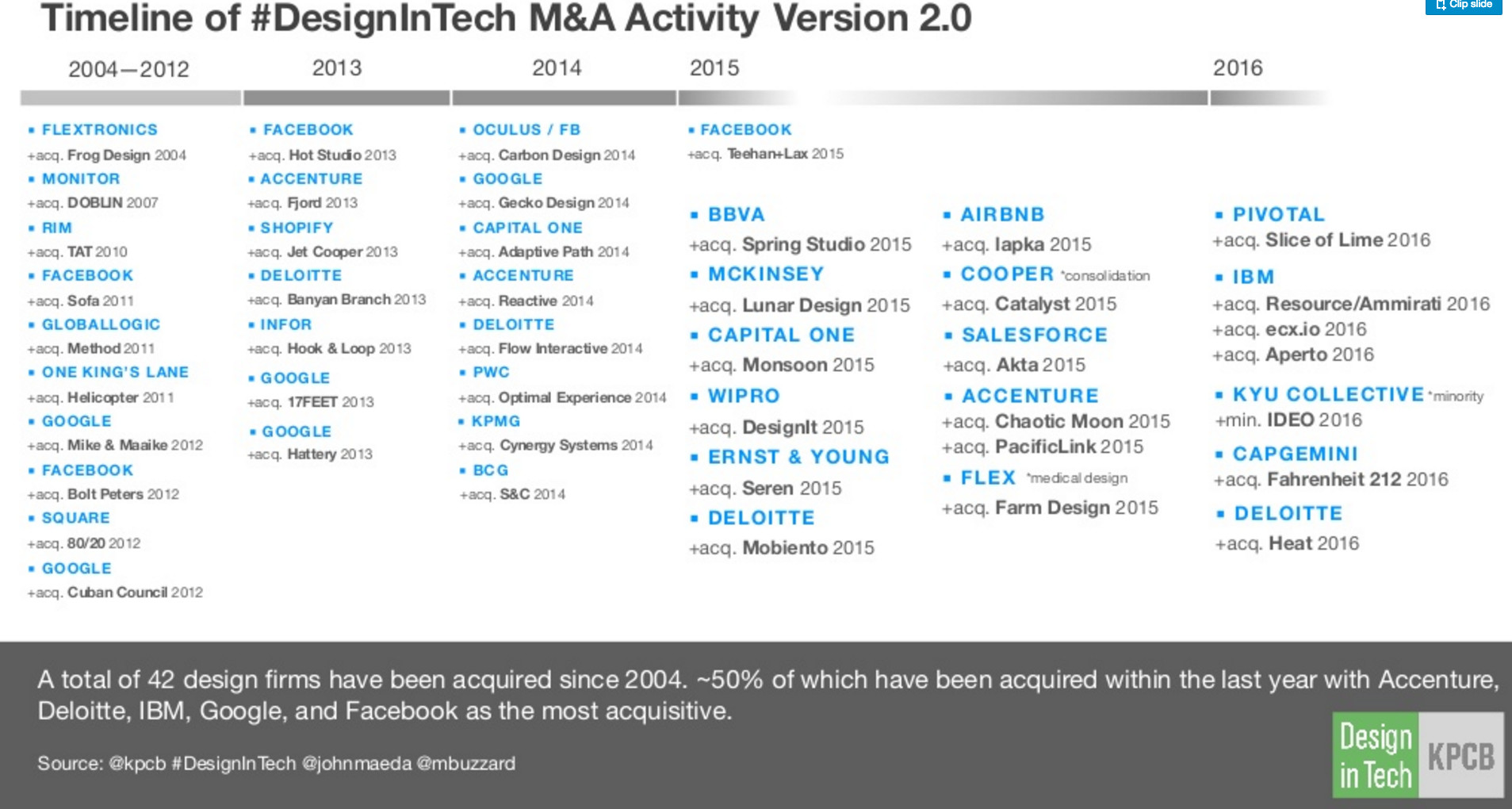
In recent weeks more articles than usual related to "digital" and "design" have turned up in my Pocket, and perhaps that is no coincidence. A year ago I was surprised when the McKinsey folks bought Lunar in June 2015. Accenture's purchase of Fjord in May 2013 also caught my attention. I have to admit that the first thing I thought was that old line about how "you can dress it up but ..." And I think that although the big consultancies are learning at breakneck speed in this new digital era, they have also always enjoyed the strategic instinct that has brought them to where they are now. It's not by chance, it's a question of focus.
The other day I was chatting with a friend who is quite possibly pulling together the big-picture fundamentals of design in his day-to-day work. In fact, I consider him one of the most qualified "content curators" in matters of design, as well as being an extraordinarily creative guy. My friend David Sanfelipe, Co-Founder of COCOE and a partner in the largest network of Spanish-speaking designers (domestika.org) -he'll surely blush when he reads this- admitted to me that the only thing that sets one great designer apart from another is a basic concept, Passion:
" ...I couldn't tell you why one design fascinates you and another doesn't, but I can tell you about the people who make them
(...) In short, for me a fantastic design always has the work of someone passionate behind it
(...) There are designers who are very correct, but who lack passion. That doesn't mean their work is good or bad
(...) Whereas those who work from passion -with the archetype of beauty, for example- (only) sometimes get it wrong."
Perhaps the digital era has been an accelerator of a paradigm shift, and it's also possible that this lesson isn't new. It was always there. Design stirs us and connects us with the most emotional part of our brain, the mammalian brain. The one that manages and activates our emotions. When design "touches" us, it makes the least rational part of our brain resonate, and it's hardly surprising that what sets one brilliant designer apart from another is passion. Nothing new. And no less thrilling for it. Does it make sense now for a strategy consultancy to invest millions in acquiring creative talent? Can design be the main driver behind the creation of positive user experiences? Without doubt, today users are capable of generating affinity, trust and a propensity to buy if the experience of interacting with digital assets is positive. A relevant user experience may become one of the most powerful levers for creating value in a brand. Something as intangible as brand value is, inherently, tied to design, to passion and to user experience. I don't think UX is displacing Branding and I'm not the only one thinking about that possibility.
A case in point:
- 79% of users who didn't like a site abandoned it and went back to run another search (Adobe, 2014)
- 59% of users prefer well-designed (beautifully designed) content over plain content, when they have 15 minutes of free time (Adobe, 2016).
One of this century's creative geniuses and the father of "Design Thinking" -Tim Brown- stated in 2009, in his book "Change by design", that the key to innovation is closer to a circular cycle than a linear one. Something more like a neural network than a traditional sequence or process:
"The continuum of innovation is best thought of as a system of overlapping spaces rather than a sequence of orderly steps" - Tim Brown
A concept that connects easily with quantum physics. Perhaps the result of bringing design and user experience together in the digital era has more to do with the observer's experience than with the logic of a mathematical experiment. I don't claim to set out the keys to success in combining design and technology in this post, and I do firmly believe that a wonderful space is emerging between the creative and the quantitative in this digital era. Perhaps the circle is closing, or perhaps it was always closed and our perception didn't let us see that reality. Once again the observer appears as the creator of experiences.
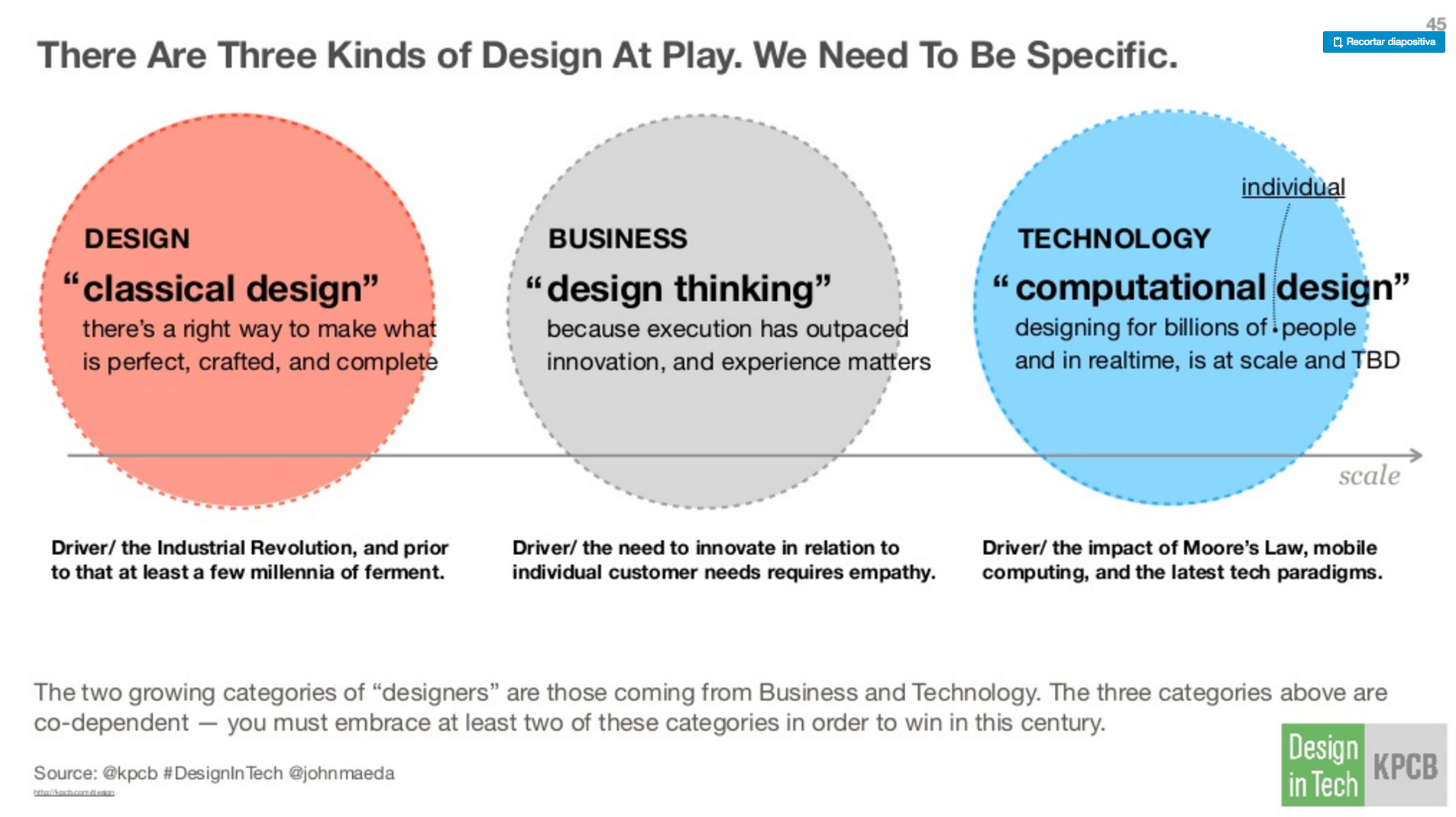
In April 2016 the venture capital fund KPBC put together another edition of the #DesignInTech2016 report. The report begins by running a "check" on 3 predictions it had already put forward in the previous year's report: 1) Corporate acquisition activity of design-intensive businesses was on the rise; 2) Designer-led startups have increased their growing access to investment capital; 3) Design, from the venture capital point of view, is not based on beauty, but on relevance / experience. Is it possible that the claim that design and technology only create value when they generate relevant user experiences is being underlined once again? Honestly, I believe so. This report highlights three distinctions in matters of design: Classical Design, Design Thinking and Computational Design. I'm not sure categories need to be spelled out. Design, creativity, ingenuity and innovation, combined with digital environments and using data as a catalyst for results, might create the seed of what KPBC calls “Computational Design”. To my mind it is the foundation of any successful digital strategy.
By the way, and connecting with the acquisition of companies intensive in design, innovation and technology by big players, this report offers a most juicy timeline:
Honestly, I've been through different experiences over the course of my professional life, and substantial increases in conversion when #data and #design are combined. All it takes is having the quantitative capabilities to hand and enough ingenuity to bring both digital spheres together:
Is it possible that there is a natural connection in digital strategy between design and data?
Digital, Design & Data: Personal learnings:
- It isn't possible to find a linear relationship between relevant user experiences and the use of design. And data can make part of this path easier.
- Design is a human activity and not a digital discipline.
- Connecting positive user experiences and design is something natural. Starting from design to create relevant user experiences is not enough.
- Ingenuity and creativity, combined with the use of quantitative and analytical skills, are a differentiating factor today.
- Our diminished capacity to process vast amounts of information (a problem of concentration) makes the visual a natural source of engagement.
- Testing and user experience personalisation are growing digital disciplines and one of the natural ways of bringing data & design together.
- The impact of a user experience on digital assets (positive or negative) becomes a powerful lever (creation or destruction) of branding.
"Everything has beauty, but not everyone sees it." - Confucius
I promised to end with a tagline that summed up in a single sentence the reasons that make a digital strategy successful, and I'm going to keep that promise. And the truth is that if you've read this post, that tagline has already appeared:
“Design, creativity, ingenuity and innovation, combined with digital environments and, using data as a catalyst for results (...) are the foundation of any successful digital strategy.”
This post was originally published on the DIVISADERO blog.
Other posts by @b_crespo on Linkedin:
About me:
Bernardo Crespo is Digital Transformation Leader at Divisadero.
Director of the Executive Programme in Digital Transformation at IE Business School and an Ontological Coach certified by Newfield Network in Bogotá (Colombia).
He holds a degree in Business Studies from UCLM and a final year of a BA Honours in Management and Economics at the University of St Andrews. Executive Master in Relationship Marketing, CRM and E-commerce from ICEMD and a lecturer at several business schools in Spain. He worked as digital marketing director at BBVA Spain.
I currently work at DIVISADERO helping companies make the journey of Digital Transformation.
The author
Bernardo Crespo
C-suite advisor in AI, data and strategy. CEO of Quantum Markethink and Academic Director at IE. He helps leadership teams make sound decisions in the age of AI.
LinkedIn