4 Phases in Digital Competence
I am going to go through each of the 4 phases and I cannot deny that there is an autobiographical component in each phase. Nothing less scientific than a life story.
Does anyone remember the phases of learning? That valuable mix of awareness and competence?
Well, more or less that is the path of most companies that decide to bring digital into their journey towards a natural value offering for their customers. Are these the phases of digital transformation? They could well be, and that was not the purpose of this post.
I am going to go through each of the 4 phases and I cannot deny that there is an autobiographical component in each phase. Nothing less scientific than a life story. And there is also a science fiction novel component. Perhaps of projection or desire. Spare yourself the last phase if you are one of those who does not enjoy guessing the future.
[See original post published on Blog @b_crespo]
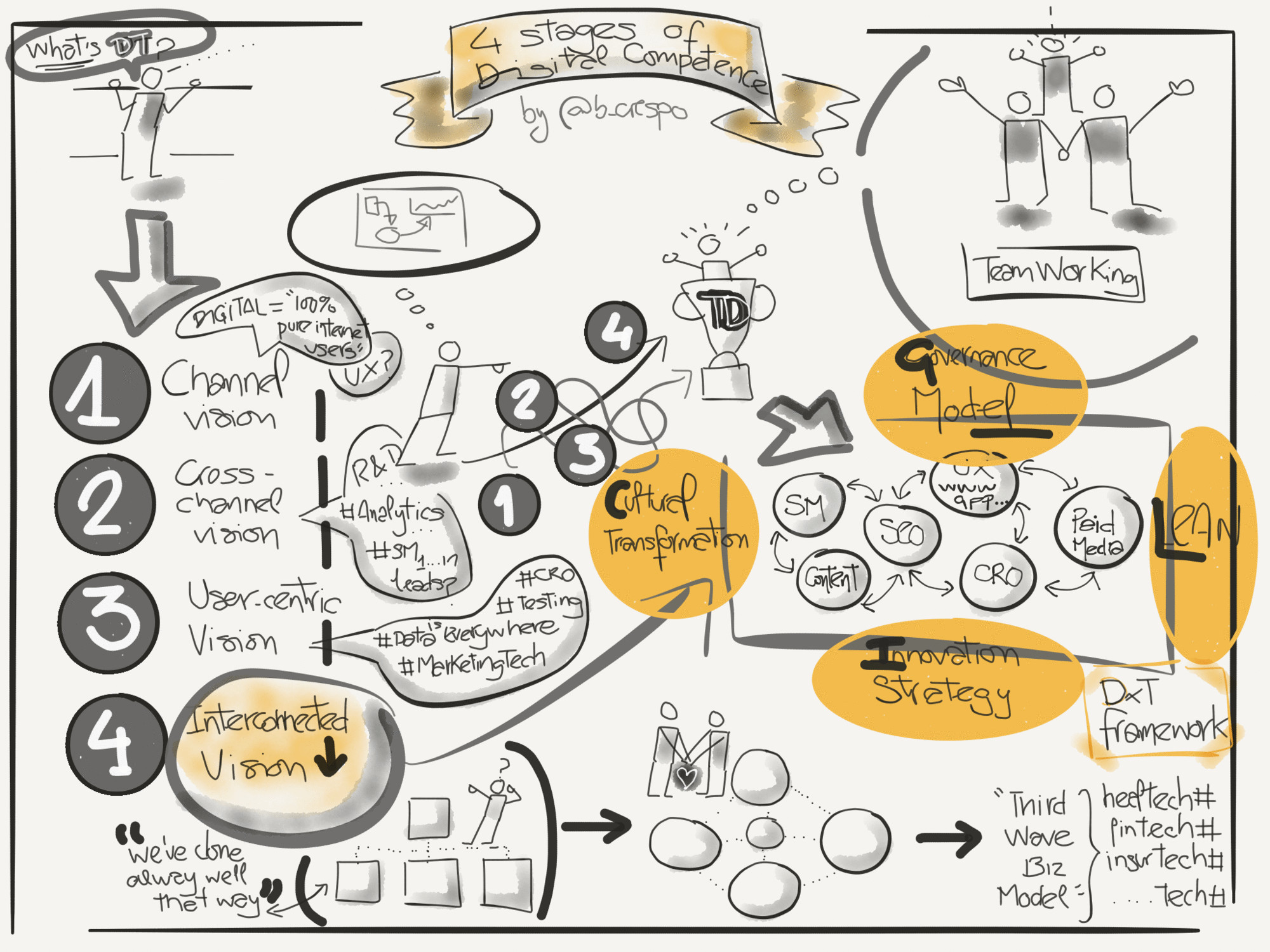
The “Unconsciously Incompetent" Phase
[Channel Vision]
In this phase companies play at thinking that most of their revenue comes from the traditional channel. Business development managers keep looking down on the possibilities of digital because, among other things, they measure the digital activity of their channels attributing the importance of digital only to the magnitude contributed by those users who are 100% "pure internet users". This reduces how critical it is to put focus on digital.
It is clear that your digital assets determine the level of use your users make of them. In other words, in this phase the company attaches no importance to the user experience and invests few resources in improving it. And even less in correctly measuring the potential of its digital assets. The old information systems can barely discern the percentage of business that may come from digital media or channels. This blindness may be one of the great obstacles to moving on to the next phase.
At the paid media level the company still treats the digital media mix as a complementary exercise in reach and coverage for traditional media. Social Media is unfinished business, an unknown, and it is scary to go in because of the rigidity of the legal and communications departments. The tone of the conversation on social media and the weight of the legal arguments in drafting customer value propositions “short-circuit" this possibility.
Intrapreneurs are treated as lunatics and their intensity burns many of them out and wears them down into the fold, or leads to talent leaks that are treated as insignificant.
Related post: In search of unicorns - Digital Marketer
The “Consciously Incompetent" Phase
[Cross-Channel Vision]
There has been an awakening in the company. Some intrapreneurs have decided to slug it out with the most reactionary parts of the company and they feel the need to start having the first web analytics inputs, the conversation about performance begins and the first innovation initiatives proliferate, always led by units that are satellites to the company's main business.
There are scattered initiatives and participation in social media and as a result profiles from certain restless departments start to proliferate. It is usually Communications and some madman in Marketing who starts down the path of creating a few profiles and reviewing some social media monitoring tools. There is no defined overall strategy and as a result there is a string of notable blunders in crisis management.
As for paid media, mass activity in digital media continues as a complement to mass campaigns and some CPL exercises begin. The funny thing is that most of the leads are sent to pages created ad hoc for the occasion, and there 90% of the leads generated will gather dust. The rigidity of compliance departments prevents such valuable contacts from being reused.
User experience is an emerging sensitivity. The most advanced are the only ones who treat it as critical enough. And sadly the front end of these companies belongs to departments more focused on the robustness and security of their systems than on the importance of managing user experience as the new paradigm of a service model where the user works in a self-assisted way.
Related post: Creating Digital Differentiation
The “Consciously Competent” Phase (Today)
[User Vision]
The company starts to coordinate efforts in social media. I have always wondered why social media is the first step, and the truth is that I think it has more to do with the fact that it "can be seen from outside". And nothing is more of a catalyst in a large organization than showing a friendly face to the outside world.
Campaign activity starts to combine the first steps towards a performance-based model. This step does not necessarily come with the correct measurement of results through digital analytics on each of the assets. At this moment it is enough to have the metrics provided by the same party that does the buying. Scary, isn't it?
There is a focus in the company on watching over the user experience, and the progressive effort to measure each and every one of the digital assets has forced the company to take unique decisions at the analytics suite level. The first steps towards personalizing digital assets and content according to each user's moment are beginning. Testing is a fledgling discipline. The data on digital activity, ever larger and more granular, cannot for the moment be joined to the old information systems responsible for measuring the traditional business. There is a significant concern about adapting campaign decisions in owned and paid media to a new audience reality that has little to do with the old segmentation exercises led from the push perspective. Sadly, at this moment the company is aware that the reality of first-party data from different sources is not homogeneous. We are not talking about the complexity yet to come regarding the enrichment of first-party and third-party data. This discussion arises when combining the richness of digital data with the richness of data from traditional information systems and the richness of data that has been handed over to third parties in order to run performance campaigns.
Initiatives that make use of Business Intelligence data and digital data are now proliferating. How much damage the keyword “Big Data" has done!
Intense conversations arise about the need to join the most traditional part of the company's systems (back office) with a new way of doing things at the front end, which in many cases has never been led by the IT departments. This is the phase in which most of the discussions about Marketing Technologists or IT Marketers appear. And possibly it is not necessary to put a name to the department, and what is necessary is that both professionals work collaboratively. This will fall into place.
At the end of this phase, the company has already decided on a new relationship model among all the digital stakeholders. Traditional departments are questioned and interdisciplinary collaboration is sought as the only route towards transformation. At this point there are companies that decide to reinvent themselves and create spinoffs to implement the new ways of doing business alongside traditional governance models. There is a sense of vertigo: what happens to the traditional business? As of today it still accounts for most of the revenue. Other companies decide to take the leap and propose a new way of doing things. And this means giving up profiles that were tremendously valuable in the past. Unifying decision-making and betting on bringing out the conflict that has always been latent between those who think "this has worked well for us” and those who sense that the model is exhausted. It is a decisive step and, like any leap into the void, it requires courage and high doses of uncertainty.
Related post: Some Lies about Digital Transformation
The “Unconsciously Competent” Phase (Tomorrow)
[Interconnected Vision]
The company has managed to find the way to join all the information together. Back office systems know how to adapt to changing reality and to the flexibility of users' decision-making. Front and back are part of the same customer vision. For the first time the user receives the same level of service regardless of the device or the person at the company they speak to directly.
The company has finally understood that a user's experience is the most important part of delivering the brand promise. Traditional sales channels collaborate easily with digital assets because nobody in the company has the slightest doubt that a customer is digital. The word digital has disappeared from the vocabulary and users have adopted technology as a habit.
Analytics no longer carries the surname digital and information management belongs to all the decision makers in the company. Each with their own, and every dashboard, every scorecard adapts to the needs of each user of the information in real time. A culture of loving the risk of getting it wrong has been created and the learning curve is getting flatter and flatter. Test and learn are the dynamics that change digital assets every day, every second. What used to be called predictive analytics is now part of the assembly line. Systems learn with each interaction and each user has a website, an app, a device, and they are all part of the same interface, which is changing and adaptable to each case. Technology is a mere facilitator and people are the lever of differentiation between companies.
Marketing budgets have a high variable-cost component tied to sales. And nobody in the company doubts the need to understand advertising as digital or traditional because tutorial content and the traceability of each interaction are the best sales tool. There is investment in more content that allows the user to improve their life. And it is information, data, that creates purchase moments naturally. The user decides to consume information that helps in their decision-making, and buying is their choice. Companies only supply content that helps at that moment. As if it were a look back in time, mass media seem to have gained share in the budgets and content is a natural extension of any branding campaign. Only now content is generated in a different way. The quality of content and the personal contribution of employees in creating that content is what differentiates one company from another. People are the ultimate lever of differentiation.
Social networks are a space for conversation and monitoring is no longer by social profile, it is by user since each and every employee, customer, investor and shareholder is no longer anonymous. And each and every one of the stakeholders creates real-time conversation that determines a user's final decision to buy a service from company A or B. Differentiation between companies lies in the stakeholders' conversations. Reputation or corporate responsibility departments have disappeared. The consistency of those conversations is what creates credibility and ends up tipping users' purchase decisions. People are the lever of final differentiation.
The old programmatic buying systems have evolved and some of those technology intermediaries are now owned by advertisers or publishers. Technology has united humanity and we all create content. And both advertisers and publishers compete in a mass market of content creation where individuals are the source. There is no concern about controlling the opinion of the big media outlets because most of the content that creates opinion is generated by people. Publishers have now started down a path of paying individuals for content creation, just as brands have. And the law requires each user to acknowledge that they receive income from a publisher or a brand. The media are the people and the audiences are the people. People are the lever of final differentiation.
Companies have slimmed down their structures and most employees work in units whose names are distinguished by the value phase they contribute to the user in purchase decision-making. Technology, marketing, sales, communications, finance, … are no longer departments, they are skills and nobody in the company doubts for a moment their role in creating responsible value for society. Talent, leadership and personal purpose are the levers that trace the professional career of people who no longer work full time at what years ago was called a corporation. Loyalty to working at one company or another is determined by the consistency of ideas and the contribution of corporations to the wellbeing of each and every one of us. Time is an employee's currency, and the consistency of corporations in their purpose is the main trigger for tipping that pool of time towards one corporation or another. Talent and value creation differentiate people and people are the ones who create value for each company.
Digital is a facilitator and transformation is created by people. And without doubt people are the last lever of differentiation. And we are all increasingly alike. At least we have already realized that we are all connected.
This post was originally published on my blog.
Bernardo Crespo is a Digital Strategist as well as an Ontological Coach certified by Newfield Network in Bogotá (Colombia). He holds a degree in Business Studies from the UCLM and a final year of a BA Honours in Management and Economics at the University of St Andrews.
Executive Master in Relationship Marketing, CRM and E-commerce from ICEMD and a lecturer at several business schools in Spain. He worked as director of digital marketing at BBVA Spain.
I currently help other companies walk the path I have learned about digital transformation.
I have discovered and keep discovering the beauty of play applied outside of play #gamification
The author
Bernardo Crespo
C-suite advisor in AI, data and strategy. CEO of Quantum Markethink and Academic Director at IE. He helps leadership teams make sound decisions in the age of AI.
LinkedIn