Disruption as a Service: An Exponential Need for Change
We may find it hard to accept, in a macroeconomic context of stagnation (with a risk of inflation if we take it into our heads to print money to pay off the debt…
In a macroeconomic context of stagnation (with a risk of inflation if we take it into our heads to print money to pay off the debt at a European level) we may find it hard to accept using the word exponential in reference to growth. We are not there and we don't expect to be until 2021 is over. And perhaps what this new context has abruptly brought is an exponential need for change. Adapt or die?
[This POST was previously published on Bernardo Crespo's blog under the title "An Exponential Need for Change: Disruption as a Service" ]
Perhaps before this year began our focus was on the progressive adaptation of technology and digital solutions to a context we all labeled as digital. Having discovered that digital companies or Big Tech Corporations held the top 7 places among the most valuable companies on the planet opened up a space for strategic reflection around the following question: “What would happen if tomorrow Google, Facebook, Amazon or Apple decide to enter my industry? How can I compete with Alibaba, Tencent or Microsoft on equal terms?”
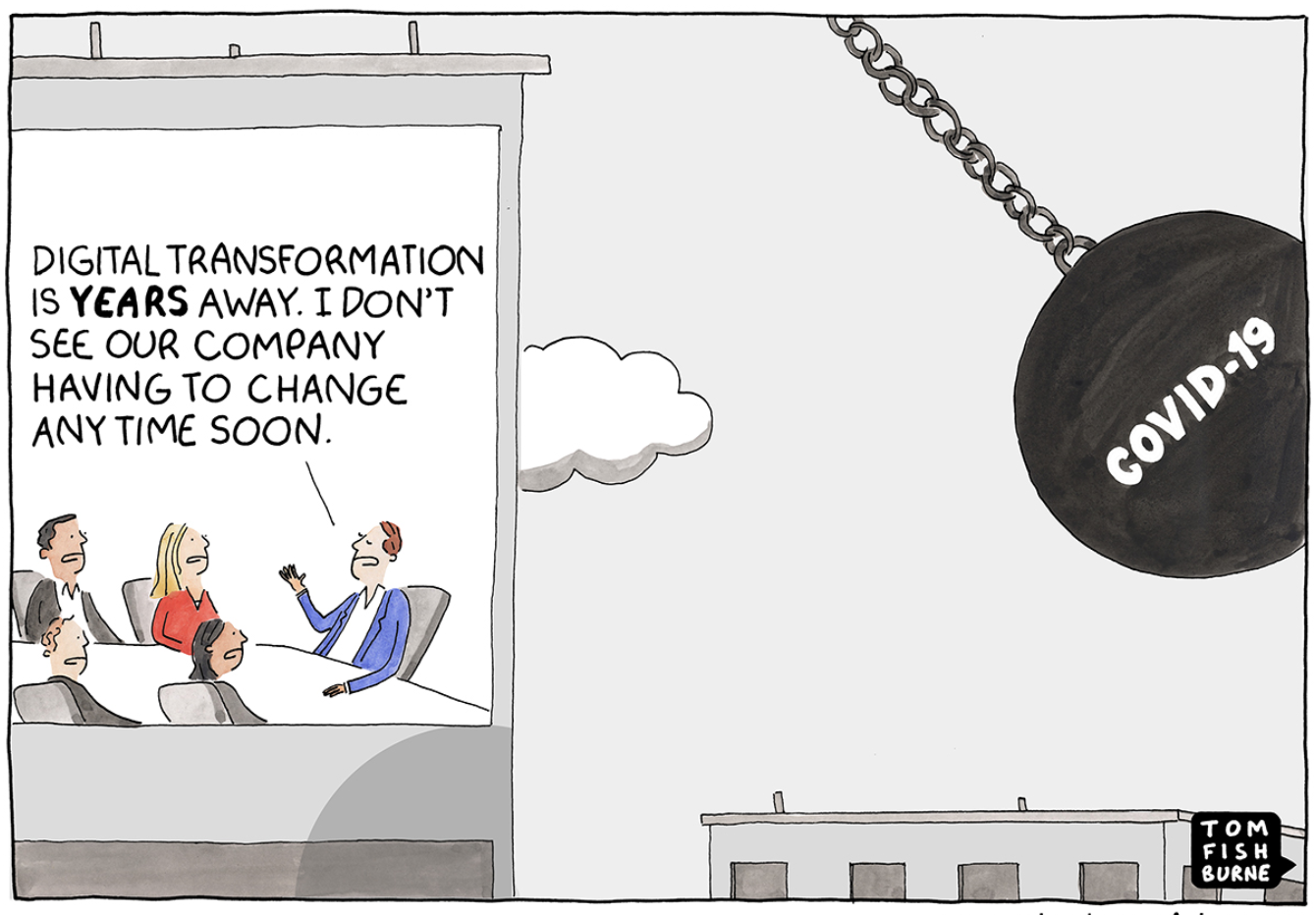
Tom Fishburne - Digital Transformation and Organizational Change | Marketoonist - April 2020
This space for reflection, taken to evolutionary levels, was a more or less urgent invitation to an exercise in transformation as something timely. And even so, there really were still entire industries that were not having this reflection, sheltered by the hope that “that change won't reach me”.
The only thing that has stayed stable before and after COVID-19 is that these seven most valuable companies on the planet are still the same ones. Does nothing change, or is it only those who change continuously that remain <
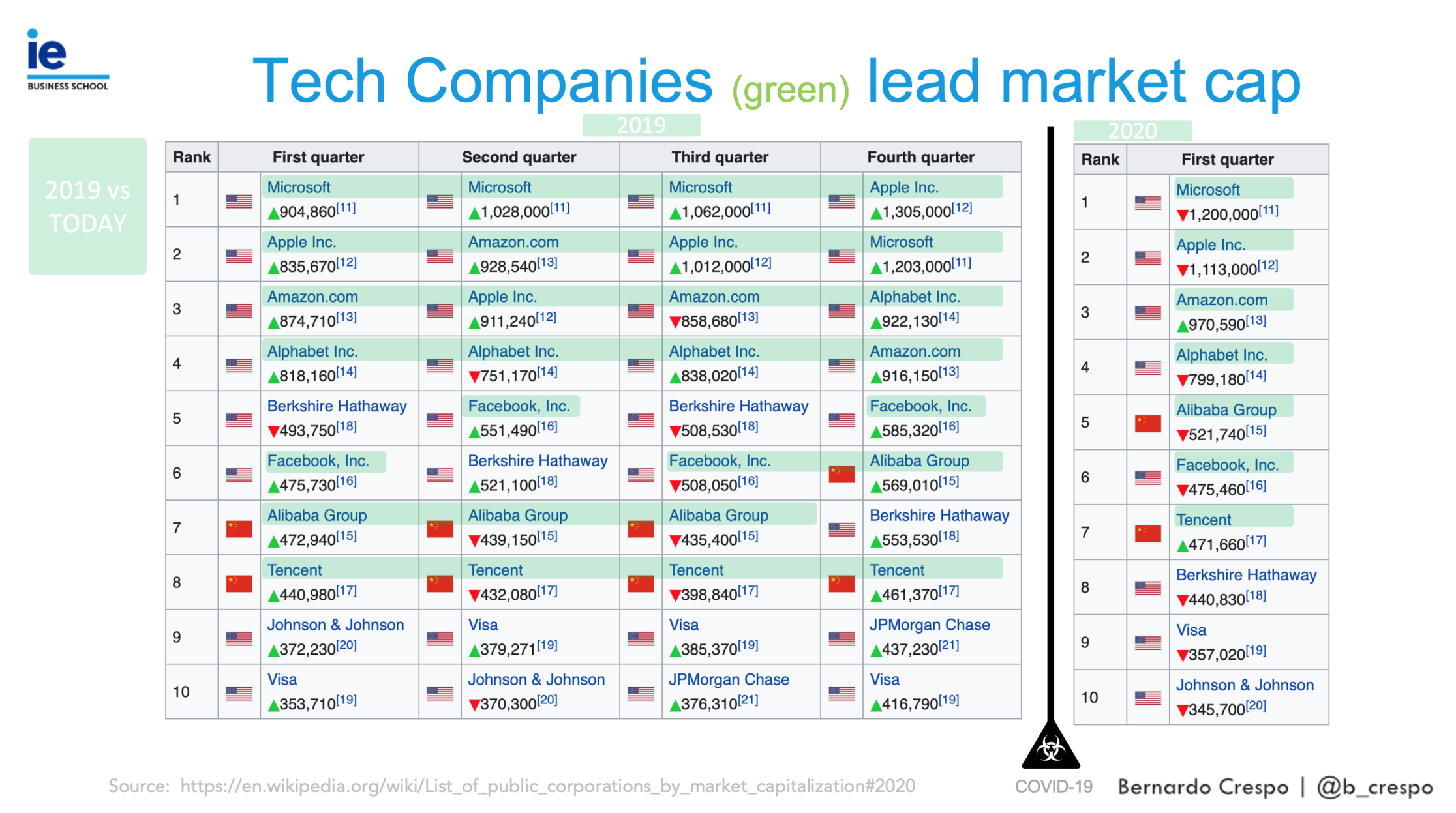
Source: Wikipedia. “List of public corporations by market capitalization”
A. REASONS TO TRANSFORM YOUR BUSINESS
- If you didn't manage to see the value of decentralizing teams and working remotely before, … This new context has imposed it on you from one day to the next. Without warning. Whether or not you had the tools, whether or not you had the skills to govern remote teams.
- If you didn't manage to see the urgency of digitalizing your distribution model before… The lockdown and distancing measures have served it up to you in a double portion. Now you could only buy and sell online (except pharmacies and supermarkets)
- If you thought that evolving your business by making use of insights from analytics was a “nice-to-have”… This new context has shown you that competing now depends on turning data into optimization (If you don't know what to measure and don't know how to collect the data, I'm afraid you have already fallen off the pace).
- If you were a technology tourist: “we've already tried blockchain and now we're going for Machine Learning” (read that quote in a solemn voice) … This new context has offered you real use cases to apply this technology and generate hard-cash business.
- If you thought that your business had always worked in this industry for more than 100 years and it wasn't worth stepping outside what you knew (“cobbler, stick to your last” —read with cynicism)… This new pandemic context has shown you that the most diversified and most digitalized businesses are the ones that have suffered least.
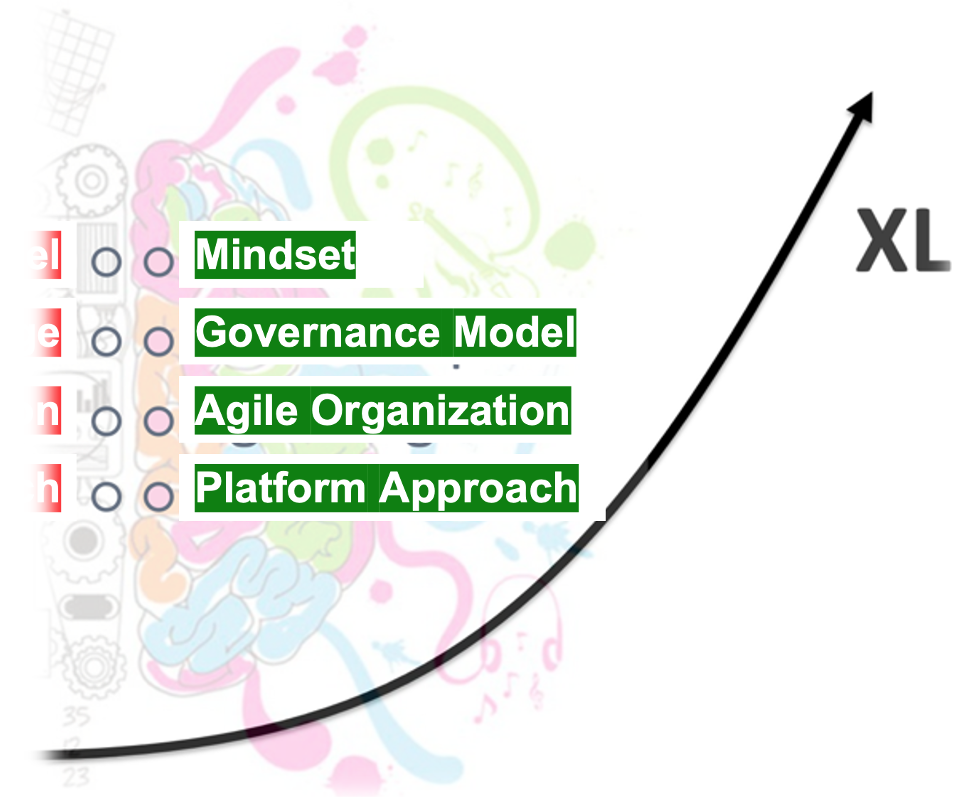
Perhaps the most complex part of transforming any company is recognizing and acting on the fact that the new strategic vision derived from a context of uncertainty entails a non-negotiable change in the teams' mindset; a radical change in the governance model, the organizational redesign of the company, and, the strategic refocusing needed to compete beyond your traditional sector or industry.
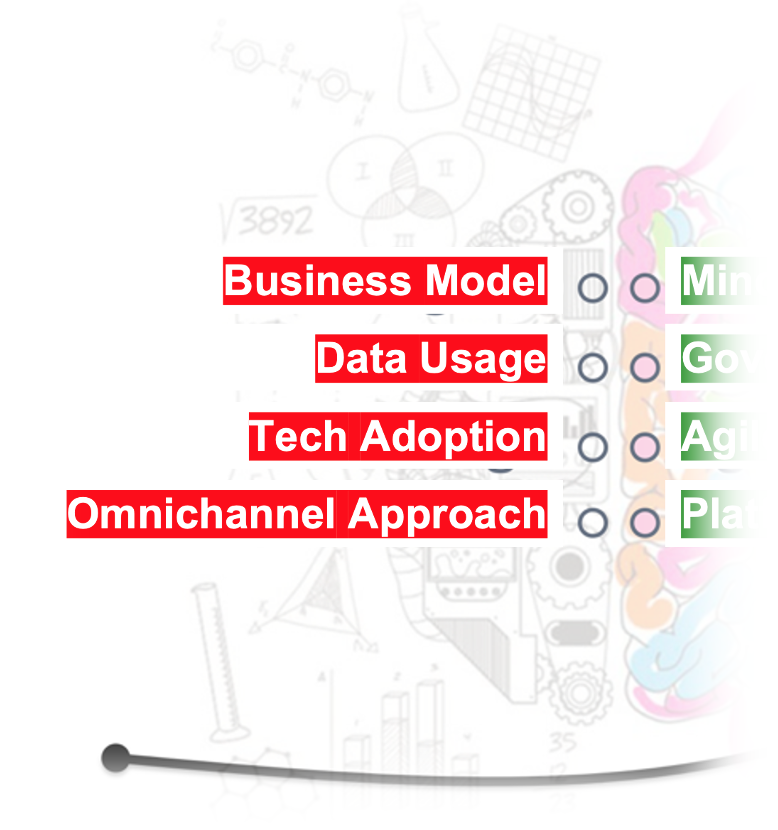
All these changes derive from the continuous review of the business model, from bringing in data and technology as enablers of that new business model, and from the non-negotiable adaptation to a new reality where users switch service providers with a single click.
That click that you — yes, you — missed on the first day a global lockdown was declared.
Is it possible to condense into a few questions how to understand the need to transform my business?. “No big reflections, just 3 or 4 questions. Something simple”. Here I go:
A. Why transform, what for (I take this as answered in the lines above)
B. Where to start
C. Who leads
D. How it is executed
"the new strategic vision derived from a context of uncertainty entails a non-negotiable change in the teams' mindset; a radical change in the governance model, the organizational redesign of the company, and, the strategic refocusing needed to compete beyond your traditional sector or industry. "
B. WHERE TO START
💡 “On creating a shared strategic intent”
Digital transformation is not a goal, it is a path. And it involves not only digitalizing the way revenue is optimized, but also generating efficiency by making use of data and technology. And most important of all, transforming a company means allowing the people who now run the company to move on to facilitating strategic change. Digital transformation is inherently a strategic change. It is time to optimize the current business model and think about how to adapt continuously to an environment of eternal change.
+ info:
- https://www.bernardocrespo.com/una-sencilla-deconstruccion-de-la-transformacion-digital/
- https://www.bernardocrespo.com/la-transformacion-digital-ha-muerto/
C. WHO LEADS
💡 “1 + 1 = 3: The team as the architect of value creation”
It is hard to accept that transforming a company is an exercise in individual leadership. And it is (and I am not referring to the figure of the CDO). Adopting agile collaborative cultures means moving away from traditional corporate cultures. It means migrating from the omnipresent figure of the CEO's leadership and its leadership team's turf wars, towards the commitment to a new, agreed and adaptive strategic intent, in which the new center of gravity of value creation passes to individuals, to working groups (cells, squads, tribes, ...) and where executives become the people who spot blockers and enable change.
+ info:
- https://www.bernardocrespo.com/liderazgo-digital-el-lider-vulnerable/
- https://www.bernardocrespo.com/intraemprendimiento-o-el-ingrediente-secreto-para-la-exponencialidad/
- https://www.bernardocrespo.com/los-retos-de-la-alta-direccion-en-la-transformacion-digital/
D. HOW IT IS EXECUTED
💡 “Agile collaborative culture vs <
Bringing an agile culture into the day-to-day management of any company means a deep review of the organizational model, the incentive systems, the collaboration dynamics projected in rituals and tools, as well as the improvement of individual productivity and the dynamics of advising on and evaluating project follow-up. Without the change of mindset at every level of the company and the review of the organizational model, bringing in agile methodologies can turn into a nightmare for any team.
+ info:
- https://www.bernardocrespo.com/como-gestionar-el-cambio-huyendo-de-los-procesos/
- https://www.bernardocrespo.com/ecosistemas-colaborativos-o-el-reto-de-la-transformacion-inteligente/
- https://www.bernardocrespo.com/el-ruido-de-la-transformacion-digital/
💡 “The strength of diversity as a catalyst for change”
Both at an individual level (lovers of control + lovers of chaos in the same person: ambidexterity), and at team level (different generations in the same role), syncretism becomes the most powerful tool for managing contexts of maximum uncertainty. The new crisis context has set off a space of total uncertainty where the best teams are those that know how to combine individual strengths with the flexibility of multidisciplinary groups as a safeguard in moments of change.
+ info:
- https://www.bernardocrespo.com/prueba-y-aprendizaje-transformacion-cultural-en-la-era-digital/
- https://www.bernardocrespo.com/31-aprendizajes-y-1-decalogo-para-cualquier-equipo/
💡 “A strategic approach from the demand side”
To keep thinking about my company's purpose as an exercise bounded by my market, my competitors and my customers is to give up the possibility of pivoting and adopting a culture of disruption as a leitmotiv. Digital transformation has been interpreted as an exercise in efficiency to survive in my sector and this context is a catalyst for that cost-saving approach. Companies that give up the noise of this limited vision allow themselves to explore possibilities beyond their industry. Perhaps growing again has more to do with the right mindset than with the intrinsic potential each company has at an infrastructure level.
+ info:
- https://www.bernardocrespo.com/despejar-el-crecimiento-de-la-ecuacion/
- https://www.bernardocrespo.com/como-medir-el-exito-de-tu-estrategia-digital/
It is possible that there are many more questions and that is good. It is the questions and not the answers that cultivate a new observer. The risk for all those who did not have the urgency or the opportunity to begin their transformation before this pandemic is that they now arrive stumbling and at risk of falling. And we really don't want any more “relapses”, we've bled enough already.
It is enough to “understand how to improve the strategic vision in a disruptive environment”. To understand transformation beyond the digital. And to do it sustainably.
#beyondDigital #DigitalSustainability
"To keep thinking about my company's purpose as an exercise bounded by my market, my competitors and my customers is to give up the possibility of pivoting and adopting a culture of disruption as a leitmotiv."
See original POST
___________________________________
The author
Bernardo Crespo
C-suite advisor in AI, data and strategy. CEO of Quantum Markethink and Academic Director at IE. He helps leadership teams make sound decisions in the age of AI.
LinkedIn