This Blessed Transformation #MustRead vol. I
I am starting this series of posts with valuable readings that have made me reflect over the past few months. And I put the readings forward with questions, otherwise they would only…
I am starting this series of posts with valuable readings that have made me reflect over the past few months. And I put the readings forward with questions, otherwise they would only be readings, what is the point of reading if it doesn't allow me to reflect?. As the Chilean biologist and philosopher Humberto Maturana says, those questions that are never answered are an evolutionary lever:
“the possibility of innovating is always there if one is willing to reflect, to let go of the certainties of where one is standing and to ask oneself whether one wants to be where one is” - Humberto Maturana
I'm afraid that in LinkedIn bios I keep running into more and more experts in Digital Transformation and in every other field of knowledge. It looks as if we were living through a never-ending fever of "showing off" (perhaps we only know where the "showing off" came from: Instagram, or maybe YouTube and the "youtuber" frenzy). I don't have a single answer to the questions I raise. And I prefer to open questions and let each person find their own answers, and let the next step in our evolution emerge from that reflection aren't questions the engine of change?
Recommended readings and questions to reflect on:
Digital C-Suite, or the digital role in executive committees: In a post from this summer on HBR, The Board Directors You Need for a Digital Transformation, they reflect on 4 types of members of an executive committee: Digital thinker (They have been a board director or adviser in a digital business but are not a digital native); Digital disruptor (The director has been deeply embedded in digital, often with experience from a pure-play company. This type of leader typically has less general management breadth); Digital leader (this person has less hands-on digital experience but has managed disruption as a general manager); Digital transformer (The director has led or participated in a transformation of a traditional business. Typically the person does not have the seniority of a digital leader but is more digitally astute.) What kind of director do Spanish companies need right now?, Large corporations, mid-sized companies and SMEs? (reference to check)
Looking inside or looking outside: On the NED (non-executive director) concept, Although you may think there is a bias in this reflection since I work in consulting, I believe that sometimes the "sweetest" way to question a business's status quo is from a position independent of the P&L. Sometimes questioning the next quarter allows us to secure the results of the coming years, Do you consider it necessary to bring non-executive digital talent onto boards? (reference to check) On the news about artificial intelligence joining executive committees**, What if we brought in a robot? (reference to check)**
On the subject of the VUCAneers and the skills the new era calls for, In a post I wrote at the end of July for the students of the second cohort of the Executive Program in Digital Transformation at IE Business School, I reflected on the chances of recovering our creative capacity. In a fit of creative drunkenness I stated the following: “Understanding the keys to governing companies' digital transformation calls for high doses of observation, for an archaeologist's method, for a mother's capacity for empathy, for a pirate's courage, and for the appetite of a she-bear waking up in spring......” Was I under the effects of some psychotropic or do these qualities make sense?; Observation, curiosity, empathy, courage and appetite, is there any other you'd add? (reference to check)
On rewriting the story of a professional life and the fear of change. One of the most inspiring readings of this summer has been a post titled "Why CEOs hate birthday cake". Thanks Craig for the recommendation. As a closing reflection it leaves us with the need to break free of what binds us in order to reinvent ourselves at one more moment of a story that is always changing: “... No surprises here, the root cause of inaction is fear. Fear of failure, fear of losing credibility, fear of losing a job, fear of...etc. The secondary cause is proximity to product. The closer you are to the product, service or process requiring transformation...the greater the fear (...) where will you leave your legacy in the continuous wheel of transformation?...” how do you think this state of mind affects all the CEOs who have lived through 10 years of crisis?, are they willing to change or do they want to leave the glass tower feet first? (reference to check)
Code as the engine of change in this new era. I have a half-finished book called The Code Economy by Philip E. Auerswald. The author defines code as the HOW of history -“It is the "how" of progress (...) It is how ideas become things”, from cooking recipes to the connector of the new economy (algorithms, APIs, html, JavaScript, JSON, R, python...), the author reflects on the role of code as history's engine of change. The capacity to include the skills that come from practising code is certainly something that has been nagging at me for some time; initiatives such as One Hour Of Code in schools are one possible route and not the only one Do you think we're going too far or do we need to bring reality closer to every decision-maker?, to touch in order to believe? (reference to check)
The new communication, or the new rules of the game in communication: In the last elections in the United States the use of bots played an important role in the distribution and reach of content on social media: "On Twitter, Trump bots are out-tweeting Clinton bots 7 to 1" Have the media changed or are we facing a space where new codes are handled?; Is content king or is the challenge really to "hack" the new medium's algorithm? (reference to check)
The post-truth era: Yes, we are in a world where a lie can be a lever for changing consciences because our time to validate the truth is limited. In this legendary post, The Guardian's editor-in-chief reflects on the limits of truth and on how technology is altering the way of narrating reality, or perhaps the truth, if a single truth were to exist at all Does anything go when we play at moving opinion or consciousness? (reference to check)
Man vs Machine: A valuable reference to bear in mind about the impact today's technology can have on the current map of occupations. Present technological capability and present stock of professions. One more piece of statistics, and we will always be left with our perception of the pessimism or optimism in managing the transition Are we ready for an environment in which half the jobs can be replaced by machines?; What would happen with half the population unemployed and a host of populist politicians lying in wait? (reference to check)
Linear logic vs quantum logic: The result of the elections in the USA, the Brexit referendum, the plebiscite in Colombia, and a long list of changes that were never anticipated. Perhaps the way we have educated our generation of hypotheses has stopped being useful in a world where the basis of decision-making no longer works through a rational lens, or perhaps the rational process no longer works in a linear way Can we go on understanding the world with the same eyes we have had until now?; Has anything changed when it comes to analysing reality? (reference to check)
On GDP in a digital economy: The weight of digital companies and of the exchanges that create an economy's macro variables has more and more impact on a system of national accounts or of indicator-building based on the old economy, is it possible to calculate inflation, the balance of payments or private consumption without taking new forms of exchange into account?; Do we know how to measure the effect of the digital economy? (reference to check)
I don't want to leave this series of recommended readings without a final reflection:
Perhaps this moment of change is the moment we are living now and perhaps there were always moments of change and this one is simply ours. The best way to live through an era of changes may be to change our observer so as not to fall into the anxiety of uncertainty. Perhaps our mistake is only to look at the present trying to guess the future, instead of living and doing NOW. And letting historians analyse this moment fifty years later. Damn our arrogance!
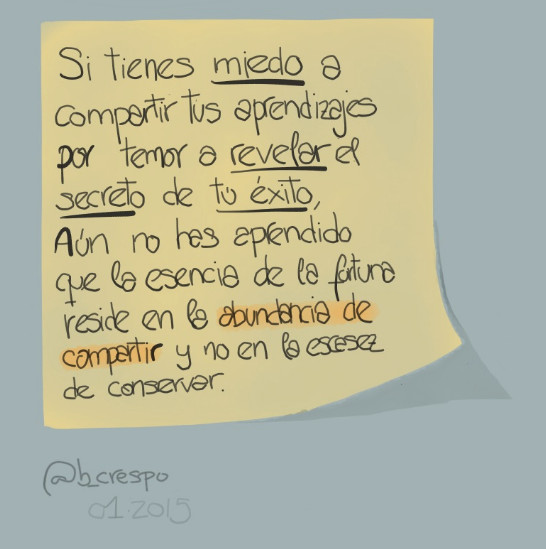
"If you are afraid to share your learnings, for fear of revealing the secret of your success. You still haven't learned that the essence of fortune lies in the abundance of sharing and not in the scarcity of keeping."
My gratitude:
[Thanks to Eduardo Lazcano, Txema Valenzuela and to Eduardo Beotas for forcing me to reflect and to look for more questions out of these readings. You are brilliant people]
[Thanks to Alberto Terol for pushing me to do this exercise of sharing. Perhaps the basis of evolution is not only questions, but also the unequivocal will to share]
The author
Bernardo Crespo
C-suite advisor in AI, data and strategy. CEO of Quantum Markethink and Academic Director at IE. He helps leadership teams make sound decisions in the age of AI.
LinkedIn