Digital Transformation or Strategic Maturity?
The digital maturity of companies is an indisputable catalyst for results, whether through business improvement or process optimization.
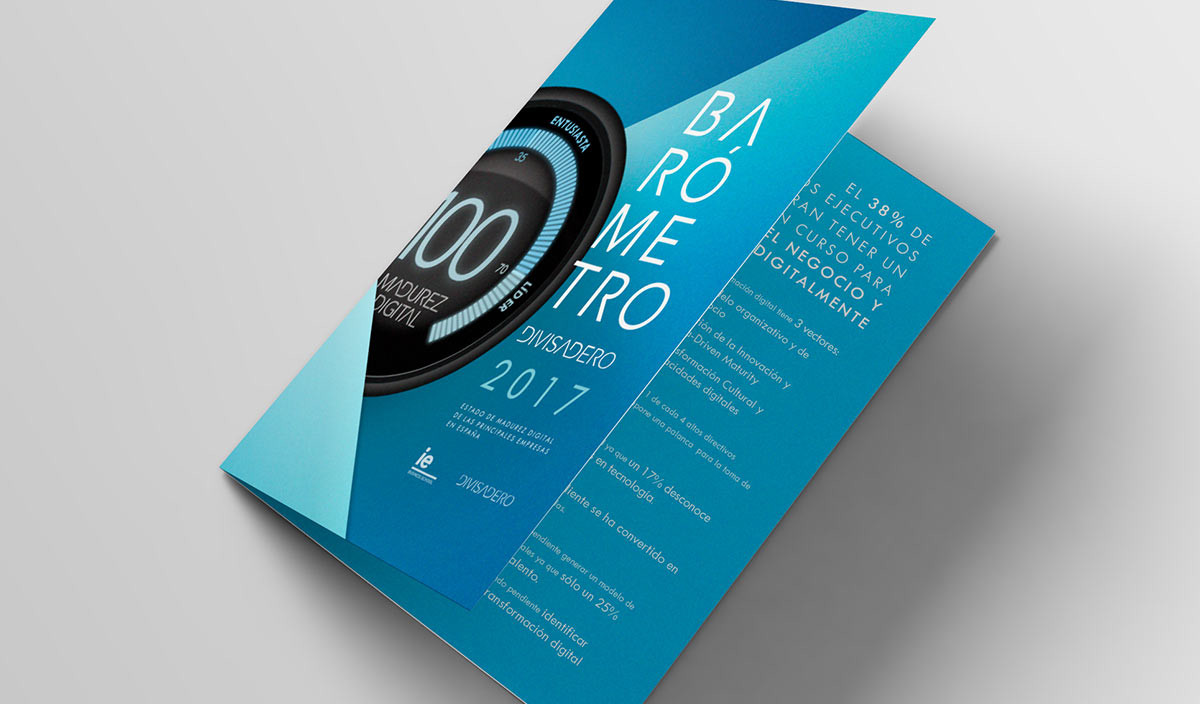
The digital maturity of companies is an indisputable catalyst for results, whether through business improvement or process optimization. DIVISADERO, in collaboration with IE Business School, has recently published the 2017 Barometer on the state of digital maturity of Spanish companies.
[The contents of this article are part of a Q&A previously shared in the post http://blogginzenith.zenithmedia.es/cual-es-la-madurez-digital-de-las-empresas-espanolas/\]
Digital transformation is a fact at both public and private level in most verticals in Spain.
How would you define the degree of digital maturity of Spanish companies?
If this were a quick interview I would tell you 54 out of 100. And that is the figure the study yields. That said, the answer changes a lot depending on where you look.
Let's say that how dependent the business model is on the end customer (retail focus) and the pressure of lightweight business models (fintech, insurtech, traveltech, healthtech, Edtech, etc.) determine the urgency of the digital transformation process.
Digital transformation is a fact at public level as well as at private level in most verticals in Spain. And from experience I can confirm that even those companies under less pressure to transform have already taken the decision to create a roadmap.
The figure of 74% of Spanish companies with a digital transformation process underway, and the fact that the same percentage of companies already has senior digital roles at the top level, confirms it. The creation of a Spanish State Secretariat (for the digital agenda) is hard evidence confirming this sensitivity in the public sphere too.
The responses of more than 175 executives from large companies operating in Spain have allowed us to produce this study, which ranks the degree of maturity of the main verticals of the Spanish economy. This initiative by DIVISADERO in collaboration with IE Business School has allowed us to validate the degree of urgency in the digital transformation process of most of the large corporations in this country.
"... most of the verticals that are more focused on end-customer services, and whose purchase experience at a physical point of sale built less of a relationship, are touched by the urgency of digital transformation."
Which sectors are leading it?
Financial Services and Telco. Unquestionably. Also Travel.
Although Financial Services, Telcos and Travel are leading the way in digital maturity, it is a fact that the digital maturity of a vertical increases the pressure on its players and generates levels of dispersion in terms of digital adoption. In other words, a sector being in the "Digital Leader" state does not guarantee the maturity of all its players, but it does guarantee the sense of urgency.
In fact, most of the verticals that are more focused on end-customer services, and whose purchase experience at a physical point of sale built less of a relationship, are touched by the urgency of digital transformation.
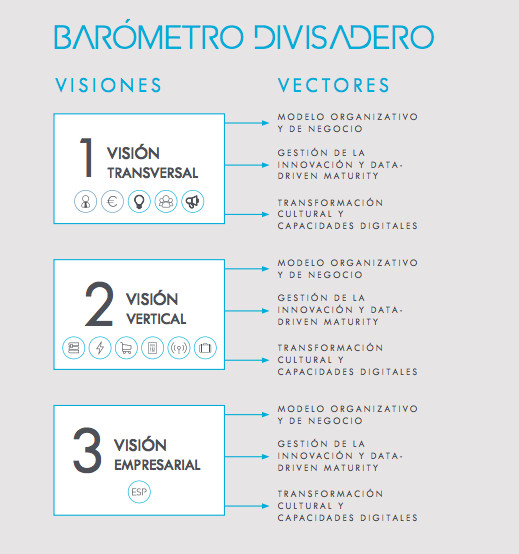
We have broken down all the verticals into 4 categories or segments of digital transformation adoption. The urgency when it comes to tackling changes in the organizational and business model; the management of innovation and how well they exploit data in their digital strategy; as well as the progress in cultural transformation and the incorporation of new competencies, have allowed us to distinguish between Amateurs, Explorers, Enthusiasts and Leaders.
What are the main problems they face in going through that transformation?
We have carried out this study taking into account 3 vectors as key areas to study in order to assess the evolution of digital transformation:
- Organizational and business model
- Innovation Management and Data-Driven Maturity
- Cultural Transformation and digital capabilities
The performance analysis under the three vectors above allows us to draw some of the following conclusions:
- Spanish executives consider that there are three key areas in the Digital Transformation process: Technology, Sales and Customer Experience. Technology would lead the way on digitalization, rated at 62% and, at the bottom as a key area, Human Resources, with a low 27% as a priority area in the digitalization process.
- As regards the areas involved in the digital transformation process, there is a majority feeling when it comes to stating that the digitalization of the business originates mostly in the Marketing and Sales departments. Other internal players that stand out in the business innovation process are: the Strategy department, the Technology department and/or the Innovation department, independently.
- As for the leadership of digital change, 60% of Spanish companies state that it is the CEO who should lead digital transformation. Against the 18.67% who believe it should be the figure of the Chief Digital Officer. That this message is not the majority one when it comes to sharing who should lead digitalization shows a certain accumulated fatigue around the figure of the CEOs of this country. Perhaps a decade of crisis management in Spain is a heavy enough backpack to invite reflection on a possible generational change at the top level.
- On the other hand, the four qualities a leader should have in this new digital environment are: vision, technological and digital knowledge, adaptability to change and, finally, the capacity to innovate.
Perhaps a decade of crisis management in Spain is a heavy enough backpack to invite reflection on a possible generational change at the top level.
What will be the digital challenges companies will have to face in the coming years?
Our final recommendations to drive the digital maturity and digitalization of companies ahead of the next 2018 barometer are:
- Make progress in awareness of each and every one of the vectors involved (Organizational and business model; Innovation Management and Data-Driven Maturity; as well as Cultural Transformation and digital capabilities).
- Definitively accept that the new competitive environment now goes by the surname digital, that innovation and digital competencies are a necessary condition, and that the criticality of culture and organizational transformation are the differentiating aspects.
- Generate a shared awareness between the public and private impetus as regards the role of digital transformation. This is a particularly interesting challenge at regulator level from the point of view of maintaining the competitiveness of each economy.
- The end customer or user is the one generating inflationary pressure for organizations to take on or face the challenge of digital transformation. The verticals less oriented towards B2C business have the opportunity to learn from the more digitalized sectors and to lead without having to react, unlike those sectors that went before them.
Approaching this digital evolution with a sense of urgency and with fear brings with it the implicit risk of interpreting digital as a source of efficiency generation for corporations
Perhaps considering digital transformation as an opportunity is the hardest challenge and the one that will make the difference between one competitor and another. Approaching this digital evolution with a sense of urgency and with fear brings with it the implicit risk of interpreting digital as a source of efficiency generation for corporations. And that, in the short term, entails risks for an entire economy.
[The contents of this article are part of a Q&A previously shared in the post http://blogginzenith.zenithmedia.es/cual-es-la-madurez-digital-de-las-empresas-espanolas/\]
The author
Bernardo Crespo
C-suite advisor in AI, data and strategy. CEO of Quantum Markethink and Academic Director at IE. He helps leadership teams make sound decisions in the age of AI.
LinkedIn