Is Digital Transformation a Public or a Private Challenge?
What if most economies at public level did not know how to measure the impact of digital transformation? What are the challenges of the public sphere and which ones remain in the private sphere?
What if most economies at public level did not know how to measure the impact of digital transformation? What are the challenges of the public sphere and which ones remain in the sphere of private transformation? Can we find "best practices" or benchmarks to follow in Spain?
CONTEXT AND ENVIRONMENT
Digital transformation is an exercise that goes beyond the strategy of corporations. As things stand today in Spain, the push for digital transformation, for digitalisation, seems to be turning towards the private sector. And the focus is on generating the competitive ground large corporations have lost to entrepreneurial initiatives -for example, fintech, healthtech, motortech, insurtech models, etc.. It is the large corporations that react to a reality imposed by the consumer, by the user. The degree of adoption of new technologies and the almost total penetration of smartphones (which already exceeds 90% in Spain according to Kantar Media data from April 2016) justify this statement. The Internet is already ubiquitous in Spain. And users have less and less resistance to changing service provider.
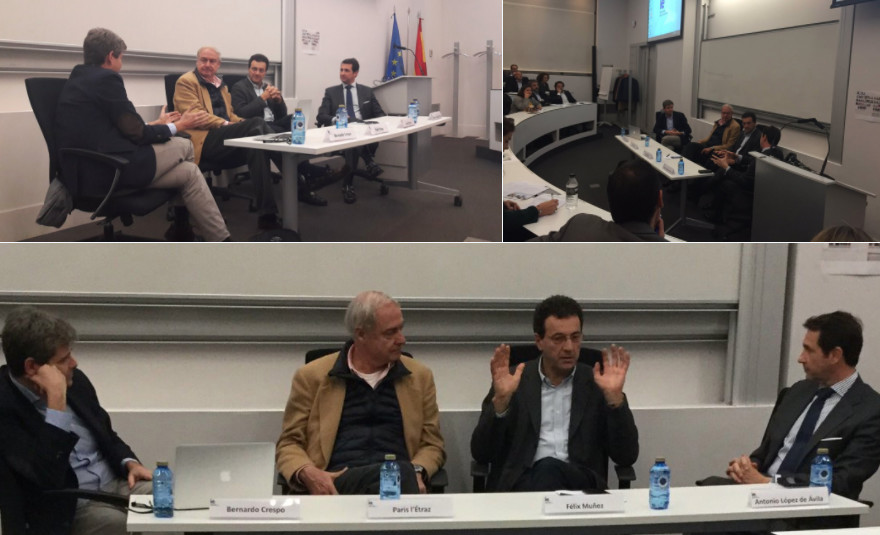
At a round table with Antonio López de Ávila, Félix Muñoz and Paris de L'Etraz I had the chance to debate digital transformation: a public and private challenge. It was a pleasure and a source of learning. This post is nothing more than my personal reflections and notes. And a token of gratitude for the valuable conversation.
Faced with the challenge of competing in an economy where lightweight digital models proliferate and attack only a tiny part of the profit injectors of large corporations, a line of debate or reflection opens up related to the public role when it comes to gauging the impact of new business models on job creation / destruction (large-corporation lens or entrepreneurship lens).
Another of the reflections that make us question the current model, as a stable model, is the emergence of global digital businesses that have an impact both on local economies and on the measurement of traditional economic variables at the level of macroeconomic policy.
In this sense, there are two pieces of evidence I would like to bring up to support this view. The first has to do with Ireland's economic growth in 2015 and the repercussions for the Irish economy of having been a magnet for technology companies within its territory. The Irish Times article from June this year makes a very valuable reflection on what Paul Krugman has come to call “leprechaun economics”. Why does economic growth have to be harmful when it alters historical series?
The second piece of evidence that supports the view on the _s_tability of the current economic model given the impact of digital has more to do with current public capabilities to measure the impact of digital transformation in the national accounts. HSBC published a study questioning whether some national economies were correctly measuring the impact of the new digital economy (this Business Insider post interviews the author of the study). To summarise this post, the appearance of new ways of generating consumption -citing the example of Spotify- may not be being measured at macro level as far as their impact on variables such as GDP, inflation, interest rates, labour productivity, etc. is concerned. In this environment it is perfectly possible that holding interest rates down is a mistaken interpretation in the face of an underestimation of the effect of the digital economy on prices (apparent deflation) and on productivity (the fallacy of not knowing how to measure the new productivity of the new economy), Are we ready to make decisions about macro variables that cannot be measured in the same way in the new digital economy?
MORE QUESTIONS THAN ANSWERS
Some questions arise that could well be addressed in a round table like the one we had at IE, or that might form part of an ongoing reflection: “The challenge of digital transformation in Spain: A private and public view”. Here they are:
- Can it be harmful for an economy to have its growth rates altered by the impact of digital business?
- Are we in Spain able to measure the impact of the new digital consumption based on a subscription model?
- Can the impact of digital entrepreneurship really offset the expected job destruction arising from digital transformation in large corporations (e.g. Banking)
- Are we generating enough entrepreneurial initiatives to attract talent?
A few brilliant reflections came out of the round table that are worth revisiting:
Félix Muñoz moderated and created a fluid conversational environment in which the audience ended up becoming part of the round table.
Antonio López de Ávila -president of SEGITTUR- recalled that the economic activity of tourism, which spans several sectors or verticals and is strategic for our country, can be accelerated through the use of data. This initiative has been public in Spain and, among other lines of work, it has produced a Tourism Intelligence system that makes it possible to turn data into knowledge (improving destination management and user experience).
Antonio recalled that the creation of new jobs in the sectors driven by tourism was a reality at European level. And that the economic activity of tourism related to taking advantage of the digital lever is a reality in Europe and the Spanish model was being taken as a benchmark (smart destinations, big data and consumer behaviour initiatives, Emprendetur: €81 million in digital entrepreneurship and tourism over the last 5 years, etc...)
Paris de L'Etraz made a valuable point about this lower resistance to change among users today. In his judgement, a leading indicator of disruption in a sector or an industry was related to the degree of relationship between service provider and user. If your service providers (financial, telecommunications, energy, ...) have NEVER had a relationship with you, that sector is destined to become the territory of "digital disruptors".
Paris went on, stating that we possibly have in this country an environment of support for entrepreneurial initiatives that has never existed in the past. As director of IE's Venture Lab, he said that today it is possibly easier to find help for a good idea in Madrid than in San Francisco. He recalled that according to the Financial Times, IE has the top European MBA for entrepreneurs and eighth worldwide.
As regards the keys to digital transformation, I personally wanted to reflect on a simple model in which PEOPLE, DATA and TECHNOLOGY are decisive vectors of the digital transformation process. Technology and data are enablers, and people are the ultimate source of differentiation.
Technology makes it possible to measure, activate and create value from data. And everything is measurable, we live surrounded by "touchpoints", whether digital or not. The challenge is for people to create value from the use of technology and data while respecting that very fine balance between value and privacy. Perhaps excessive regulation of data may guarantee privacy and slow growth.
Speaking of transformation priorities in B2C or B2B businesses, Félix Muñoz recalled an anecdote from his time as marketing director at an energy company regarding the asphalt business: is it worth running a campaign to promote the sale of a product like asphalt? Ultimately it is people who make decisions. The concept of the person in the field of digital transformation is always an indisputable lever.
As I said before, it is easier to draw out questions than answers. And some conclusions arise by way of reflection in the context of the Spanish economy. It is possible that we need to help the regulator bring out learnings from the private sector in order to create an environment of trust and growth. So that regulating does not hinder growth in an economy that competes beyond our borders. We may need to make a focused effort to observe how certain macro variables that have been affected in new ways by digital consumption based on new subscription models are evolving.
All of the above shifts the focus towards deeper reflections, and where the private and public spheres have no choice but to understand one another:
The public role in digital transformation:
- What should be the role of the public body/entity (Secretary of State, Programme of Experts, etc.) that regulates, promotes and incentivises Digital Transformation in Spain?
- What is the objective of promoting Digital Transformation from a public entity? What effects will it bring to the Economy?
- How will the promotion of Digital Transformation from the Public sphere affect the Spanish Economy? Why or why not?
- Are politicians (our public representatives) aware of the need to invest in Digital Transformation? Do they realise how important digital strategy is for the Spanish Economy?
- Will we have a line item in the General State Budget that puts Digital Transformation in the front line of priorities in the search for growth?
- Are our representatives equipped to face and understand what Digital Transformation is (public and private spheres), and to take on this challenge as their own?
- Regulation and Taxation: Rules for tackling Digital Transformation in Spain
The private role in the public initiative:
- Who should be part of the council of experts on Digital Transformation promoted by a State body?
- Is there room for the CEOs, CDOs of the most important companies in Spain?,
- Is there also room for young entrepreneurial leaders in this reflection?
We are in a constant change of model and the ways of doing things are a product of what we now observe. Managing digital transformation with an individual, survival-driven view on the part of corporations can carry risks.
The gap between the evolution of technology and the regulator getting up to speed is creating transition spaces that may require more than one reflection like this one. And it will not be the first. And I hope it will not be the last.
[Extract / Reflection from my personal notes based on the round table I shared with Antonio López de Ávila, Félix Muñoz and Paris de L'Etraz on November 28, 2016 | Digital Transformation: Public or Private Challenge. For those who want to visually recall the event through the various tweets, I recommend looking at STORIFY (Round table: The challenge of digital transformation in Spain: private and public view)].
The author
Bernardo Crespo
C-suite advisor in AI, data and strategy. CEO of Quantum Markethink and Academic Director at IE. He helps leadership teams make sound decisions in the age of AI.
LinkedIn