Personal Transformation and Digital Transformation
And sometimes it doesn't make much sense to stay still. You're expecting a child, you want to start a business, you decide to learn something new, you change jobs, you start playing an instrument, you break up with your partner, ... And it all happens within the same stretch of time.
A teacher once told me that the crisis of the forties isn't really a crisis at all. Instead of at forty, it happens at forty-two (a multiple of 7). There's a fair amount of library-shelf material written about the magical multiplicity of the number seven in the stages of a life -The Stages of Life by Rudolph Steiner. Maybe the fact that forty-two is the prelude to seven times seven hides the reason why laypeople and experts alike don't hesitate to talk about the "crisis of the forties".
With 42 springs in sight, I left a position of responsibility at a corporation where I'd worked for more than fifteen years, decided to join a boutique digital strategy consultancy, started running an executive program at one of the most prestigious business schools, my wife stopped working and is training to become a yoga teacher, we decided to change my son's school, and I just celebrated 25 years since I left the school where I was educated. Many changes for the same year of life. And all of it naturally. If someone had asked me to sign a statement that I was capable of doing all that between two of my birthdays, I wouldn't have believed it.
It may have happened to you at 42 or at 49, and maybe you needed another seven-year life cycle to take the leap and start over. And it always makes sense that all of this happens. And once you've done it, you have the intuition that it was meant to happen that way. And there's no laziness in it. And it always turns into a success. As long as you don't frame your change as fleeing from what came before, but rather as the start of a new path.
That capacity to create without limits was possibly an inherent part of our nature, and we forgot it. Maybe we need to take up that creative practice again. The philosopher and thinker José Antonio Marina says that education needs a re-focus to teach people to keep learning. And perhaps in an environment as changing as today's -and yes, I'm talking about digital transformation- the best way to put an end to doom-laden views on the chances of building a stable working future is to learn to keep learning. Renew or die? I'd rather talk about "learning to live", as the philosopher put it.
"The function of education is not to transmit knowledge, but to teach how to live." -J.A. Marina
We're in an environment where artificial intelligence, algorithms, robotics and what we call "Internet of everything" (The Third Wave by Steve Case) are advancing to change the rules of the game in a short span of time. Maybe personal transformation and digital transformation are the same concept, and it's all a matter of organic search-engine positioning (leaning toward the second one). I hold the firm conviction that uncertainty was always present and now it's simply unavoidable. I've heard, and I've written, about a paradigm shift, an age of changes or a change of age. A couple of years ago everything changed, and now we all understand that digital is responsible for everything. To my mind it's no more than a trigger. Years from now, we'll look back on it with less awe than we do now. I've always liked to say that digital will have fulfilled its mission when it becomes a biodegradable concept and helps define strategy without tagging along as a surname (Digital strategy, Digital marketing, Digital transformation).
And once we're immersed in this business of personal transformation, who leads this whole circus if we're all immersed in transforming ourselves? A year ago I reflected on the role of the digital leader, and there's something from that time I want to bring back: enabling the team's talent; being human and approachable; being generous; knowing how to persevere and course-correct; using intuition and cultivating curiosity, and always keeping an ear open to listen.
My friend and coach Craig Miller likes to bring up this quote from Eric Hoffer: “In times of change, learners inherit the earth, while the learned find themselves beautifully equipped to deal with a world that no longer exists.” I believe the capacity to learn is the lever for living through a stage of change. And once again we connect with the concept of learning. I myself have spent the last two years gathering weekly learnings, and I believe this has no end:
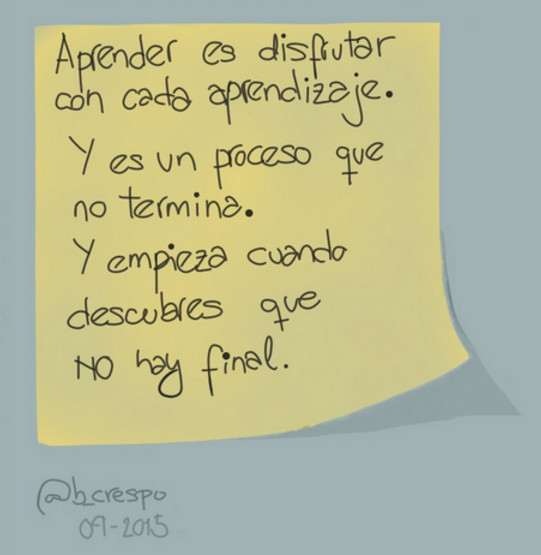
I want to sum up the exercise of personal transformation in 4 steps, or 4 parts of a single sequence. It makes no sense to skip any of the steps; everything makes sense when the 4 parts of the sequence are set in motion simultaneously:
1. Your interpretation of reality depends on your perception: "Feel with your mind".
If you believe it's impossible, it will never be possible. If you believe it's possible, all that's left is to persevere. When KODAK decided to reinvent itself, it ended up becoming a story of digital transformation failure that culminated in its own bankruptcy in 2012. Possibly none of those failures would have happened if its perception of reality hadn't been limited to reading trends only in terms of short-term profitability. Having been one of the giants of photography, it saw its reinvention in the new digital era as taking advantage of digital printing as the next step. It's easy to read the past once you already know how the story ends. And it's possible that digital transformation requires a certain level of detachment from the current P&L. And that's close to impossible when you have to answer to analysts and investors every quarter.
If you're the type who needs to financially rationalize every decision, maybe there's no room for your transformation, and even less for those who follow you.
2. Think beyond your beliefs about what's possible: "Think with your heart".
None of us would have thought that S. Kubrick's film 2001: A Space Odyssey would end up becoming a reality within the span of a generation (Digital Conversation is The New Black). Henry Ford's line about what he would have created if he'd asked the consumers of his time is well known ["If I had asked people what they wanted, they would have said faster horses."]. It's possible that the exercise of personal transformation calls for new keys. Developing spaces for creativity that go beyond the limits of what's understood as possible now. And that doesn't take genius, it takes a drop of eccentricity, perseverance and a lot of focus.
There's a method for arriving at new concepts. And that method requires flexibility and creativity.
3. Put the focus on what you know how to do and on what you enjoy doing: "Focus on what you care."
Every time we hear a success story about some twenty-something who's built a unicorn startup, our mind drifts to the ideas we've had ourselves. There's no need to feel guilty. There's still time. And that time has good odds of success if we devote our efforts to what makes us unique and what we enjoy. And curiously, it's usually the same thing. I love Eddie Cantor's quote "it takes 20 years to become an overnight success". Every successful person I've had time to talk with agrees with Thomas Edison's maxim that success is 1% inspiration and 99% perspiration ["Genius is one percent inspiration, ninety nine percent perspiration"- Thomas Edison]. And who said effort couldn't go hand in hand with fun?
If you haven't yet had time to think about what really makes you unique, what makes you lose track of time, it's hard to find the keys to what really matters to you. And after that, it's time to persevere. And it can be fun.
4. Don't try to look for a model that can predict a disruptive change: "Let things flow as they are".
"Damn reality that won't fit my model", or in other words, after all the money we've invested in adapting to this model, now reality goes and turns stubborn on us?. We can't change the present, but we can accept it. We can go through exercises of strategic definition, and it's the attitude of adaptation that makes the difference. Maybe the best way to apply Adaptive Strategy to ourselves is to internalize the concept of detachment. I'm not talking about resignation, I'm talking about saving energy to keep our focus.
We've confused concepts like resilience or perseverance with stubbornness and pig-headedness. If what made you succeed no longer works; Move on, ... You are not your job, nor your ideas, nor your choices. All of that is incidental to your life. You're the one who chooses. Think about everything around you and translate it into other people's anecdotes. Does it make sense to interpret every move?
And now take each of these points and condense them into a mantra. Maybe it makes sense to hold onto this as a learning until it's integrated?
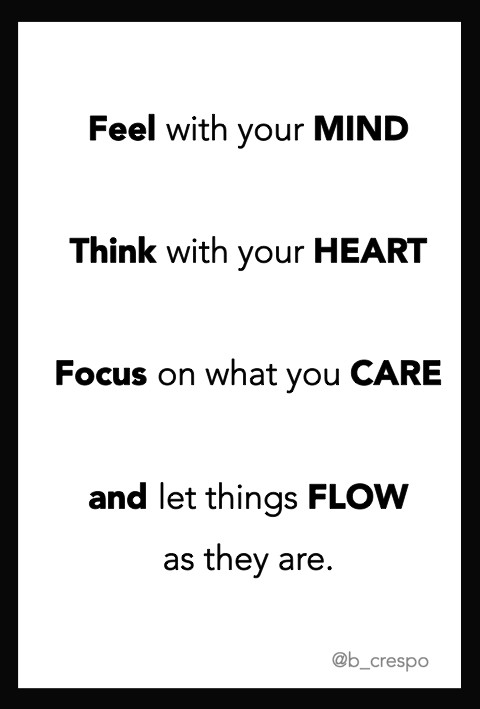
[Dedicated to the participants of the first edition of the Programa de Dirección en Transformación Digital de IE Business School (IE Business School's Digital Transformation Management Program) - Transforming Business Leaders]
This post was originally published on Bernardo Crespo Blog: https://www.bernardocrespo.com/transformacion-personal-y-transformacion-digital/
The author
Bernardo Crespo
C-suite advisor in AI, data and strategy. CEO of Quantum Markethink and Academic Director at IE. He helps leadership teams make sound decisions in the age of AI.
LinkedIn