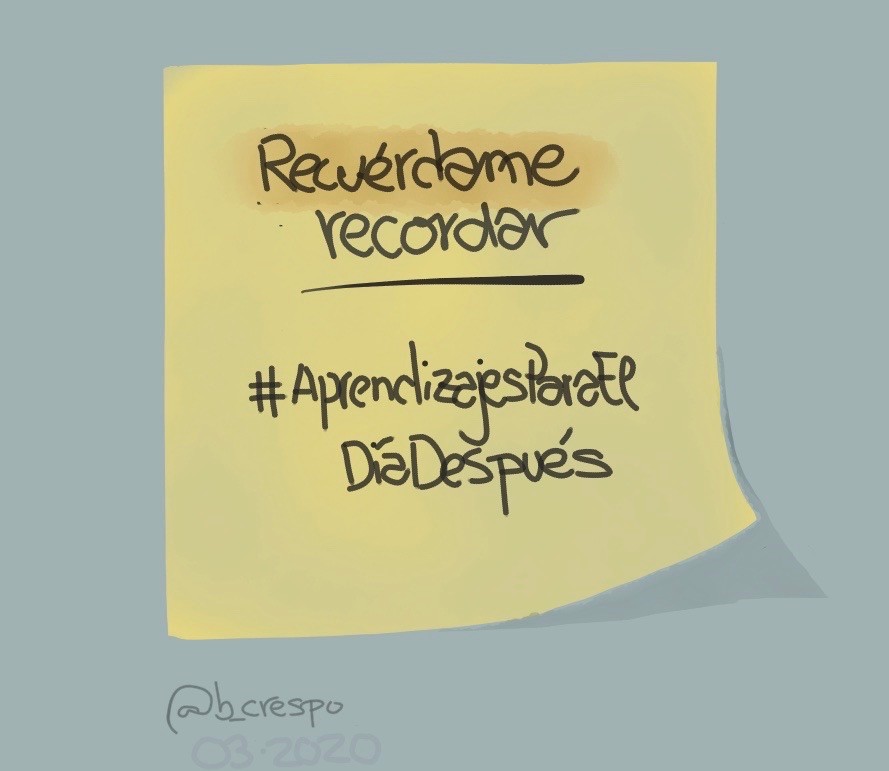
Remind Me to Remember
There will be a day after this lockdown. And perhaps it's worth remembering learnings for when the rush returns, the quick breakfast before…
There will be a day after this lockdown. And perhaps it's worth remembering learnings for when the rush returns, the quick breakfast before heading out comes back, the traffic jams return, calendars fill up with unnecessary meetings, and the short-sightedness of daily life will make us forget this space of valuable learnings. When daily life eats you up again, give yourself time to remember what you've lived through.
[This POST was previously published on Bernardo Crespo's blog under the title "Recuérdame recordar #AprendizajesParaElDíaDespués"]
A friend of mine said around these days that when you lose a loved one, you reconcile with your nature, and that's when you feel a flash of clarity about what really matters in life. This lockdown is a planetary flash of clarity. I hope we don't lose that clarity the day after.
“This lockdown is a planetary flash of clarity. I hope we don't lose that clarity the day after.”
#AprendizajesParaElDíaDespués
Learnings for the day after, or a collection of reminders so that once normality is restored, daily life doesn't eat us up again:
#1 – Remember that commuting time and your vehicle's pollution are an optional decision. Remember that during those days we lived through, the planet's pollution dropped by more than 20% [1]. Is it worth polluting to go to your workplace today?
#2 – Remember that you can give thanks every day for all the gestures you value and that build unity. You did it every day at 8:00pm when you were afraid of dying. Are you sure you have nothing to be thankful for, nothing worth a round of applause at the end of today? #AplausoSolidario #AplausoSolidario – Twitter Search
#3 – Remember that during the lockdown, we would have gone crazy without WhatsApp, and we also went crazy over the use that the more than two billion users of WhatsApp [2] and of the various messaging apps decided to make of it. Let's remember that the conscious use we give to technology is what grants it either usefulness or perversion. The conversation about data ownership is a different conversation.
“Let's remember that the conscious use we give to technology is what grants it either usefulness or perversion.”
#4 – Remember how many initiatives you took part in to report your health status, get tested, or provide sensitive information in order to help improve the crisis situation caused by the coronavirus. And remember how little your privacy worried you at that moment. Using data isn't bad per se; the problem lies in the purpose behind the use of that data. And Yuval Noah Harari already gives us goosebumps over dystopian purposes in this article [3]. Remember this reflection the next time you fill out a survey about the importance of privacy and consent in the use of your data. Health or Privacy? The debate is on. Remember this distinction after the crisis.
#5 – Remember that it was technology that helped you manage remote work and manage the routine of the lockdown. Remember that thanks to free video conferencing platforms we were able to see and talk to our loved ones. Remember the generosity of those companies that made this difficult period easier. And remember, before setting up your next meeting, to ask your guests whether it's worth holding it in person or not (reminder #1).
#6 – Remember that it was the lockdown that put the challenge of looking after your diet and exercising squarely in front of you. If back then you had time to take care of your Self, why don't you have time now to take care of yourself? Perhaps human beings only take charge of their health when they feel the risk of death closest. Remember that we are all contingent, as the line goes in “Amanece que no es poco”, by the late José Luis Cuerda [4]. And not just diet and physical exercise — remember that humor is also part of the task of taking care of yourself.
#7 – Remember that even though it was hard to work from home with your kids, you never had more time to closely follow their progress, their doubts, and your/their blocks when it came to studying. And remember that they lived through this crisis with you, trusting that you were the adult. And that we all had time to lose our temper and time to recover our calm. And remember that we all lived through that crisis together. Remember to go back to learning with them. Every day.
#8 – Remember that caution stopped Barcelona's 2020 Mobile World Congress from being held on February 13 (with 3 cases in Italy and 2 in Spain, and 63,851 cases and 1,380 deaths in China) [5], an event that had been planned for February 24 to 27 with a strong presence of tech companies from the millennia-old country. Remember that caution declared the isolation measures in Wuhan (the pandemic's geographic focus) as of January 23, when China already had 830 detected cases and 25 deaths (CGTN on Twitter: “One day in #Wuhan through a photographer's lens… “ ).
And remember that recklessness allowed the International Women's Day rallies on March 8, a VOX rally, and Spanish La Liga matches to be held up to the weekend of Sunday, March 8 (with 625 cases and 17 deaths in Spain, 7,375 cases and 366 deaths in Italy; 19,016 active cases, 80,735 cumulative cases, and 3,119 deaths in China) [5].
#9 – Remember that the mobility of citizens in a global reality makes every country an equal stakeholder in global security against pandemic risk. And that advances in early detection no longer depend solely on your country's healthcare system. Remember that we were never all so connected, with its advantages and its downsides. And remember that perhaps the enormous arrogance of borders doesn't solve health crises when the problem causing them looks as tiny as a microbe. Even though some states decide to resort to extreme surveillance to keep closing their borders. Remember that trust is the last ingredient in the equation. (reminder #4)
The author
Bernardo Crespo
C-suite advisor in AI, data and strategy. CEO of Quantum Markethink and Academic Director at IE. He helps leadership teams make sound decisions in the age of AI.
LinkedIn