SFD: How to prioritise your digital strategy.
"Give me a purpose, passion and perseverance, and I will make any dream come true".
For some time now I have been working on the exercise of creating a desirable future situation at a personal level. An exercise we should all do in life, and one that consists of defining a situation that acts as north on your life's compass. After that, the work to be done is writing the roadmap up to that attainable and desirable state. My personal experience tells me that setting out your wishes is one thing and charting the path to reach them quite another. There is no sense in thinking about the path while you are still wishing, or, put another way, you will limit your capacity to wish. For any organisation, the exercise should be the same. Whether you are an SME, an organisation or a team, there is no way of getting to any result if you are not clear about that desirable future situation. To reach it, I am going to lend a hand with this post.
"Give me a purpose, passion and perseverance, and I will make any dream come true".
- @b_crespo [Learning No. 39]
[This post was originally published in DIVISADERO, Actualidad blog, December 2015].
I already reflected on this very exercise at the time in “5 inspiring tips to help you with digital transformation”. There is a starting framework or diagnosis that every digital professional should run on themselves. At the very least, I invite you to spend a few minutes reflecting on the subject. It has always helped me. The image below covers this diagnosis visually and lays out the reflections that a business professional should go through in order to size up the impact of digital transformation on their business.
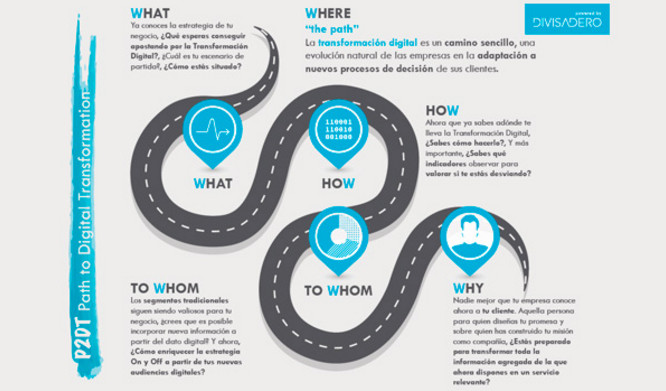
5 Inspiring Tips to Help You with Digital Transformation
If we use an expanded view of the digital funnel (Awareness, Consideration, Action, Conversion and Advocacy) and break down digital skills or competencies, the following table can serve as a summary of the digital competencies to bear in mind:
Each of these digital competencies only aims to put the foundations of a digital strategy in order. The sole ambition is to place digital knowledge as a catalyst for our business results. Of course, I do not want to magnify the view that each of these digital competencies can offer. At the end of the day, digital is a mere enabler of strategy. And it is also true that without these levers, the company's overall strategy would be left limping.
Some of the most highly qualified professionals in digital analytics and inbound marketing may well see their competencies as an exercise that cuts across the table above. Without a doubt, data management and adapting content to the different stages of our users' journey is cross-cutting work—all the way to the purchase or advocacy decision. In fact, this exercise is a simplification of the different digital competencies in the service of business strategy, and always from first fitting things to the user.
From the standpoint of any SaaS vendor, software as a service, this is digital's holy grail: finding a way to order the needs of a digital marketing professional and to support their digital strategy with tools. In Sergio Maldonado's post on the Marketing Data Technology ecosystem I think you get the most complete picture of how tools can make building a strategy easier, and people will always be needed to connect the whole ecosystem. Each of the levers that enable digital strategy needs people with specific skills: making it easier to manage the team's talent, being human, close and generous, persevering and knowing how to correct course, as well as drawing on intuition, curiosity and listening. Ultimately, all the levers within a digital professional's reach, whether they are tools, data or personal skills (soft skills), need to be put in order so they translate into the priorities of a digital strategy.
DIVISADERO, Actualidad blog. December 2015 [GO to original POST]
Now, I invite you to do the following exercise. Use the table above, putting the focus on your users' behaviour, and then try to answer some of the following questions:
- When a customer searches for my product or needs help, do I have a voice to answer them with? [Social Media monitoring; Customer service on social media]
- Am I well positioned if the search is direct and/or for my generic product or service? [Organic and paid positioning on generic keywords + brand keywords]
- What are the questions a user asks themselves before making a purchase decision about my product? [Content strategy]
- What is my main digital asset in the first encounter with a potential buying user? [Web and mobile presence, app design and development]
- What is users' habitual behaviour in relation to my ecosystem of digital assets? [Traffic source, user profile, content consumption paths, main traffic entry and exit sources, behaviour of logged-in versus non-logged-in users, cross-device view]
- Am I able to group user data into homogeneous clusters based on content consumption interests across my digital assets? Have I defined a contact strategy for each phase of a user's relationship with my brand? [Audience modelling; Definition of customer journeys by service or product and audience]
- Does my site offer a differentiated view to customer users versus potential users? And my site? Is it optimised for mobile devices for those same users? [Personalisation and content segmentation by audience]
- Am I able to obtain data and interpret it in order to optimise the conversion of visits into better results in a sustainable way? [User experience optimisation; Personalisation and testing]
- Am I able to direct every extra euro of my budget to the very audiences that, as things stand today, put food on my table? Am I able to grow into new audiences? [Building a data management platform or DMP, Integrating information with third parties, Programmatic Buying management, Assigning the right contribution to each source]
- Is it possible to connect all the previous learnings and go beyond the digital personalisation of a user's experience across my digital assets? [Integration of information with own systems, Single Customer View]
By answering the questions above, it becomes relatively easy to order the priorities of a digital strategy. In each of the questions, I have included possible solutions [in italics] that a digital professional should have sorted out.
Perhaps with questions it becomes easier to order each of the concepts above. I believe any digital professional can juggle many priorities, and there is no one better than her or him to define a desirable future situation. The [answers] are challenges to face and pieces to add to your digital ecosystem. The key to prioritising your digital strategy lies in the questions.
Does this make sense to you? Please do leave a comment. Thank you.
Other related posts:
- Marketing Data Technology: in the eye of the storm
- 5 Inspiring Tips to Help You with Digital Transformation
- Closing the Circle of Digital Strategy
- How are Spanish companies tackling Digital Transformation?
_____________________________________________

By the way: We're turning 10 at DIVISADERO! [Discover our story]
_____________________________________________
Bernardo Crespo is Digital Transformation Leader at DIVISADERO and an Ontological Coach certified by Newfield Network in Bogotá (Colombia). He holds a degree in Business Studies from UCLM and final year of a BA Honours in Management and Economics, University of St Andrews. Executive Master in Relationship Marketing, CRM and E-commerce from ICEMD, and a lecturer at several business schools in Spain. He worked as digital marketing director at BBVA Spain.
I currently devote myself to helping companies walk the path of Digital Transformation at DIVISADERO.
I have discovered, and keep discovering, the beauty of play applied outside of play #gamification
The author
Bernardo Crespo
C-suite advisor in AI, data and strategy. CEO of Quantum Markethink and Academic Director at IE. He helps leadership teams make sound decisions in the age of AI.
LinkedIn