Synthetic Feedback Loop: The New AI Bedchamber, or the New Filter Bubble of AI
Ever since social media was created, we had been trapped in a filter bubble built on the content that rewarded whatever ultimately generated…
1. Post-Truth: The Filter Bubble and the Echo Chamber
Until now, ever since social media was created, we had been trapped in a filter bubble built on the content that rewarded whatever ultimately generated stickiness for the social platforms: if I keep the user one second longer, then go ahead and show more of that content, or content like it.In other words, the web and social media generated:
Bias about what information we saw.
The bias was external (the platforms' distribution algorithms).
The unit of bias was the content shown to us as we browsed.
The result is that now (two decades later) we hate more (polarisation), we talk less to people whose ideas differ from ours (ideological tribalisation), and the facts we think about, argue about and even dream about belong to the narratives that win the virality race (current affairs ≂ virality).
Filter-bubble bias is by now anthropologically proven. It has toppled democracies, it has changed the course of history through referendums, and it has elected world leaders of dubious reputation as regards their interest in the common good.
The term "echo chamber" was coined by Cass Sunstein (Echo Chambers: Bush v. Gore, Impeachment, and Beyond). The term "filter bubble" a decade later by Eli Parisier (The Filter Bubble: What The Internet is Hiding from You).
And now? That was the problem. But it is not today's problem.
2. Post-Reality: From Bias to Structural Dependency
People now talk to AI every day. They ask about their loves and even about their insecurities (therapy and companionship), they chat about how to organise their lives and even about how to find a purpose or a north star for life. AI is our personal advisor (Top 10 GenAI cases in 2025 by Marc Zao-Sanders) and it has arguably become the most intimate piece of our lives, rivalling even our most closely guarded private life.
Along the way, perhaps we have not realised that we no longer share only our searches and our affinities (likes) to define the thickness of our filter bubble. Over the last three years, we have been enriching the narrative with our most intimate reflections. Those preferences — inferred rather than declared, and read as a trail of digital breadcrumbs of our own personality in our interactions with AI — have generated a new layer of bias that amalgamates with the previous bubble. The echo of the digital room and the AI bedchamber is hardening into reinforced concrete, impossible to break through.
New bias filters appear that keep thickening the "wall of our AI bedchamber", which technically we could call the synthetic feedback loop:
For each of us, a reality is built in every answer.
The bias is endogenous and dynamic.
The unit is the response generated for each one of us.
2.1 Invisible Biases: The ones you don't see
New bias filters appear that define that "synthetic feedback loop", or AI bedchamber, starting with the bias of the manufacturer of the base model on which the LLM (Large Language Model) runs, derived from the data corpus the original model and its successive versions were trained on.
Then there is the context bias defined by the interests and preferences the user has set when using an AI and its interface, whatever the model in play (OpenAI, Gemini, Claude, Perplexity, Doubao — or Dola, ErnieBot, etc.). We do not all receive the same answer, because the AI has tried to please us — to be sycophantic — and has progressively won us over by personalising its answers according to our interests and our work or personal preferences. In this way, every new answer runs into a filter bubble much like the one social media or search platforms used to offer us, only now it is expressed as a function of the historical preferences we have shown and that have been observed on the basis of our past conversations with that same AI.
This bias is one I want to call user contextual memory bias, and we have defined it, consciously or unconsciously, in the platform's general terms of acceptance (Saved memories — ChatGPT, for example, automatically remembers and manages what is relevant and personal).
Another bias that creeps in is the one derived from the model's cache memory, used to optimise cost per token. When a user makes a query that others have already made, the segmentation generated by the AI manufacturer — based on that user's peculiarities and their membership of a cohort with similar tastes — assigns them an already-generated answer, without reading the entirety of the documentation presented. No AI reprocesses information whose metadata it has already analysed before. The cost per million tokens of processing that information cannot be higher than the cost passed on to the user in their monthly subscription. Truth now competes against computational cost.
2.2 Systemic Biases: The ones you don't control
The bias generated by a critical mass of users conditions the model's evolution. When users limit their own queries — as happens in non-democratic regimes, where questioning authority is avoided for fear of surveillance — they restrict the knowledge the model can develop in certain areas. A clear example is the disparity that ByteDance must already be detecting between Doubao - 豆包 (China) and Dola (international). The volume of answers in a specific geographical area therefore limits the model's depth on controversial topics compared with other systems. This is not just about the bias of origin in the data corpus, but about the mass bias derived from reinforcement learning from human feedback (RLHF bias).
On top of that, future biases are emerging that have not yet been detected and that affect the personalisation of answers according to our prompt. I am referring to the bias that will appear when models begin to be retrained, one generation after another, on content produced mostly by other AIs. This phenomenon occurs naturally when users publish synthetic content on social media which then goes on to feed the new data corpus of the next generations of models. We could call this circular feedback process regurgitation bias or AI mad cow bias (an allusion to spongiform encephalopathy, mad cow disease, spread by feeding cattle proteins from their own species; a loop where degradation is inherited and amplified until the system collapses).
2.3 Future Biases: The ones you won't be able to correct
There is also a final bias, or a sum of final biases, that has not arrived yet and that is worth mentioning. It is the combined, accumulated final bias that will result from the evolution of the models and from all the previous biases, once those models evolve from non-deterministic to deterministic.
As things stand today, faced with different semantic formulations of the same question, each of us receives different answers, which has driven a battle over recent years to reduce model hallucination. Evolving from LLM to LRM (Large Reasoning Models) has been a success: not only tokenising natural language but also tokenising thought or clusters of ideas in order to fine-tune the quality of answers, adding the user's intent before sequencing the response. When the moment comes in which models gain scientific rigour and their answers are homogeneous regardless of the semantics used to formulate the question or prompt (the same answer for different prompts, generating absolute rigour independent of the user's profile), there will be a 'zero moment' from which models will start operating in a deterministic reality.
What will the total compound bias accumulated up to that moment be? Clearly, they will start from a total stock of accumulated information as data corpus in which the training data will contain the earlier effect of regurgitation bias. On top of that they will add the mediocrity of the conversations generated by users around trending and viral topics, or the mass human-feedback bias accumulated up to the determinism milestone. It will be data already biased by the hypothetical accumulated reality at the moment non-determinism is defeated. That longed-for moment Mira Murati announced last year (https://thinkingmachines.ai/blog/defeating-nondeterminism-in-llm-inference/) and that was on the verge of being achieved in September 2025 will arrive one day, at some point. What will the total aggregate compound bias be by then?
This accumulated zero bias of the defeat of non-determinism has to be added in as well.
In short, we have gone from accumulating a filter-bubble bias (post-truth) to a bias now compounded by the creation of models, user contextual memory, truth skewed by computational cost, regurgitation bias and mass bias — and we ought to be thinking about the consequences of future determinism.
It is time to work on the future of a daily collaboration between humans and machines.
3. Human–model cognitive co-evolution
If data is the base unit that, once processed, gives us access to homogeneous information about a domain, and if we in turn define knowledge as the communication or acquisition of that learning or content that allows us to broaden or sharpen a given subject. Then intelligence, understood as the capacity to understand and solve problems, is the faculty that lets us orchestrate that knowledge. And if, in addition, when we endow that intelligence with the ability to recognise the surrounding reality and to relate to it, we call it consciousness. Then transcending the limits of our own existence and reaching the highest degree of deep knowledge becomes wisdom or transcendence.
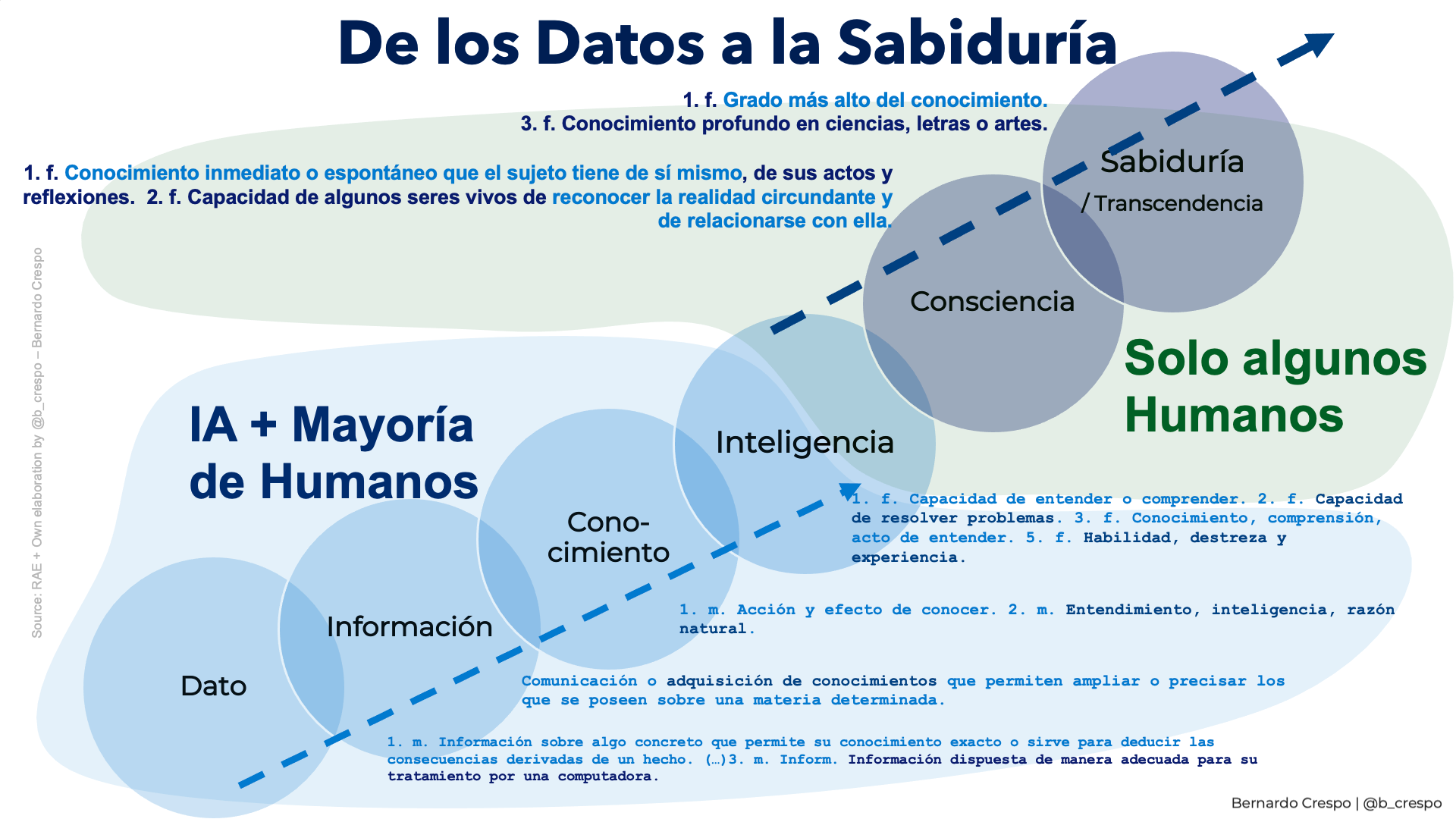
data > information > knowledge > intelligence > consciousness > Wisdom and Transcendence
If we accept, as the following visual model suggests, that the domain running from data to intelligence belongs to AI as much as it does to most humans, while consciousness, wisdom and transcendence are attributes exclusive to only some humans, how are we going to pull off this challenge of transcending together in an era where humans and AI collaborate every day?
Without noticing it, we have entered a new era in which we live mutualistically with AI in everything we do. We reinforce the models with human feedback through our replies, and the models improve by aggregating the planet's cognitive collective and making it available to the next conversation, to the next prompt. Has any human ever wondered how he or she individually contributes to the evolution of AI through their musings? Sometimes I have my doubts that this is a mutualistic game, because I suspect that the evolution of the common interest and of the companies designing this AI is more a relationship of parasitism than of mutualism or commensalism. But let us assume a context of mutual collaboration.
In that context, and with the above biases now known, our challenge ought to be to systematically foster and develop critical thinking so as to avoid making banal, superficial analyses of the answers we receive from AI every day. That would be a responsible use of AI. And yet, I am seeing an urgent need for mandatory, non-optional literacy in AI. All the more so in clear situations of confusion within an uninformed mass. Bernie Sanders, in his conversations with Claude (see viral video), should be aware of the whole battery of biases above before taking an answer as true.
It pains me to watch how the social conversation around AI's possibilities is evolving without any prior discernment of the biases we accumulate (invisible, systemic and future) when we use this new digital companion. On top of that, we should all be reflecting daily on how to question much of the easy discourse we now use AI to pad our conversations with. The knowledge of the models and their biases is conditioned by users' lack of critical thinking. We are short of critical minds and long on content.
By way of a self-contained summary, we are facing a system of multiple bias vectors and of filters on access to knowledge that we now have to see through:
[𝙸𝚗𝚟𝚒𝚜𝚒𝚋𝚕𝚎] Self-censorship → implicit dataset
[𝙸𝚗𝚟𝚒𝚜𝚒𝚋𝚕𝚎] User context memory: epistemological dependency on our preferences
[𝙸𝚗𝚟𝚒𝚜𝚒𝚋𝚕𝚎] Cache memory: the contest between truth and computational cost
[𝚂𝚢𝚜𝚝𝚎𝚖𝚒𝚌] Aggregate use: culture, or the limits of modelled thought
[𝚂𝚢𝚜𝚝𝚎𝚖𝚒𝚌] Regurgitation: retraining on synthetic content
[𝚂𝚢𝚜𝚝𝚎𝚖𝚒𝚌] bias by common interest defined by virality
[𝙵𝚞𝚝𝚞𝚛𝚎] convergence and accumulation of mediocrity before determinism
This soft epistemological collapse (analogy: a frog slowly cooking in a pot of lukewarm water) should lead us to formulate a series of reflections as new mantras for the era of human–machine collaboration:
The knowledge of the models is conditioned by the collective courage of their users → Shared epistemological dependency
The bubble is no longer a filter that hides the world from us. It is a system that rebuilds it for us, according to each one of us and to our collective being or thinking.
In the era of AI (generative, agentic and contextual), the problem is no longer what information gets selected for the user, but what reality gets generated for the user. The filter bubble is evolving into a predictive context bubble, sustained by a synthetic feedback loop, where computational efficiency, contextual memory and the collective behaviour of users converge to produce a world that, while coherent and plausible, may be drifting progressively further from the truth — or may be generating a representation of a new collective truth (post-reality).
And what is truth? Is there any indisputable factual reality left to us?
The answer is not technical. It is behavioural: deliberately exposing yourself to what does not fit. I still believe that it is no longer enough to fight cognitive offloading at the individual level; it is time to develop critical thinking as an individual exercise, and beyond that, we have to raise literacy in AI in order to generate awareness and discernment (moral responsibility) about what a future co-created between humans and machines interacting daily ought to look like.
The Enlightenment fought against ignorance.
The digital age fought against disinformation.
The generative AI era fights against nothing. It simply optimises.
And in that process, it may be optimising something dangerous: a world where everything appears to make sense.
A world so coherent with ourselves that we stop looking for meaning outside… even when it stops being true.
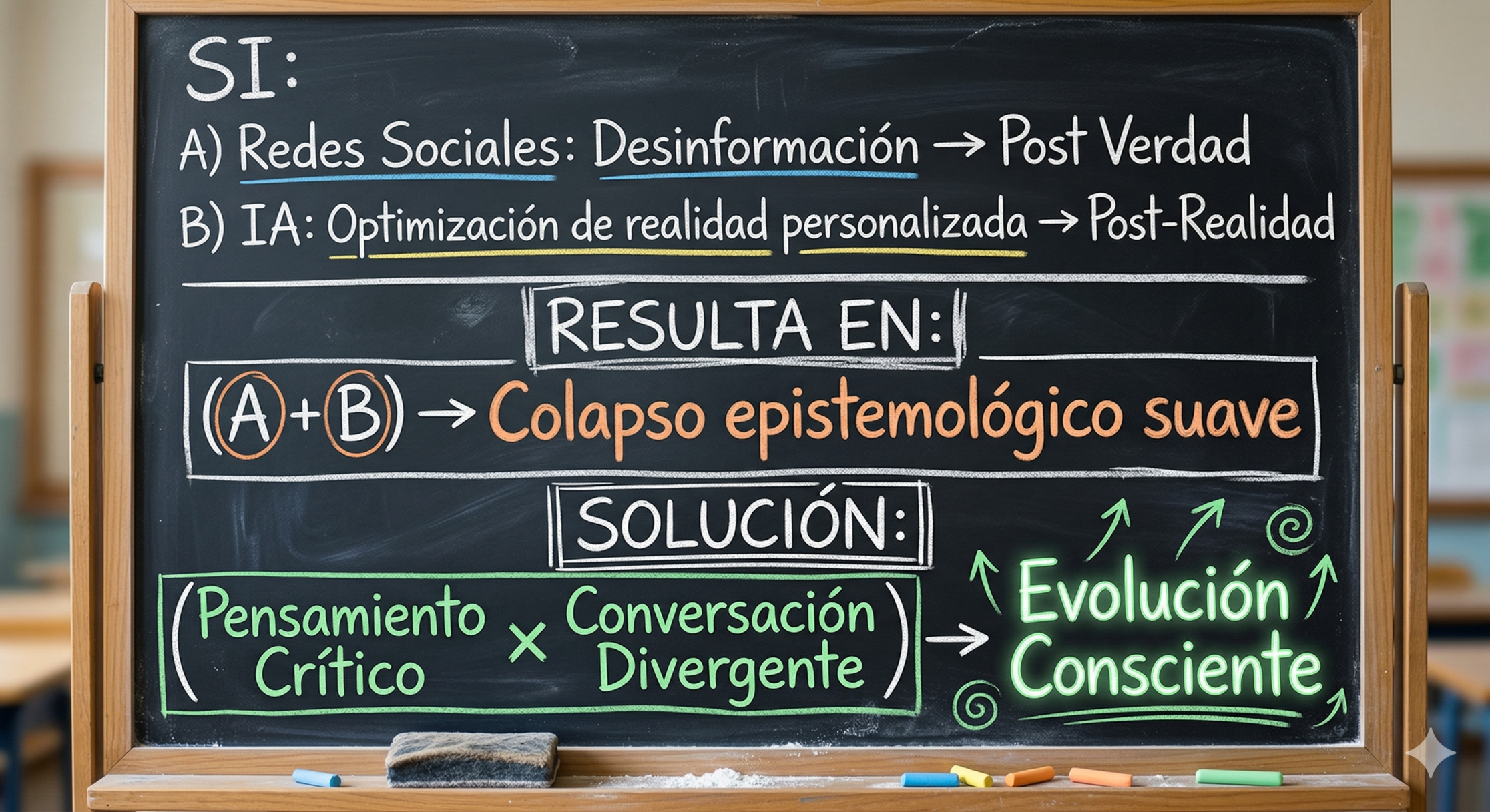
Solution to the Synthetic Feedback Loop
A) Social Media → Post-Truth
B) AI → Post-Reality
(A + B) → Soft epistemological collapse
Solution: (Critical Thinking × Divergent Conversation)→ Evolution
And could this challenge of a new biased world (post-truth + post-reality) built on human–machine collaboration not be neutralised if we foster sustained critical thinking grounded in conversations between un-equals?
ADDENDUM [May 12, 2026]
ℝ𝕖𝕗𝕝𝕖𝕔𝕥𝕚𝕠𝕟: 𝗙𝗶𝘃𝗲 𝗜𝗱𝗲𝗮𝘀 𝗳𝗼𝗿 𝗡𝗼𝘁 𝗔𝗯𝗱𝗶𝗰𝗮𝘁𝗶𝗻𝗴 𝗶𝗻 𝗮 𝗞𝗻𝗼𝘄𝗹𝗲𝗱𝗴𝗲 𝗦𝗽𝗮𝗰𝗲 𝗗𝗼𝗺𝗶𝗻𝗮𝘁𝗲𝗱 𝗯𝘆 𝗔𝗜
𝟭. 𝗥𝗲𝗰𝗹𝗮𝗶𝗺 𝗳𝘂𝗹𝗹 𝗮𝘁𝘁𝗲𝗻𝘁𝗶𝗼𝗻 𝗮𝘀 𝘀𝗼𝘃𝗲𝗿𝗲𝗶𝗴𝗻 𝘁𝗲𝗿𝗿𝗶𝘁𝗼𝗿𝘆. If information consumes attention, and the digital economy has learnt to capture it, then the first frontier of freedom is not in technology but in attention. Attention is not an engagement metric. It is the place from which we decide.
“Information consumes attention"-Herbert Simon
𝟮. 𝗗𝗲𝗳𝗲𝗻𝗱 𝘁𝗵𝗲 𝘀𝗽𝗮𝗰𝗲 𝗯𝗲𝘁𝘄𝗲𝗲𝗻 𝘀𝘁𝗶𝗺𝘂𝗹𝘂𝘀 𝗮𝗻𝗱 𝗿𝗲𝘀𝗽𝗼𝗻𝘀𝗲: 𝗖𝗼𝗻𝘀𝗰𝗶𝗼𝘂𝘀𝗻𝗲𝘀𝘀 AI tends to close that space: it anticipates, suggests, orders and executes. Human consciousness opens it: it pauses, doubts, contemplates, waits. Perhaps one of the most radical skills of the future will be recovering the right not to answer immediately.
“Between stimulus and response there is a space. In that space is our power to choose our response. In our response lies our growth and our freedom”–Viktor Frankl.
𝟯. 𝗥𝗲𝗵𝗮𝗯𝗶𝗹𝗶𝘁𝗮𝘁𝗲 𝗶𝗻𝘁𝘂𝗶𝘁𝗶𝗼𝗻 𝗮𝗻𝗱 𝘄𝗶𝘀𝗱𝗼𝗺 𝗼𝘃𝗲𝗿 𝗶𝗻𝗳𝗼𝗿𝗺𝗮𝘁𝗶𝗼𝗻 AI can amplify knowledge, but it does not replace wisdom. It can process more data than we can, but it does not necessarily understand better what deserves to be cared for. Knowledge speaks. Wisdom listens.
“Knowledge speaks. Wisdom listens” –Jimi Hendrix
𝟰. 𝗕𝘂𝗶𝗹𝗱 𝗰𝗼𝗼𝗽𝗲𝗿𝗮𝘁𝗶𝗼𝗻— 𝗵𝘂𝗺𝗮𝗻 𝗶𝗻𝘁𝗲𝗿𝗱𝗲𝗽𝗲𝗻𝗱𝗲𝗻𝗰𝗲, 𝗻𝗼𝘁 𝗮𝗹𝗴𝗼𝗿𝗶𝘁𝗵𝗺𝗶𝗰 𝗱𝗲𝗽𝗲𝗻𝗱𝗲𝗻𝗰𝗲. The dystopia of a governing AI thrives when the human being is left alone in front of a screen. It is neutralised when decisions are held up by communities, conversations, shared judgement and trust.
Trust is not an ethical ornament. It is the architecture that stops technology from becoming a substitute for what is human. Because if you go with the whole tribe, you will go further.
𝟱. 𝗣𝗿𝗮𝗰𝘁𝗶𝗰𝗲 𝗮 𝗿𝗮𝗱𝗶𝗰𝗮𝗹 𝗽𝗼𝘀𝘀𝗶𝗯𝗶𝗹𝗶𝘀𝗺 𝗯𝘂𝗶𝗹𝘁 𝗼𝗻 𝗶𝗺𝗮𝗴𝗶𝗻𝗮𝘁𝗶𝗼𝗻 𝗮𝗻𝗱 𝘃𝗼𝗰𝗮𝘁𝗶𝗼𝗻 This is not about being naively optimistic. It is about being seriously possibilistic. Imagining alternative futures is not escapism: it is responsibility. Because the digital future is not inherited. It is designed, contested and built.
“I am not an optimist. I am a very serious possibilist”-.Hans Rosling
1 + 2 + 3 + 4 +5 = 𝗕𝘂𝗶𝗹𝗱𝗶𝗻𝗴 𝗧𝗿𝘂𝘀𝘁. The five ideas converge on a simple intuition: AI will not govern us by its power alone, but by our abdication of attention, of the pause, of wisdom, of connection and of imagination.
Recovering those five practices — not as private virtues, but as civic infrastructure — is a concrete way of neutralising the dystopia. More than machinery, we need humanity.
Note: [This article is tagged as "Human led". Content led by a human. Machines conduct checks, highlight and correct errors, enhance output. Framework based on the Dubai Future Foundation. "Human-Machine Collaboration (HMC) Icons." Dubai Future Foundation, dubaifuture.ae/hmc]

www.bernardocrespo.com/#aboutme
Bernardo Crespo is a seasoned digital transformation and data strategy leader with over 25 years of experience. He has held leadership positions in Fortune 500 companies and digital consultancies, and has founded and advised numerous startups and venture builders. Currently, as CEO of his own firm, Quantum Markethink, he provides strategic guidance to C-suite executives, helping them navigate the complexities of digital transformation.
Furthermore, he serves as an Academic Director at IE Executive Education, where he brings his expertise in emerging technologies, digital strategy, data strategy, and artificial intelligence to the classroom. Prior to these roles, he spearheaded digital transformation initiatives at Merkle Spain and led digital marketing at BBVA, where he notably pioneered the application of gamification in banking.
Bernardo is also the co-author, with Gam Dias, of "The Data Mindset Playbook: A Book about Data for People Who Don't Feel Like Reading about Data" (KDP, March 2023).
The author
Bernardo Crespo
C-suite advisor in AI, data and strategy. CEO of Quantum Markethink and Academic Director at IE. He helps leadership teams make sound decisions in the age of AI.
LinkedIn