The Invisible Crisis in the Modern Workplace: How Hybrid Work, AI, and Culture Are Hollowing Out Our Talent Future
[Read the complete article in Spanish: https://www.bernardocrespo.com/la-crisis-invisible-en-el-lugar-de-trabajo-moderno/]
[Read the complete article in Spanish: https://www.bernardocrespo.com/la-crisis-invisible-en-el-lugar-de-trabajo-moderno/]
Something Has Broken in How We Build Talent
At the aftermath of the pandemic, the transition to hybrid work seemed like a liberation. Young professionals embraced flexibility; companies touted productivity gains. Yet beneath the surface of Zoom calls and Slack channels, a structural problem has been growing: the erosion of mentorship, tacit learning, and professional mastery — the very foundations of a thriving workforce.
For decades, organizations relied on a stable pipeline of talent: early‑career professionals learned by doing — absorbing tradecraft, collaborating physically with more experienced peers, and benefiting from informal “knowledge osmosis.”–the natural evolution of explicit knowledge towards tacit knowledge. This apprenticeship model was never perfect, but it created depth of skill, continuity of leadership, and cultural transmission across generations. Building and contributing to the current state-of-the-art corporate cultural capital that differentiates managerial modern cultures with traditional ones.
Today, that model is eroding.
In hybrid environments where senior leaders and junior hires rarely share physical space, and cultural generational codes are more distant than ever before, the apprenticeship has been replaced with scheduled check‑ins and fragmented communication. The intangible benefits of shared context, overheard wisdom, and spontaneous collaboration have been lost. The consequence is that young workers may be flexible and digitally fluent, but they lack the deep professional grounding that fuels leadership, innovation, and institutional memory. The end of an imperfect model of the sociology of education to build corporate cultural capital inspiring in the ideas of Pierre Bourdieu.
Simultaneously, higher education continues to emphasize explicit knowledge transfer, utilizing legacy models that fail to account for the advent of GenAI. By continuing to train students in domains where AI can already circumvent traditional access and management of information, universities are preparing 'to-be' workers for a reality that no longer exists.
This is not a marginal glitch — it’s structural. The model is broken.
By continuing to train students in domains where AI can already circumvent traditional access and management of information, universities are preparing 'to-be' workers for a reality that no longer exists.
[1] Why This Matters — And Why It’s Worse Than It Looks
The superficial buzz around hybrid work masks a series of deeper cultural and technological forces that are exacerbating this problem.
1.1. The Cultural Clash Between Dopamine and Stamina
We now live in a world conditioned by digital platforms built on instant feedback loops — the “dopamine economy.” Social media, gamification, and always‑on micro‑rewards shape expectations toward immediacy. Likes, notifications, and rapid responses are now the psychological default.
But professional mastery requires the opposite: deep work, repetition, delayed gratification, and tacit learning that doesn’t show results on a KPI dashboard until years later. A motivational crisis has emerged as the instant-feedback 'dopamine economy' of digital platforms clashes with the slow, tacit learning required for professional mastery (stamina economy).
This isn’t a trivial clash — it’s a motivation economy mismatch. Young workers arrive conditioned for quick feedback yet are asked to invest in slow, cumulative professional growth. The resulting attentional fragmentation is not just distraction; it is a fundamental impedance mismatch between how work rewards are structured and how mastery is cultivated. Companies struggle with this daily. They invest in engagement surveys and “productivity hacks,” but they have yet to reconcile a workforce conditioned for instant results with roles that demand long-term tacit learning.
This gap isn’t just theoretical — it shows up in engagement scores, rising absenteeism, and declining clarity about career progression.
A motivational crisis has emerged as the instant-feedback 'dopamine economy' of digital platforms clashes with the slow, tacit learning required for professional mastery (stamina economy).
1.2. Hybrid Work Without a Mentorship Strategy Is a Mirage
Hybrid work was widely celebrated for flexibility, but companies failed to adapt their people‑development frameworks accordingly. Leaders assumed “work happens where the body isn’t,” but mistook co‑location for mentorship.
While young professionals thrived on newfound flexibility, their engagement and access to 'knowledge osmosis' plummeted—largely due to a managerial failure to adapt to distributed environments. Consequently, the hybrid transition has structurally weakened the mentorship frameworks essential for career development.
In traditional environments, junior professionals learn continuously — not just from explicit training, but from observing how seniors navigate complexity, handle conflict, and make judgment calls. That kind of learning evaporates when people are distributed and interactions are transactional. Suddenly, opportunities for serendipitous guidance — overheard conversations, informal feedback, hallway chats — are gone. Managers default to task assignment and progress tracking, not developmental coaching. The result is that transactional supervision replaces transformational mentorship.
We are seeing this play out as a weakening of career development, institutional knowledge transfer, and leadership readiness.
While young professionals thrived on newfound flexibility, their engagement and access to 'knowledge osmosis' plummeted—largely due to a managerial failure to adapt to distributed environments. Consequently, the hybrid transition has structurally weakened the mentorship frameworks essential for career development.
1.3. GenAI Is Not Just a Tool — It’s Disrupting the Talent Pipeline
Here’s where the problem gets truly counterintuitive.
Companies are excited about generative AI — and rightly so. Some 71% of leaders list GenAI as a top investment priority for 2026 (KPMG 2025 Global CEO Outlook). These tools can automate routine drafting, basic coding, data entry, and other foundational tasks. But what happens when the very tasks that once trained new professionals are delegated to AI copilots? This phenomenon — called Seniority‑Biased Technological Change (SBTC) — means automation disproportionately replaces the tasks typically assigned to junior staff. Entry‑level work was never glamorous, but it was essential for building capability.
By removing these assignments, organizations are effectively telling young professionals: “You don’t need to learn the basics — AI will do it.” The unintended consequence is that the talent pipeline stalls. Without real work to train on, young professionals skip developmental stages they once had to grow through. They don’t learn judgment, debugging, pattern recognition, or how to handle ambiguity. The result is a future workforce that is technically enabled — but lacking the depth of experience that makes an expert a leader.
Organizations are inadvertently disinvesting in the cultivation of tacit knowledge—a quiet erosion that may offer short-term efficiency but carries fatal long-term consequences. This systemic neglect, driven by a cycle of short-sighted leadership, ignores a fundamental truth: you cannot automate the intuition and judgment that only comes from years of hands-on experience.
The consequences of this neglect will be felt only when it is too late to fix. Automating the wrong things at the wrong stage of career growth doesn’t just optimize roles — it erodes future leadership.
Organizations are inadvertently disinvesting in the cultivation of tacit knowledge (...) The consequences of this neglect will be felt only when it is too late to fix.
1.4. Generational Tensions Amplify the Problem
Adding fuel to the fire is the first‑ever workplace in history where at least four generations coexist — each with distinct motivational and communicational codes.
Baby Boomers, Gen X, and traditional-minded Millennials leaders sometimes respond to workplace disruptions with whimsical ‘return to office’ mandates, assuming that physical proximity will boost productivity and culture. However, these solutions often come across as punitive and insensitive to younger workers, leading to increased disengagement rather than fostering connection.
Meanwhile, decisions to prioritize short‑term efficiency gains through AI are made by senior leaders focused on operational metrics — yet these gains come at the expense of long‑term talent development. We have lost wisdom in favor of transactionality in the workplace.
This generational mismatch isn’t insignificant; it’s a management challenge on an unprecedented scale, forcing organizations to reconcile different beliefs about work, purpose, and career progression.
Decisions to prioritize short‑term efficiency gains through AI are made by senior leaders focused on operational metrics — yet these gains come at the expense of long‑term talent development.
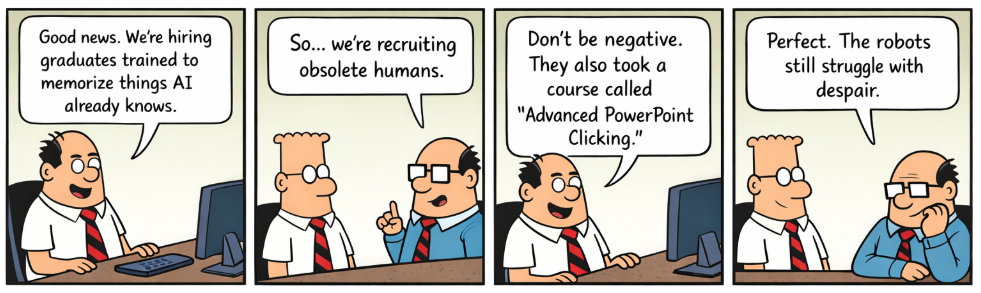
AI-generated cartoon. A tribute to Dilbert's creator Scott Adams.
[2] A Cultural Reset — Rebalancing Mastery, Mentorship, and Modern Work
This is not a technology problem. It is a cultural architecture problem.
If companies want to thrive in an era of hybrid work and rapid automation — while still cultivating deep professional mastery — they must embrace a radical cultural reset that synthesizes the strengths of digital fluency with the timeless needs of professional growth. Here’s how that synthesis must happen.
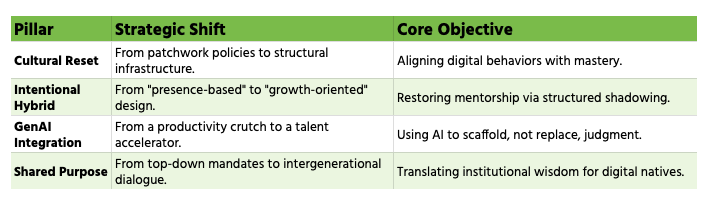
2.1. Transformational Culture as the Foundation:
Instead of patchwork policies, companies need a culture strategy designed for the new realities of work. This means:
Auditing existing norms, behaviors, and incentives.
Identifying where digital‑native behaviors conflict with mastery‑oriented expectations.
Rewriting standards to explicitly support both flexibility and mentorship.
This is not HR window dressing. It is strategic infrastructure — akin to rewriting the operating system on which people and processes run. A new hybrid culture, new skill taxonomies, and new rituals for transferring expertise.
2.2. Hybrid Work With Intentional Mentorship Systems
Hybrid work is here to stay. But it must be paired with purposeful design:
Structured mentorship programs that pair junior and senior professionals with accountability and measurable outcomes.
Shadowing frameworks where distributed workers can observe high‑stakes decision making.
Task rotations that ensure exposure to foundational work across hybrid contexts.
In other words: don’t ask if hybrid works — ask how it supports growth and value creation.
2.3 Redefining the Role of GenAI in Professional Development
GenAI should augment learning, not replace the learning experiences themselves. Companies should:
Reserve foundational assignments as developmental opportunities.
Defining when to work with AI and when not to as part of the corporate work culture.
Use AI as teaching copilots that offer feedback, simulation, or scaffolding — not as substitutes for human judgment formation.
Create career stage definitions that integrate AI fluency with cognitive mastery.
This shifts AI from being a productivity crutch to being a strategic talent accelerator: A new augmented workplace.
2.4 Bridging Generational Gaps With Shared Purpose
Rather than top‑down mandates, firms must cultivate intergenerational dialogue and co‑creation of norms. This includes:
Cross‑generational learning exchanges.
Leadership development programs that help senior leaders translate institutional wisdom for digital‑native workers.
Communication frameworks that honor different preferences while aligning on shared objectives.
This is how real culture — not superficial policy — evolves. No one taught us how to coexist across multiple generations in the workplace, and transforming corporate culture to adapt to multiple generations is becoming a new strategic challenge.
Avoiding the Systemic Talent Crisis
We are at an inflection point: organizations that fail to reconcile hybrid work, AI adoption, and generational diversity risk more than declining engagement — they risk a systemic talent crisis.
The symptoms — weakened mentorship, motivational misalignment, and hollowed‑out talent pipelines — are the early warnings of deeper dysfunction. But this can be reversed. The path forward is not to retreat to the office or uncritically automate entry‑level work. It is to rebuild the invisible scaffolding of culture that supports mastery, purpose, and growth. Only by aligning how we work, how we develop, and how we reward growth and long-term value creation can organizations unlock the full potential of both people and technology.
This is a shared commitment and a shared responsibility. We are not beyond repair — but the clock is ticking.
Note: [This article is labeled "Machine assisted." Machines and humans work together. Humans and machines collaborating and working together. Outline based on the Dubai Future Foundation. "Human-Machine Collaboration (HMC) by Dubai Future Foundation, dubaifuture.ae/hmc]

Bernardo Crespo is a seasoned digital transformation and data strategy leader with over 25 years of experience. He has held leadership positions in Fortune 500 companies and digital consultancies, and has founded and advised numerous startups and venture builders. Currently, as CEO of his own firm, Quantum Markethink, he provides strategic guidance to C-suite executives, helping them navigate the complexities of digital transformation.
Furthermore, he serves as an Academic Director at IE Executive Education, where he brings his expertise in emerging technologies, digital strategy, data strategy, and artificial intelligence to the classroom. Prior to these roles, he spearheaded digital transformation initiatives at Merkle Spain and led digital marketing at BBVA, where he notably pioneered the application of gamification in banking.
Bernardo is also the co-author, with Gam Dias, of "The Data Mindset Playbook: A Book about Data for People Who Don't Feel Like Reading about Data" (KDP, March 2023).
Articles augmented by AI: Newsletter "My AI-ter Digial Ego"
Articles 100% crafted by a human: Newsletter "Digital Sustainability"
The author
Bernardo Crespo
C-suite advisor in AI, data and strategy. CEO of Quantum Markethink and Academic Director at IE. He helps leadership teams make sound decisions in the age of AI.
LinkedIn