Communication, Content and User Experience as levers of Digital Transformation
Communication, content strategy and user experience are decisive levers in any digital transformation process, and they are not the only ones. Is it possible to capture the user's attention in a world saturated with messages? In this paradigm shift we are living through, can content (format, the medium carrying the message and the traceability of that information) be a lever for generating attraction and affinity from a user towards a brand?
[These are my personal notes from yesterday's round table #IEliveclass as part of the presentation of the Digital Transformation Management Program at IE Business School.]
Eduardo Beotas opened by suggesting that the turn organizations have to take in this new digital era is to accept that storytelling no longer makes sense as a way of generating content and communication. In this new era, the way brands generate affinity means moving from “storytelling” to “storydoing”. You have to deliver on the promise in order to be relevant and generate affinity -stickiness- with users.
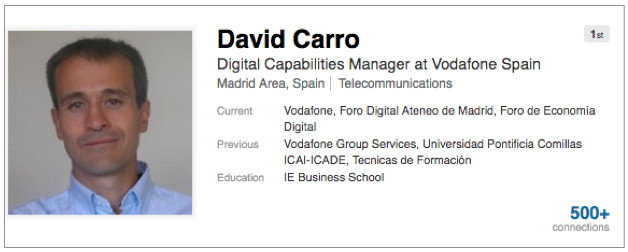
Organizations clearly suffer from a shortage of talent that combines digital skills with deep knowledge of the business model -David Carro continued. Perhaps the challenge for large organizations, and for not so large ones, is to “hybridize” these two competencies into a new professional profile. Digital skills are insufficient if they do not come with deep knowledge of the business model they operate in.
David noted that there is no doubt whatsoever that customer experience leads to results. Only experiences move emotions, and emotions make memories stick. The challenge now lies in driving the generation of a relevant user experience through innovation. The challenge for large organizations is to accept that innovation should be an exercise fostered within day-to-day work and not a testing ground inside a sandbox. The challenge is to take on continuous spaces for innovation inside large organizations. Practicing use cases continuously and proving with data, with business results, that digital really is business. This is only possible by accepting that some use cases will never produce results.
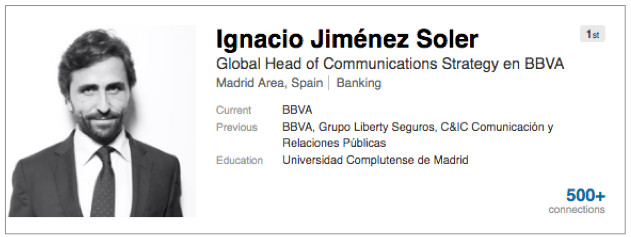
Nacho Jiménez Soler stressed that the role of large organizations in driving digital transformation may well require a convergence model in which communication -as a generator of content and attraction- and marketing -as a driver of conversion- finally converge.
”Content is King, Distribution is the Queen and Conversation is the Kingdom” - Jeff Jarvis.
Nacho recalled a wonderful Jeff Jarvis quote on the value of content: ”Content is King, Distribution is the Queen and Conversation -engagement- is the Kingdom”. Creating relevant content is not enough if we do not know how to generate the context for it to be shared or searched for. There is a saturation of content and a diminished attention on the part of users (The Shallows, by Nicholas Carr). In this sense, communication has changed in the digital era. We are living through an exercise in disintermediation in communication, in which the old paid communication models give way to the creation of owned content as a space for recovering direct conversation between users and brands. The challenge still to be taken on in the future may well be that of disintermediating the algorithm.
We commented that this past May we witnessed a notable event: the creator of Siri, Dag Kittlaus, showed the world the first public demo of Viv at the TechCrunch Disrupt NY 2016 conference. Google Home then followed a similar path, with voice recognition as the new user interface. This undoubtedly changes the rules of the game. It is not clear what the new route will be for turning communication into positive user experiences, and the message that conversation will be the new paradigm has come up repeatedly: relevant content and the power of conversation, conversational commerce, the convergence of marketing and communication around conversation...
Eduardo remarked that large organizations demand “being digital” and have yet to take on the challenge of “being digital, letting their employees be digital”. We talked about promoting employees' personal brands and about accepting social conversation models in natural environments rather than in artificial social environments forced by organizations (closed social communities). The digital transformation model is an inside-out exercise. If digital transformation does not happen inside, it can never radiate outward. Nacho underlined that there is no better internal communication than external communication.
On agile models and “lean” approaches -David said, there is no doubt that there is no single “agile” formula for all organizations. Perhaps the best way is to adapt agile models and methodologies to each type of project and to each organization. A risk of confusing “agilism” with rushing is emerging today. Perhaps the best formula is to “hybridize” trends. There are no absolute formulas.
There is no doubt that digital awareness has taken hold in executive committees and it may well come accompanied by digital ignorance. Perhaps the challenge for that new layer of digital talent, which combines deep knowledge of the business model, is to translate “digital” into “business”. Which brings the following thought: ”Why do they call it digital when they mean business? The existence of digital awareness in leadership teams does not mean they understand it, and they do understand the business they run. Perhaps the recommendation is not to move faster than the organization's context.
On digital transformation and the application of data to other settings such as politics, David Carro -a founding member of the Digital Forum of the Ateneo de Madrid- commented that political parties still have a way to go if they think digital transformation consists of communicating through social media. Nacho was more emphatic, admitting that there is clear room for improvement in embedding the digital role in political settings; combining mass media with social media is not enough. The media coverage vector -TV, press and social networks- is politics' only current focus.
Everyone agreed that it is the user who has revolutionized large organizations. The concept of digital transformation encompasses a lot of conversation and a lot of varied content; is there a universal definition? The concept of digital transformation was invented with a reactive outlook. The user has broken their resistance to change, and it is large organizations that react by transforming themselves. In itself, digital transformation is proving to be a reaction driven by the fear of losing relevance, now that digital is ubiquitous.
Digital transformation is a combination of new governance models in companies, new working methodologies, a new approach to strategic definition and innovation, as well as an exercise in transforming the culture of every employee. And all of it seasoned with technology solutions, people and the use of data. In this setting, the generation of experiences, relevant content and brand consistency in generating conversation may perhaps be a winning combination.
There is no magic formula for coming down from strategy to tactics in corporate settings with a certain aversion to technology. Perhaps tackling digital transformation calls for an exercise in accepting uncertainty as the only way. And it was always there. Perhaps now uncertainty is impossible to ignore.
By way of summary, I will keep some of the following reflections as “takeaways”:
The way brands generate affinity is to move from storytelling to storydoing. You have to deliver on the promise in order to be relevant and generate affinity.
The shortage of digital talent + business knowledge: Digital skills are insufficient if they do not come with deep knowledge of the business model they operate in.
”Content is King, Distribution is the Queen and Conversation -engagement- is the Kingdom”
The challenge lies in driving the generation of relevant user experience through innovation
Creating relevant content is not enough if we do not know how to generate the context for it to be shared or searched for. We live in the era of disintermediating the algorithm.
Large organizations demand “being digital” and have yet to take on the challenge of “being digital, letting their employees be digital”.
On agile methodologies, there is a risk of confusing “agilism” with being in a hurry. Perhaps the best formula is to “hybridize” trends. There are no absolute formulas.
Digital awareness has taken hold in executive committees and it may well come accompanied by digital ignorance. Perhaps the recommendation is not to move faster than the organization's context.
The user has broken their resistance to change, and it is large organizations that react by transforming themselves.
Digital transformation is a combination of new governance models in companies, new working methodologies, a new approach to strategic definition and innovation, as well as an exercise in transforming the culture of every employee.
Perhaps tackling digital transformation calls for an exercise in accepting uncertainty.
Thanks to everyone who attended and also to Eduardo**, David and Nacho for sharing what you have learned, and for enjoying it.**

See the full round table in Tweets:
Previous Round Table:
About me:
Bernardo Crespo is Digital Transformation Leader at Divisadero.
Director of the Executive Program in Digital Transformation at IE Business School and an Ontological Coach certified by Newfield Network in Bogotá (Colombia).
Degree in Business Studies from UCLM and final year of a BA Honours in Management and Economics, University of St Andrews. Executive Master in Relationship Marketing, CRM and E-commerce from ICEMD, and a teacher at several business schools in Spain. He led digital marketing at BBVA Spain.
I currently work on helping companies walk the path of Digital Transformation at DIVISADERO.
The author
Bernardo Crespo
C-suite advisor in AI, data and strategy. CEO of Quantum Markethink and Academic Director at IE. He helps leadership teams make sound decisions in the age of AI.
LinkedIn