Digital Transformation: A Concept Born of Fear
Digital is a lever for transformation, a new vector of strategy; it is a path and not a goal. Business models are in continuous change…
Digital is a lever for transformation, a new vector of strategy; it is a path and not a goal. Business models are in continuous change and uncertainty has become the standard right now. In this context, the new management profile requires soft skills as an essential element in managing digital transformation.
The concept of digital transformation is a concept that is born of fear. We could well call it “the natural evolution of competitive capabilities in an environment where digital has become paramount”, and the truth is that we are in an environment in which users choose how to communicate, how to search. The tyranny of “keywords” or, as my friend David San Felipe calls it, “SEO killed the lyric star”.
[This article was originally published in English on www.ie.edu IE Insights]
The moment we are living through is nothing other than part of an evolutionary process, and if we have decided to call it transformation it is because it has been the user who adopted technology naturally before companies did, and it is the latter who must accept the change -transform themselves. It seems that the traditional has taken on a pejorative connotation, and it still accounts for 80% of the P&L of most companies. Technology evolves at a far faster pace than organizational change or than the capabilities and competencies of most professionals (See the attached image. Source: http://chiefmartec.com/).
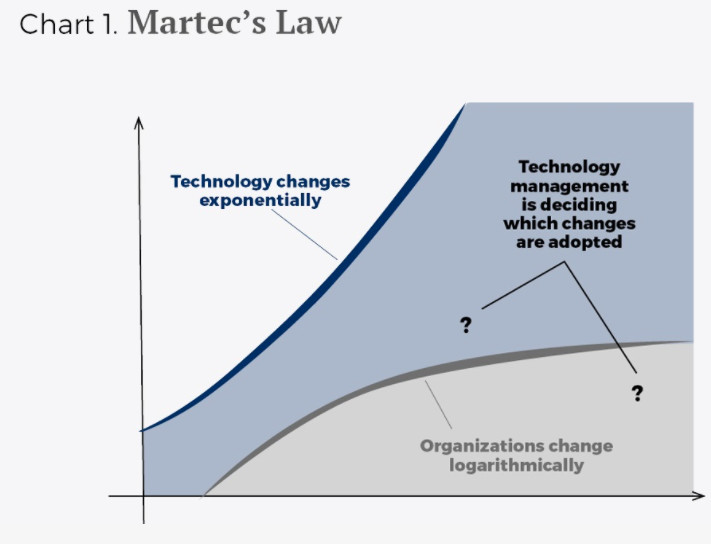
Source: Scott Brinker, Martec’s Law: Technology changes exponentially, organizations change logarithmically.
In this new context, who is going to lead digital transformation? — those younger professionals who are naturally adapted to the new technological environment, or perhaps those professionals who know how to embrace digital and integrate it with their solid strategic knowledge of the sector in which they operate? Digital transformation is not only an exercise in technology, there are more vectors. And experience and strategic skills are decisive for the new professional.
The context: a new environment full of paradoxes
The new reality we are living in is marked by multiple paradoxes. Let us start with one of them.
In 1996, Bill Gates shared the following quote: “Much of the money that is going to be made on the Internet will revolve around content, as happened with the arrival of the mass media” (original text:”Content is where I expect much of the real money will be made on the Internet, just as it was in broadcasting.”). And that is really what is happening. Who could have told Telefónica or Vodafone 10 or 15 years ago that their business was going to be oriented, to a large extent, towards content. It was unimaginable, they were telcos and their business was oriented towards the connection, towards communication between users. Today, content is their focus. The reality is that a large part of the investment of most companies today is oriented towards creating more and more content, in an environment where, curiously, attention is diminished. Here comes the paradox.
In 2008, Nicholas Carr wrote in The Atlantic: ‘Is Google Making Us Stupid? What the Internet is doing to our brains’, where he basically argued that we have lost our capacity for attention. We find a society that does not read, that is incapable of retaining content, of focusing and holding attention. And this diminished attention takes place precisely at a moment in the history of humanity when we have never before had access to so much information.
In Google’s foundational paper in 1998 (The Anatomy of a Large-Scale Hypertextual Web Search Engine), Sergey Brin and Larry Page laid the foundations of their search engine and introduced the challenge of scalability. In their view, the challenge lay in scaling from the first search engine of 1994, able to index more than one hundred and ten thousand web pages, to their prediction at the time, which was that by the year 2000 a search engine could be expected to process hundreds of millions of queries per day. The reality is that today Google processes more than 3.5 billion queries per day. More than forty thousand per second (source: http://www.internetlivestats.com/google-search-statistics/ February 2017).
Are we prepared, as human beings, to generate discernment, given that our attention is ever more accustomed to 140-character headlines?
The rules of the game are changing and all those who are willing to lead this space of transformation have to be managers of uncertainty.
The challenge of the new leader | #VUCA: uncertainty is here to stay
It seems that evolution is moving at full speed. And yes, we are in an increasingly complex environment, where uncertainty is the new norm and where the rules of the game are less and less clear. The well-known acronym #VUCA (volatility, uncertainty, complexity, ambiguity) defines the perception of this new environment.
The truth is that we are trying to explain, under a Newtonian logic, a reality that no longer responds to a linear logic, but to a much more complex one (perhaps quantum). Users may well no longer make buying decisions influenced by the same media as always; it is possible that information is more fragmented than ever. A world where there is more information, more accessibility and less discernment.
The rules of the game are changing and all those who are willing to lead this space of transformation have to be managers of uncertainty. For decades, professionals have been trained to control and manage risks, to minimize them and to get decisions right. Now it is just the other way round. We need professionals who are able to accept and manage uncertainty and, on top of that, to find models that work in environments where historical series no longer do. The new professional not only has to have digital competencies but also has to be ready to integrate a new set of soft skills. These are the ones that are making the difference, because volatility, uncertainty, complexity and ambiguity are here to stay.
We are talking about a new professional who cultivates acceptance of the environment and who, at the same time, is ready to envision a possible future and execute a plan that can be iterated on the basis of a test-and-learn methodology. Digital competencies and soft skills. Visionaries and excellent managers. These are the ingredients of the new leader.
This article was originally published in English on www.ie.edu
The author
Bernardo Crespo
C-suite advisor in AI, data and strategy. CEO of Quantum Markethink and Academic Director at IE. He helps leadership teams make sound decisions in the age of AI.
LinkedIn