How to Have Your Digital Cake and Eat It.
What are the factors that accelerate or catalyze the need to take on the strategic challenge of digital transformation?; Is this an exercise…
What are the factors that accelerate or catalyze the need to take on the strategic challenge of digital transformation?; Is this an exercise that every current CEO is up to?; Are executives and boards of directors ready for the challenge?; Is it a challenge of knowledge or of attitude?; Do we have all the information, if only to formalize the first thesis?; or are we already in the territory of synthesis?
[Reading Time: 9 min. 29 sec. source read-o-meter]
[See POST on blog @b_crespo QUANTUM MARKETHINK]
Accelerating factors
In response to a question a few days ago about the factors that accelerate digital transformation, in a few words, this is my exercise in synthesis (the factors that accelerate digital transformation are):
- the digitalization of users (internet access has been democratized and this triggers the emergence of new capabilities that were previously not so crucial as critical competencies),
- the falling cost of information storage systems (storing and processing data is increasingly cheap and accessible),
- the ability to access SaaS (Software as a Service) for any company, and the resulting and
- progressive proliferation of asset-light business models that tap into the P&L niches of once-unbeatable competitors (Fintech, EdTech, MotorTech, HealthTech, InsurTech, etc.).
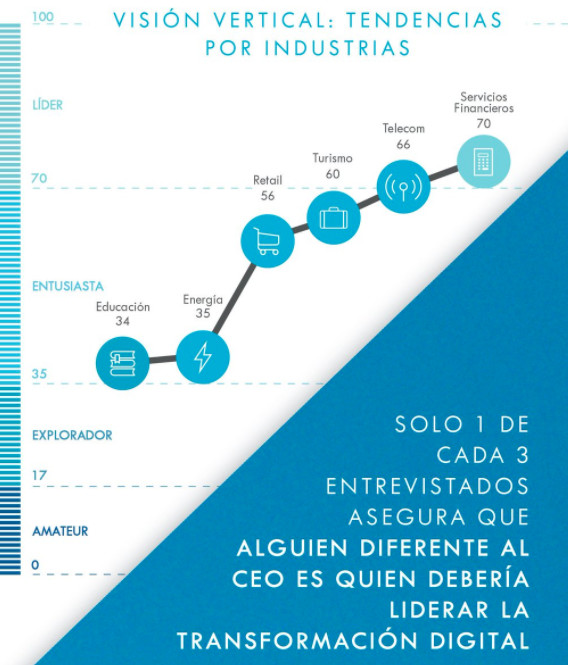
This whole landscape is generating paths of innovation from the demand side that traditional companies —intensive in physical distribution models— have not been able to read as quickly. They are working on it. It is no wonder, then, that Travel, Telco, Banking and Insurance are leading on digital maturity (see Divisadero Barometer 2017 on digital maturity). It is not their wish, it is the urgency imposed from outside; that is why we should always talk about digital transformation as a concept born of fear.
To put it simply, digital transformation is nothing other than a strategic approach that maximizes the value of businesses on the basis of People, Data and Technology, all of it catalyzed by something called Trust. If trust breaks, everything falls apart. If we are able to hook ourselves, as human beings, onto the activity of a social network and, at the same time, we are aware that the activity of that social network is starting to be run by bots —up to 15% (Emilio Ferrara et al. 2017)— how far are we able to interact naturally if on the other side there is only an algorithm and non-human activity run by a set of predefined rules (the automation of trust). In environments of stability and constant growth it may be a “commodity”, and trust is now the old value to preserve in an environment of change.
“digital transformation is nothing other than a strategic approach that maximizes the value of businesses on the basis of People, Data and Technology, all of it <
> by something called Trust.”
Understanding the new context for these large organizations means redefining their business models, their organizational models, rethinking the way they innovate on the basis of technology and data, as well as adapting culture, capabilities and processes to this new competitive environment. Large companies still believe that emulating a startup is the shortcut and remain absorbed in a strategic myopia that keeps them from recognizing that unity of purpose as a company is only the HOW, and the WHY has to be revisited. A startup rarely has silos. And in this space culture displaces strategy as the priority. And when we talk about culture, it is the CEO who holds the key... although the door may still be waiting to be found. And which door is the one to choose? To answer this question we have to go back to the conversation between Alice and the Cheshire Cat in Lewis Carroll's wonderful tale:
“...`Would you tell me, please, which way I ought to go from here?'
`That depends a good deal on where you want to get to,' said the Cat.
`I don't much care where--' said Alice.
`Then it doesn't matter which way you go,' said the Cat.
To keep insisting that technology and data can evolve the current offering is to concentrate on one part of the equation to be solved (exploit). Doing only this exercise means denying the possibility of seeing that the reshaping of business models now largely starts on the demand side, because it is users who open up avenues of value —profit pools?— in new relationship models enabled by digital. The challenge lies in innovation from the demand side. And that requires the ability to envision the next step, without fear of getting it wrong (explore). If we look for a new leader who hits the right key on the first try, we will stay anchored in alchemy tricks. And I don't deny that someone may turn lead into gold today. I simply have no record of it having happened.
Having your cake and eating it
All of the above is forcing the new CEO, male or female, to look after his or her value proposition at the same time as investing, with high doses of uncertainty, in creating a new promise that will end up burying the current one. And possibly in less time than their hidebound boards of directors believe. Today the metronome runs faster. The old music no longer makes those damn customers dance the way it used to.
Quite a story, worthy of superheroes and superheroines: Controllers of old systems and creators of a new economy in a single person. The gift of oversight and control, and creative skills in the same person: Geniuses? I would say we are talking about a new model of leadership. A leadership that calls not only for strategic vision and control over the old value chain, but also for a new, richer vision able to bring together talent intensive in new capabilities, create value out of team collaboration, generate trust in environments of uncertainty, distill a new flavor as an organization that permeates its new value offering, and be able to create a new narrative. The magic of developing the Soft Edge, as Rich Karlgaard —editor of Forbes— called it in his 2014 book.
This having your cake and eating it in a context of continuous change catalyzed by technology and data —ambidextrous leadership— is nothing more than a recipe that is already more than five years old.
Daniel Goleman in his book Focus frames this new exercise in leadership as a balance between the ability to contain and the ability to expand investment decisions, balancing focus between our intuitions, rules of the game and best past decisions, our nose for the world and our relationships with others. The “when” to contain and when to expand investment decisions is contained in this new skill:“...The best decision-makers are ambidextrous in their balance of the two, knowing when to switch from one to the other. They can lead switch-hitting organizations, which are, for instance, good at seeking growth by simultaneously innovating and containing costs—two very different operations.”
In their Harvard Business Review article The Ambidextrous CEO Michael L. Tushman, Wendy K. Smith and Andy Binns reflect on the positive value generated by the tension of mixing old and new profiles at the executive level: “...When leaders take this approach, they empower their senior teams to move from a negotiation of feudal interests to an explicit, ongoing, and forward-looking debate about the tensions at the heart of the business.”
The new environment calls not only for leaders who have read that RIM's revenue peak came a few years after the iPhone launch, or that the music industry hit all-time highs around the time Spotify was born. The new context calls for leaders who have understood that digital transformation is a strategic exercise in which there is no choice but to keep today's P&Ls standing and manage the new ones at the same time. Look after talent and look for new talent. Manage the technological transition and create value out of the new flow of data. Envision the future, design it in the present and keep your feet on the ground. And all of this has already happened. Now it has to be managed.
“It may be that we are feeling the urgency now, and the need was already there.
It may be that we look for new profiles to face a context of change, and it is not possible to create leaders in a “batch” process
It may be that we are feeling the urgency now, and the need was already there. It may be that we look for new profiles to face a context of change, and it is not possible to create leaders in a “batch” process. They already exist and possibly all that is needed is to add new competencies and polish the odd old skill. Another option is to hire a Google (or a Yahoo), or an Apple (or a Samsung), or a Facebook (or a Twitter or a LinkedIn), an Amazon (or an Alibaba) and enjoy the tension between old and new talent. It is all a matter of taste. And there is talent everywhere. What is scarce is leadership. And that leadership is not guaranteed by the absence of a tie or by a woman's suit.
Less than a month ago I advised a professional with more than twenty years' experience against taking a digital marketing program if the only thing they were after with that attempt was to give their CV a coat of “digital”. She thanked me and shared with me her sorrow at seeing how every headhunter pigeonholed her daily into her old vertical, without any chance of moving an inch towards new horizons. It is not easy to wage this conversation every day without falling into discouragement. Nor is it easy to look for the solution to a problem that has not been understood. The challenge is not only digital. It is also cultural. Above all, it is strategic.
I want to start this year by inviting all headhunters to ask their clients powerful questions so that they, in turn, reflect on the traditional exercise of pigeonholing candidates into their old verticals. Nobody has led a digital transformation process from beginning to end. Nobody. Don't let anyone tell you lies. It is teamwork. And perhaps the profiles from the most digitally mature verticals already carry life wounds deep enough not to repeat the mistakes of the past. I don't want to trivialize the difficulty of finding the new leader and perhaps, just perhaps, there are already enough leaders, and there are capabilities and skills left to complete.
Acknowledgements
Thanks to the students of the third edition of the Digital Transformation program at IE Business School. This post is my tribute to your effort and curiosity over these past months. I name you one by one:
Antonio Alvarez Bolaños, Antonio Escobar, Elena De Mingo Sánchez, Estíbaliz Guinea, Juan Abel Ruiz Rivas, Juan Martín, M. Isabel Fernández Puértolas, Manuel Maestro Casado, Mariska Schaap, Miguel Peco Perea, Pablo Carranza Navarro, Pablo Gallo, Rafael Merina Prieto, Santiago González Arauzo).
Thank you Luis Lorenzo for your timely question on a Sunday, in the hangover weekend after the Christmas dinners. You have been the inspiration for this post with your question.
Sources
- IE Insights. Bernardo Crespo. A concept born of fear: digital transformation. .Last accessed December 17, 2017 (https://www.ie.edu/es/relaciones-corporativas/insights/concepto-nacido-del-miedo-transformacion-digital/ )
- Goleman, Daniel. Focus: The Hidden Driver of Excellence (p. 219). HarperCollins. 1st edition. 2013. Kindle Edition.
- Harvard Business Review. Michael L. Tushman, Wendy K. Smith and Andy Binns. The Ambidextrous CEO. June 2011 Issue. Last accessed December 17, 2017 (https://hbr.org/2011/06/the-ambidextrous-ceo )
- DIVISADERO.es Bernardo Crespo. How far can we configure the automation of our trust?. Last accessed December 17, 2017 (http://www.divisadero.es/automatizacion-confianza )
- Emilio Ferrara et al., Online Human-Bot Interactions: Detection, Estimation, and Characterization. March 2017. Last accessed December 17, 2017 (https://arxiv.org/pdf/1703.03107.pdf )
See the original post on DIVISADERO.es
The author
Bernardo Crespo
C-suite advisor in AI, data and strategy. CEO of Quantum Markethink and Academic Director at IE. He helps leadership teams make sound decisions in the age of AI.
LinkedIn